

Xi Projects Confidence in Shorter New Year’s Speech
Arran Hope

Executive Summary:
Exuding confidence, Xi’s new year’s eve speech heralded the start of a new five-year plan, praised advances in artificial intelligence and other emerging technologies, and declared that the country’s comprehensive national power had reached a new stage.
Military matters were unusually prominent in the speech, with the September 2025 military parade in Beijing eulogized near the beginning of his remarks. He also used this section to praise the establishment of “Taiwan Retrocession Memorial Day.”
Xi’s speeches have become shorter in terms of both word count and duration in his third term. The choreography of the speech has also become less personal and more austere.
The key sentence came toward the end of President Xi Jinping’s New Year’s message: “We must anchor our goals and tasks, bolster our confidence, and seize opportunities to press ahead” (我们要锚定目标任务,坚定信心、乘势而上), he said (Xinhua, December 31, 2025). This was the tone Xi had decided to strike to kick off 2026: projecting confidence, emphasizing unity, and focusing on success. Such themes have been common to all of Xi’s new year speeches, but recent iterations have rarely been positive to quite this degree. By contrast, Xi more or less avoided the candor deployed in previous years to acknowledge people’s hardships and problems in executing policies.
Key Themes: The 15th Five-Year Plan and Innovation
New Year’s Eve signaled the end of the 14th Five-Year Plan period and heralded the beginning of the 15th. This is a significant moment in the trajectory of the People’s Republic of China (PRC) and as such received top billing in Xi’s remarks. The first paragraph—the longest of the entire speech—valorized the achievements of the past five years. He described these as “extraordinary” (极不寻常), saying that people’s sense of gain, happiness, and security had relentlessly increased (获得感幸福感安全感不断增强). He acknowledged that “results have not come easily” (成绩来之不易), and that “we have overcome many difficulties and challenges” (克服重重困难挑战). But by eliding these vague references to hardships over a five-year period with discussions of success, Xi avoided dwelling on any specific episodes from recent memory.
An important statement in this first substantive paragraph was a quote from the readout from the 20th Central Committee’s fourth plenary session in October. Xi said that the country’s “economic strength, scientific and technological strength, national defense strength, and comprehensive national power, have all reached a new stage” (经济实力、科技实力、国防实力、综合国力跃上新台阶). As the analyst Erik Quam has argued, changes in PRC behavior are likely informed by changes in calculation of the country’s comprehensive national power. The assessment that the PRC has reached a new stage therefore suggests that Beijing is in the middle of a shift in its approach to the world (China Brief, January 6).
The Central Committee’s recommendations for the new five-year plan indicated that the Party is doubling down on its pursuit of dominating innovation and the research and development of emerging technologies. This came through clearly in Xi’s speech, too. The Party’s shorthand for innovation-driven, high-quality development, “New quality productive forces” (新质生产力), was mentioned; and the annual list of technological breakthroughs was topped by “AI large models” (人工智能大模型)—likely a nod to private firm DeepSeek’s breakout year—followed by advances in “chip self-sufficiency” (芯片自主).
The PRC president’s New Year’s Eve addresses traditionally targeted an external audience. This has changed in recent years, but the leader’s remarks continue to include comments on the PRC’s role and standing in global affairs. This year was no different. Xi repeated language from previous speeches about how the PRC continues to embrace the world, but he also chose to highlight areas in which Beijing has begun to try to shape the international environment in ways that are more responsive to its interests. September’s Shanghai Cooperation Organization summit in Tianjin featured prominently, as did the PRC’s four global initiatives. These include, most recently, the Global Governance Initiative (全球治理倡议), which Xi reminded listeners was his own personal contribution. He continued to have a bleak assessment of the international system, however, noting that “the world today is fraught with turmoil and conflict” (当今世界变乱交织).
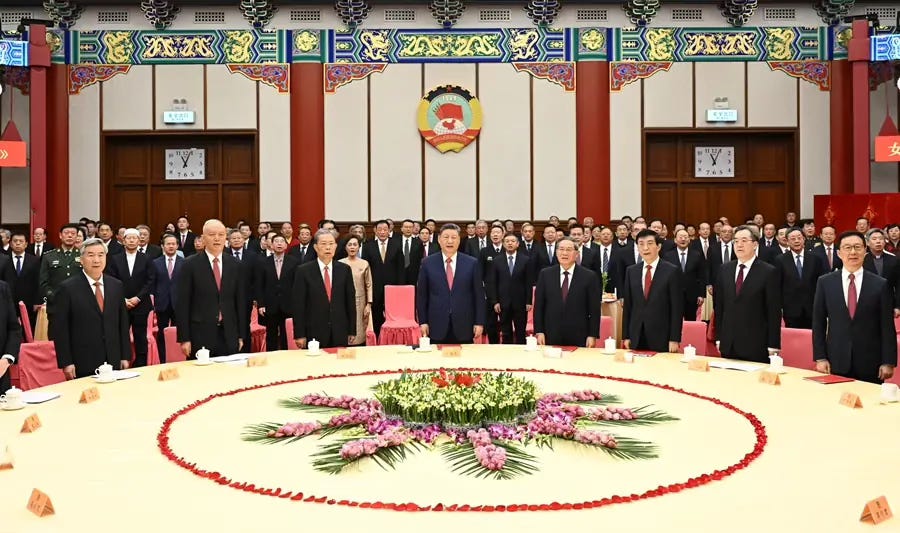
The international section of Xi’s new year’s addresses generally avoid mention of other countries, though the United States is never far away from Xi’s considerations. In a speech delivered the same day to the Chinese People’s Political Consultative Conference at the organization’s annual tea party, Xi alluded to U.S. actions taken in 2025, saying that the PRC economy had “forged ahead against pressure” (顶压前行) and “demonstrated remarkable resiliency” (展现强大韧性和活力)—likely a reference to U.S. competitive actions, such as President Donald Trump’s “liberation day” tariffs. He also noted that the PRC had faced “external risks and challenges” (对外部风险挑战) but had persisted in “protecting national sovereignty, security, and development interests” (坚决维护国家主权、安全、发展利益) (Xinhua, December 31, 2025). His confident tone, both here and in his new year’s remarks, have been echoed by other senior officials. A January 8 article in the People’s Daily written by International Liaison Department director Liu Haixing (刘海星), for instance, is a disquisition on what the world can learn from the PRC’s governance model (People’s Daily, January 8).
Military Might Front and Center
Military matters usually do not feature prominently in Xi’s new year’s speeches. This is because Xi delivers them in his capacity as state president, not as Party general secretary or chairman of the Central Military Commission. Nevertheless, last year’s September 3 military parade provided an opportunity for Xi to celebrate the growing military capabilities of the People’s Liberation Army (PLA) in his capacity as head of state, both to the country and to assembled world leaders, including Russian president Vladimir Putin and North Korean supreme leader Kim Jong Un.
Xi made it clear in his speech how important he sees “national defense strength” (国防实力). The second paragraph—coming before the list of technological achievements—discussed the parade, which Xi characterized as “unforgettable” (令人难忘的). He also reminded listeners that the PRC had used its commemorative activities of the “80th anniversary of the victory in the people’s war of resistance against Japanese aggression and the world anti-fascist war” (中国人民抗日战争暨世界反法西斯战争胜利80周年) by establishing “Taiwan Retrocession Day” (台湾光复纪念日) (China Brief, October 28, 2025). [1] Accompanied in the CCTV broadcast by over 30 seconds of b-roll footage of the spectacle and new capabilities such as the Type 003 aircraft carrier, Xi said:
“These grand national events were majestic and powerful, and the glory of victory will shine through the pages of history. They inspire all the sons and daughters of the Chinese nation to remember history, honor fallen heroes, cherish peace, and create a better future. They are rallying a mighty force for the great rejuvenation of the Chinese nation” (国之盛典威武雄壮,胜利荣光永载史册,激励中华儿女铭记历史、缅怀先烈、珍爱和平、开创未来,凝聚起中华民族伟大复兴的磅礴伟力) (CCTV, December 31, 2025).
Underscoring this importance, Xi repeated much of this language verbatim at the CPPCC tea party, an event that finished with a rousing group rendition of “Unity is Strength,” an anti-Japanese war song written in 1942. (State media in 2015 selected the song as one of the nation’s top ten songs from the War of Resistance against Japanese Aggression) (Baidu/团结就是力量, accessed January 9). This song is sung annually at the CPPCC tea party, though it perhaps took on renewed significance this time in light of the war commemoration events of the past year and Beijing’s current saber-rattling against Japan, which the PRC government claims is geared toward “preventing the revival of Japanese militarism” (Xinhua, December 31, 2025; MFA, January 6).
Shorter Speech was Less People-Centered
Without wishing to overanalyze the production of Xi’s new year’s set piece, his latest new year’s speech provided further evidence of his drift toward aging autocrat status. Over the past several years, his new year’s speech has become shorter, both in terms of word count and duration of delivery. And, as with last year’s broadcast, the camera spent much of the monologue cutting away from Xi to show various propaganda footage from the past year.
Perhaps as a result, Xi comes across increasingly distant from those he governs. Last year, for the first time since 2017, Xi was not seated in his office for his speech. No longer seated behind a desk stacked with papers and bookshelves displaying a curated set of pictures and other items, Xi instead appeared behind an enormous, empty table, next to a PRC flag, and in front of a large mural of the Great Wall. This, coupled with the avoidance of the more people-centered substance of his first-term new year’s speeches, suggests a leader who is less involved in the day-to-day running of national affairs. This is something that is also evident in his reduced travel schedule over the last two years and his apparent increased willingness to delegate to his colleagues on the Politburo Standing Committee (China Brief, November 15, 2024, July 26, 2025; China Leadership Monitor, November 30, 2025).
Conclusion
Xi’s speech provided few concrete clues for what he has in store for 2026. A brief paragraph previewing the year ahead was the shortest in the entire speech. Perhaps this was because, as he remarked, “the blueprint has already been drawn up” (蓝图已经绘就), and so all that remains is to ensure that the Party follows the plan, continuing to focus on new quality productive forces at home, advancing resilience against instability overseas, and corralling the people to engage in further struggle on the long road toward national rejuvenation and Chinese-style modernization. Global events at the outset of the year, however, including the U.S. military operation in Venezuela and widespread popular protests throughout Iran, already conspire against Beijing’s interests. While not directly damaging for Xi at this stage, they serve as a reminder that the best-laid plans can often go awry.
This article originally appeared in China Brief. Check it out here!
Arran Hope is the editor of China Brief at The Jamestown Foundation, where he also has responsibility for additional China-related publications and programming.
Notes
[1] Beyond the mention of Taiwan Retrocession Day, other language used to discuss Taiwan and cross-Strait relations was in line with Xi’s new year’s speeches of the last two years.