

Ukrainian Mid-Range Drones Target Russian Logistics
Yuri Lapaiev
Executive Summary:
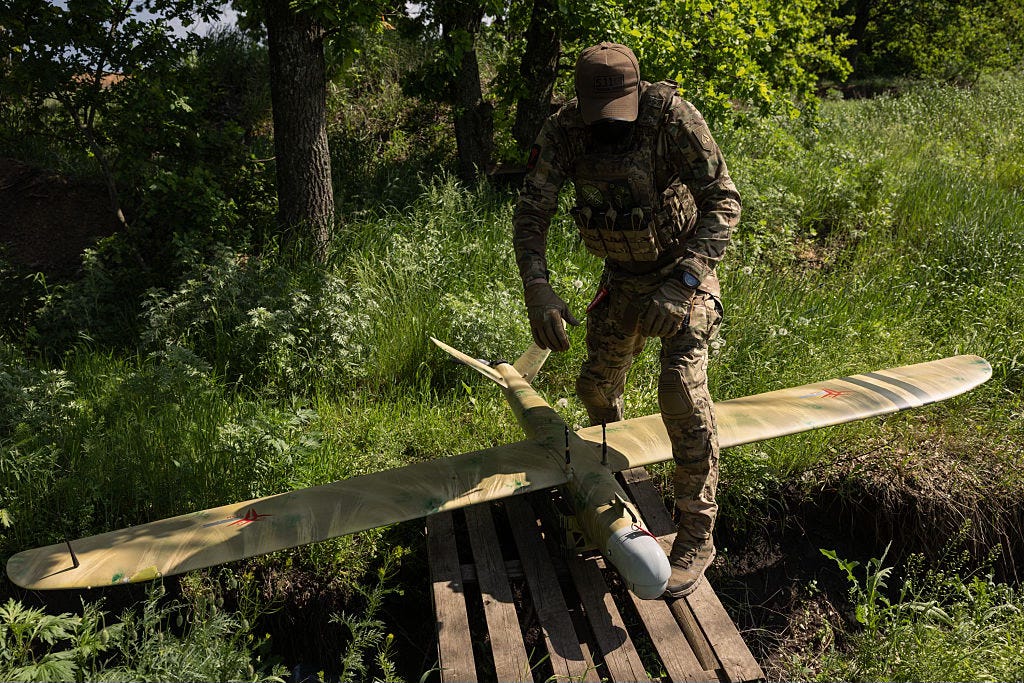
On May 27, Ukrainian Defense Minister Mykhailo Fedorov announced the start of a “logistical lockdown” for the Russian army characterized by an increase in Ukrainian “middle strike” drone attacks on the Russian rear to disrupt logistics connecting the occupied territories of Ukraine to Russia.
The deterioration of the Russian army’s logistics on the front lines could open a window of opportunity for Ukraine to conduct limited offensive operations until the enemy finds effective ways to counter them.
Ukrainian drone strikes are causing problems for the Russian economy, which could have negative political consequences for the Kremlin. While the middle-strike campaign is causing significant military and economic pressure on Russia, it is not by itself a decisive war-winning strategy.
On May 27, Ukrainian Defense Minister Mykhailo Fedorov announced the start of a “logistical lockdown” for the Russian army characterized by an increase in Ukrainian “middle strike” drone attacks on the Russian rear. According to Fedorov, Ukraine has quadrupled its destruction of Russian logistics, warehouses, equipment, command posts, and supply routes over the past few months. The more logistics Ukraine destroys, the fewer Russian assault operations take place on the front line. Kyiv is expected to allocate approximately 5 billion hryvnia ($1.12 million) for the purchase of drones in the first phase of this “logistical lockdown” program (Telegram/@zedigital, May 27).
President of Ukraine Volodymyr Zelenskyy stated that the Ukrainian drones now have the capability to reach Russian military logistics across virtually the entire depth of the temporarily occupied territory of Ukraine on June 1. According to Zelenskyy, there are practically no safe roads left for Russia in the south and east of occupied Ukraine (Telegram/@V_Zelenskiy_official, June 1). This statement came after the 3rd Army Corps of the Armed Forces of Ukraine (AFU) announced an operation to establish unmanned aerial vehicle (UAV) fire control over Russian logistics routes in the Luhansk oblast and the eastern Slobozhanshchyna region (3rd Army Corps Facebook, May 31). On May 8, the 1st National Guard of Ukraine Corps “Azov” declared that it is “returning” to the temporarily occupied city of Mariupol in the Donetsk oblast by patrolling logistics routes using reconnaissance and strike drones (YouTube/@AZOVmedia, May 8). In both cases, the distances between operators and targets are up to 150 kilometers (93 miles). The Ukrainian military has, to some extent, adapted the successful Russian tactics of encirclement and cutting off supply lines that the Russian “Rubicon” drone unit employed in Avdiivka and Pokrovsk (see EDM, April 29).
The increased intensity and extended range of Ukrainian attacks on Russian logistics are confirmed by numerous verified photos and videos captured by Ukrainian drones (X/@clement_molin, June 2). The strike map also indicates that the AFU is focused on the R-280 “Novorossiya” highway, which connects the occupied territories of the Donetsk and Zaporizhzhia oblasts and the Crimean Peninsula and serves as a land-based alternative to the Kerch Bridge (X/@clement_molin, June 2; Ministry of Defence of Ukraine, June 3). The importance of this route cannot be overstated—following previous Ukrainian attacks on the Kerch Bridge, Russian authorities imposed a series of restrictions on the types of cargo that can be transported across it, particularly fuel. In addition, the number of available ferries has been limited since the attacks, putting additional pressure on the transportation system. Therefore, the land corridor is essential for supplying the occupied territories in southern and eastern Ukraine (Telegram/@Bomber_fighter, May 31). With the latest middle-range Ukrainian drone attacks, the risks for drivers on the R-280 “Novorossiya” highway have increased, which Russian bloggers are already openly writing about (Telegram/@romanov_92, June 1, 3). As a result, the number of drivers willing to work the route is falling, and shipping costs are rising.
Russian logistics connecting the front lines to its supplies are gradually beginning to break down because of the systematic strikes. These logistics issues are causing serious problems for Russian Armed Forces units on the front lines. According to some Russian sources, there is no longer such a thing as “secure rear areas” for the Russian army (Telegram/@infantry_1, May 24). The situation is further complicated by constant Ukrainian strikes on Russian oil refining facilities, which have begun to create fuel shortages. These shortages place an additional strain on the Russian economy, which is particularly unwelcome for Moscow during the summer vacation season and the harvest. No major protests by Russians are expected, but public support for the government’s actions and for continuing its war against Ukraine may decline. This problem has mostly affected civilians in the occupied territories and border regions but could also impact the military if the crisis deepens (The Moscow Times, June 2).
Launching large-scale mechanized assaults has become virtually impossible for both Ukraine and Russia due to a lack of armored vehicles and the enemy’s total drone surveillance. The inability to launch large-scale assaults is especially problematic for Russia, since Ukraine is on the defensive. Consequently, the enemy relies on isolated infiltrations by its soldiers in its offensive attempts. In response, the AFU is strengthening a multi-layered system of obstacles that prevent rapid advancement, buying time for the detection and attack of Russian forces (Radio Svoboda, April 14; Telegram/@OSHP_225, June 2).
This strategy has yielded some success for Ukraine. According to the DeepState analytical project, the number of offensive operations by the Russian Armed Forces increased by 37.5 percent in May, reaching a record high of more than 7,000 attacks. This increase, however, did not result in a Russian breakthrough on the front lines—the Russian Armed Forces recorded their slowest monthly rate of advance and territorial gains since 2023, approximately 14 square kilometers (5.4 square miles) (Telegram/@DeepStateUA, June 1). Ukrainian Brigadier General Andriy Biletsky, commander of the 3rd Army Corps of the AFU, said that Ukraine’s gains in May were greater than those of the Russians, indicating the failure of the Russian Armed Forces’ winter and spring campaigns (YouTube/@tsn, June 2). Some experts, such as Rob Lee, a senior fellow at the Foreign Policy Research Institute (FPRI), even believe that it is realistic to expect offensive operations by the Ukrainian Armed Forces by the end of this year (The Economist, May 28).
At the same time, the situation on the front lines remains difficult for Ukrainian forces. It is likely overly optimistic and premature to speak of a turning point in the war. Moreover, drone strikes targeting logistics alone will not be enough to win the war. The enemy, recognizing the threat, is actively trying to protect its vital routes and counter Ukrainian strike drones, deploying, among others, the elite “Rubicon” drone unit (Telegram/@dva_majors; Telegram/@icpbtrubicon, June 3). However, Ukrainian drone strikes against Russian logistics—combined with tactical and strategic strikes—are causing significant problems for the Russian military command, which is already facing difficulties due to a shortage of troops, their poor training, and limited success on the battlefield. Under favorable conditions for the AFU, this could open an opportunity to launch limited local counterattacks, similar to the recent operation in that Zaporizhzhia oblast.
This article was originally published in Eurasia Daily Monitor.