

Trade Network Could Erode Uyghur Forced Labor Prevention Act
Jonah Reisboard
Executive Summary:
The Uyghur Forced Labor Prevention Act (UFLPA) faces an enforcement challenge from an expanding network of Chinese trade platforms that restrict trade data outside of the hands of U.S. law enforcement and facilitate the flow of goods through illicit transshipment hubs.
Data-sharing provisions in the People’s Republic of China’s (PRC) Anti-Foreign Sanctions Law, coupled with control over trade data, provides Beijing with a potential kill switch to restrict information from reaching Customs and Border Protection (CBP) personnel.
In its current form, the Chinese trade network advances only Chinese interests and presents a significant challenge to U.S. economic security and human rights interests.
Just four years after the Uyghur Forced Labor Prevention Act (UFLPA) went into effect in the United States, the forensic verification firm Oritain found that exposure to prohibited cotton among the 40 companies it surveyed had returned to pre-UFLPA levels (Oritain, May 14). Corporate supply chain tracing initiatives and efforts by U.S. Customs and Border Protection (CBP) are not stopping the flow of goods produced with forced labor. Instead, there is a growing “gap between supply chain documentation and supply chain truth” (Oritain, May 14).
The UFLPA establishes a legal presumption that all goods produced “wholly or in part” in the Xinjiang Uyghur Autonomous Region (XUAR) were produced with forced labor, prohibiting their entry into the United States unless importers can provide “clear and convincing evidence” that the supply chain is free of forced labor (U.S. Congress, December 23, 2021). The gap that Oritain identified suggests that importers are no longer receiving accurate information about the origin of raw materials. This gap is exacerbated by the adoption of Chinese digital trade platforms that provide little transparency for U.S. actors, move Chinese products through notorious transshipment hubs, and whose operators see financial incentives in promoting unobstructed exports.
Supply Chain Data Not Accessible
LOGINK (国家交通运输物流公共信息平台), the PRC’s leading aggregator of shipping data, is controlled by those adverse to supporting U.S. law enforcement efforts. Established in 2007, it quickly grew in the wake of the 2008–2009 financial crisis to mitigate chokepoints in global trade (China Brief, May 28). Since then, the state-operated entity has come to gain access to over 90 percent of global shipping data through its partnerships with CargoSmart (国讯通) and the International Port Community Systems Association (IPCSA) (Guangming Daily, November 20, 2016; IPCSA, April 11, 2022). Although its logistics data could be useful in evaluating illicit transshipment and other deceptive shipping practices, LOGINK’s operators at the China Transport Telecommunications and Information Center (CTTIC; 中国交通通信信息中心) under the PRC Ministry of Transportation (MOT) ensure that the platform serves Chinese interests, not those of the United States (CTTIC, April 2, 2019).
The electronic world trade platform (eWTP; 世界电子贸易平台), Alibaba’s initiative for promoting Chinese trade solutions, as well as the firm’s logistics arm, Cainiao Network Technology (菜鸟网络科技), are more likely to hold the necessary information for comprehensive supply chain tracing. Where LOGINK tracks maritime shipping, eWTP’s public service platform is used in land crossings and airports, making it more applicable to XUAR-exposed trade. eWTP also maintains some traceability capabilities, although they are intended only to “cultivate a mindset of authenticity” (培养正品心智), provide “product return/exchange vouchers” (商品退换凭证), and produce “anti-counterfeiting traceability codes” (溯源码防伪) (eWTP, accessed May 3). These are commercial interests, not political ones. Local news articles confirm that Cainiao has a presence in the XUAR, outlining how it facilitates the freight shipment of XUAR-sourced goods abroad (Khorgos City, July 22, 2021; National Development and Reform Commission [NDRC], August 29, 2021). Alibaba’s eWTP Cainiao hub in Liège, Belgium even receives direct cargo flights from Urumqi (China Pictorial, September 14, 2020; Uyghur Human Rights Project [UHRP], July 31, 2025).
As more trade occurs through these platforms, data becomes concentrated in the hands of those who legally cannot share it. Such prohibitions are grounded in the PRC’s legal interpretation of the UFLPA and the passage of subsequent Chinese laws. When then-U.S. president Joe Biden signed the UFLPA into law, the PRC’s Ministry of Foreign Affairs (MFA) spokesperson responded by characterizing it as a “grave violation of international law” (严重违反国际法), denying its legitimacy (MFA, December 24, 2021). Later, a March 2025 update to the PRC’s Anti-Foreign Sanctions Law (反外国制裁法) empowered the State Council to extend counter-sanctions and restrict the transfer of data to specific entities involved in imposing foreign sanctions (PRC Government, March 24, 2025). This creates the possibility for the Ministry of Commerce to sanction CBP personnel or offices for their execution of the UFLPA. Any designation of CBP affiliates would pose a significant hurdle to overcome the rebuttable presumption that the UFLPA presents to importers, as Chinese entities involved in the supply chain would be compelled to not cooperate with sourcing inquiries and research. This capability provides the PRC with a kill switch against UFLPA enforcement.
As more trade data comes under the control of PRC-affiliated entities, Beijing has an extraterritorial tool to create blanket opacity over the sourcing of a growing body of global trade. Recent laws, such as April’s Provisions on the Security of Industrial and Supply Chains (产业链供应链安全管理条例), restrict supply chain “information gathering activities” (信息收集活动), hindering comprehensive due diligence efforts (State Council, March 31). Such legislation sets the mechanisms through which Beijing can weaponize its trade network. With its current technical capabilities, the PRC can withhold the supply chain information of goods sourced in the XUAR and sent by air to Belgium before they reach U.S. customs. This provides the ability to obscure the goods’ origin by suggesting that they are not sourced in the PRC or the XUAR, as all documentation occurs on Alibaba’s platforms and through its logistics network. Even without the use of a sanction-dependent kill switch to restrict data, the spread of the digital network itself presents the possibility of a systemic failure where the UFLPA becomes unenforceable due to a newfound mass of goods whose sourcing cannot be verified.
Network Prioritizes Transshipment Hubs
Both licit and illicit transshipment poses a risk to UFLPA enforcement by creating additional opportunities to disguise a shipment’s true origin. Successful circumvention of export controls, sanctions, tariffs, and import controls through transshipment works by introducing additional layers of transit, while “[e]xporters, insurers, and trade financiers often have a limited, ‘point-in-time’ view of the entire global logistics process” (Kharon, April 21).
eWTP partnerships and Cainiao hubs attract Chinese goods by reducing trade barriers, and often overlap with transshipment hubs. Seven out of the ten countries that host major Cainiao facilities or are eWTP participants have had over $1 million in goods detained by CBP for failing to overcome the UFLPA’s rebuttable presumption, suggesting that XUAR-sourced goods are already flowing through these hubs (Cainiao, accessed March 13; eWTP, accessed May 19; CBP, accessed May 19). This overlap may be an incidental outcome of Alibaba’s early expansion in Southeast Asia. Regardless of intention, the facilitation of Chinese goods through these Alibaba hubs means that the issue of transshipment through Vietnam, Malaysia, Thailand, Indonesia, and countries outside the region, such as Ethiopia and Mexico, will only become more prevalent. While the PRC’s access to private data in its jurisdiction gives it the ability to enforce criminal and compliance measures intended to protect its market and advance its political interests; the United States and Western countries lose the ability to do so for their respective markets and interests.
Data opacity may also create new transshipment hubs. As more Chinese goods flow through the Cainiao eHub in Belgium’s Liège airport or through border crossings into Rwanda, non-state actors may be able to bypass U.S. trade controls and sanctions, so long as they advance—or at least do not violate—PRC interests.
One way that transshipment can advance PRC interests is by facilitating the import of goods sourced in the XUAR. In 2024, there was a significant rise in cargo flights from the XUAR to European countries, including 29 flights from Urumqi to Liège in a one-year period (UHRP, July 31, 2025). There were more flights to the United Kingdom, Germany, and Greece in the same period, but Alibaba’s platforms provide a qualitative difference from goods imported elsewhere in Europe: customs clearance in Liège is processed through the eWTP platform, creating an insider threat to commercial processing. As Alibaba scales up a country’s customs capabilities, Beijing holds the key to processing imports and can calibrate processing at a specific eHub to disrupt trade. The same threat emerges with smaller hubs in Rwanda and Ethiopia, where capabilities grow even more dramatically with Alibaba’s support. Beijing has growing leverage to ensure that XUAR-origin goods keep flowing; even the threat of disruption can ensure support for Beijing’s priorities.
Platforms Reduce Trade Compliance Friction
The Chinese trade network, driven by Alibaba’s initiatives, expedites the outflow of goods from the PRC and into the network’s hubs. This network has expanded in part through the PRC’s diplomatic efforts—including the One Belt One Road (OBOR) initiative—as well efforts by Alibaba and its co-founder, Jack Ma (China Brief, May 28). Alibaba’s commercial interest in reducing barriers to trade runs directly against the practice of comprehensive customs enforcement, which the UFLPA’s viability depends on.
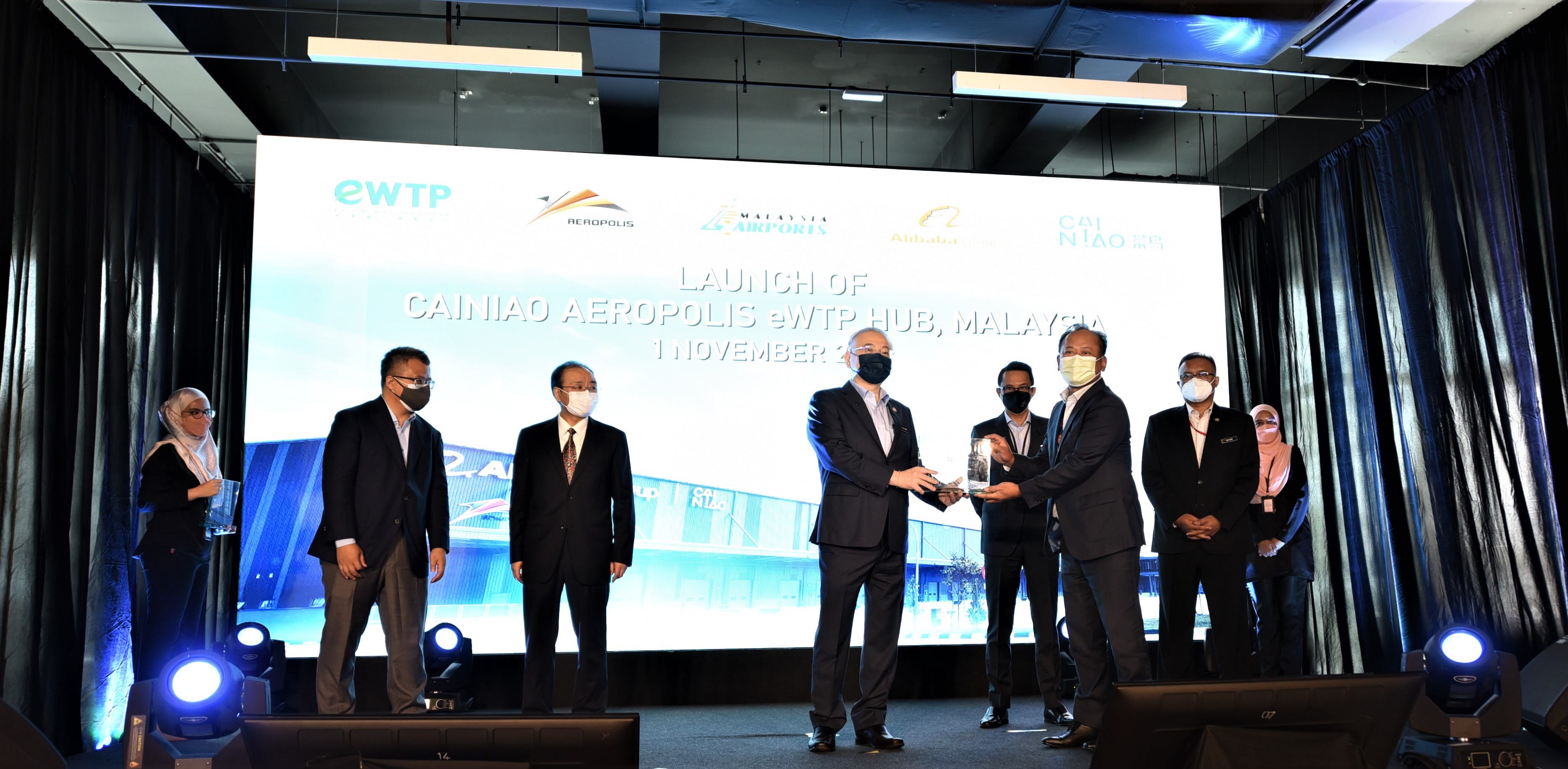
Drastically reduced customs clearance times pose a challenge to law enforcement. eWTP’s goal is to eventually reduce average customs clearance times from 24–48 hours to under three (World Internet Conference, November 24, 2021). At the Cainiao Aeropolis eHub in Kuala Lumpur, customs clearance processed by eWTP already has dropped from 12–48 hours to 1.5 hours (Aeropolis, November 1, 2021). This reportedly includes clearance for 99 percent of packages in seconds (World Internet Conference, November 24, 2021). In Ethiopia, Prime Minister Abiy Ahmed’s office posted on social media that the move to reduce clearance times included using a “paperless environment” and “eliminating multiple physical inspections” (X/PMEthiopia, January 4, 2020). When entire countries move to paperless documentation, as eWTP enables, their customs documentation becomes concentrated entirely on Chinese platforms, cutting off access to due diligence analysts outside of the PRC apparatus.
One way that customs clearance can be further optimized is with artificial intelligence (AI). The General Administration of Customs of China (GACC) promotes tianxuan (天璇) AI for image analysis to screen incoming shipments for prohibited material or discrepancies from declarations, promoting it through the World Customs Organization (WCO) and to delegations of foreign officials (China Brief, May 28). Huawei has entered the “smart customs” sector, applying DeepSeek (深度求索) AI to identify regulatory provisions, conduct corporate background investigations, flag potential risks, and eliminate manual checks (Sohu, April 2, 2025). Like eWTP’s clearance in “seconds,” Huawei and Maxvision’s (盛视) “customs smart gate solution” reduces clearance from 15 minutes to nine seconds (Huawei, May 18). These applications are deployed across Latin America and the Middle East, embedding PRC norms around sensitive issues and its censorship apparatus in customs clearance decisions (Huawei, October 12, 2022, May 18). [1]
While these documentation platforms and AI solutions are not used in U.S. customs clearance, they pose challenges to supply chain visibility, given the frequency of transshipment of goods and the complexity of global supply chains. At the most general level, they add additional layers of opacity for investigators or importers, as this information leaves no physical paper trail and is accessible only to those within the PRC-dominated system. More specifically, the ease of clearance facilitates a lack of documentation that might include sourcing information, and reliance on Chinese AI tools as substitution for human inspections means that XUAR-related sensitivities may not raise flags in the system. As PRC-origin digital documentation platforms and “smart customs” solutions continue to be adopted globally, the risks for both the United States and other concerned parties grow.
Conclusion
The PRC’s digital trade network explains the systemic erosion of the UFLPA that Oritain’s investigation found. Traditional transshipment and other evasion tactics honed since the law’s passage undoubtedly play a role in evasion, but the growing network of Chinese trade platforms present the possibility of a worse fate by eliminating conventional transparency, facilitating trade through transshipment hubs, and introducing new technology that supports CCP interests—not those of the United States. The most pressing of these concerns surround what is recorded in customs and trade, and who can access it. The PRC’s push to dominate global trade infrastructure may result in the CCP holding the world’s supply chain data hostage by default.
This article originally appeared in China Brief. Check it out here!
Jonah Reisboard is an editorial assistant at the Jamestown Foundation. His research focuses on foreign influence and corporate engagement in the Xinjiang Uyghur Autonomous Region. He received his BA from the University of Richmond and is pursuing an MA in Asian Studies at George Washington University.
Notes
[1] Huawei’s 2022 expo in Dubai attracted its “customers and partners” from the United Arab Emirates (UAE), Saudi Arabia, and Libya (Huawei, October 12, 2022). The 2026 Huawei Latin America Partner Conference was held in Rio de Janeiro, suggesting applications in Brazil, and likely elsewhere (Huawei, May 18).