

The Type 075’s Operational Integration in Justice Mission-2025
Yu-cheng Chen & Yang Shang-wei
Executive Summary:
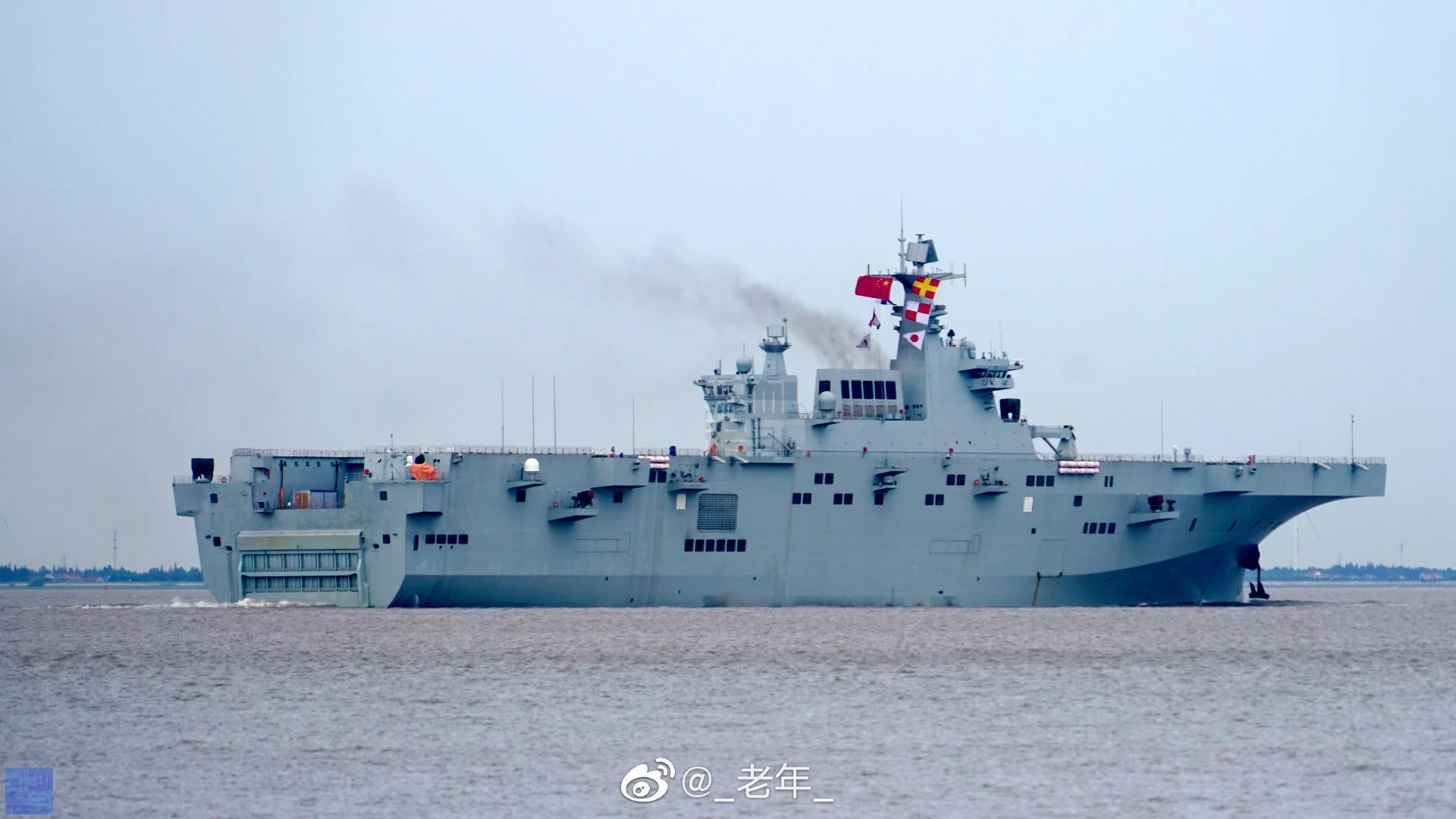
In late December 2025, the PLA Eastern Theater Command launched the Taiwan-focused joint exercise “Justice Mission-2025.” Officially released training items included “blockade and control of key ports and areas” and “outer-line three-dimensional deterrence,” while Chinese reporting suggested the presence of a Type 075 amphibious assault ship—making the platform a key entry point for assessing the PLA’s evolving outer-line intervention-denial concept.
Rather than implying that aircraft carriers will disappear from Taiwan contingencies, the forward positioning of a Type 075 task group in this exercise suggests the PLA is experimenting with alternative large combat platforms for “outer-line” employment.
The Type 075’s activity pattern also suggests a “far-seas mission first, Taiwan exercise second” logic—consistent with PLA emphasis on using one deployment for multiple objectives, while highlighting the growing centrality of ASW capacity to any future attempt to contain Taiwan and deter external forces.
In late December 2025, the Eastern Theater Command of the People’s Liberation Army (PLA) announced a military exercise titled “Justice Mission 2025” (正义使命—2025). The announcement explicitly highlighted “blockade and control of key ports and areas” (要港要域封控) alongside “outer-line three-dimensional deterrence” (外线立体慑阻) (China Military Online, December 30, 2025; China Brief, January 9). This emphasis indicates that Beijing is now framing exercises around Taiwan more openly as aimed at preventing external intervention, and not just conducting near-shore operations.
State media reporting in the People’s Republic of China (PRC) further referenced activity associated with a “Type 075” (075型) amphibious assault ship—a form of large helicopter platform. This was the first time a Type 075 formation has featured prominently in coverage of an Eastern Theater Command drill centered on Taiwan, highlighting the platform’s emerging role, though it does not does not entail that the exercise’s primary training theme was amphibious assault (Global Times, December 29, 2025).
“Justice Mission-2025” followed a year in which official narratives around the PLA’s Taiwan-related exercises increasingly stressed integrated inner-line and outer-line linkage and multi-axis containment. For example, during the first “Joint Sword” (联合利剑) exercise in April 2023, reporting indicated that the Shandong carrier group operated east of Taiwan, establishing an outer-line pressure precedent (Global Times, April 11, 2023; China Brief, May 5, 2023). In PLA operational discourse, the “inner line” generally refers to operations conducted in the PRC’s near seas and around Taiwan and the Taiwan Strait, while the “outer line” refers to operations or forces positioned east of Taiwan and along the approaches from the Philippine Sea, intended to deter or delay external intervention.
From Carrier ‘Outer-Line Presence’ to Type 075 ‘Outer-Line Deterrence’
In recent Taiwan-focused drills and exercises, the aircraft carrier has typically been the PLA Navy’s most visible outer-line platform east of Taiwan. Carriers are a conspicuous signal of far-seas sortie generation, fixed-wings flight operations, and send a political message that external forces would face escalation risk if they attempt to intervene. This pattern is evident in recent large-scale activities. The Shandong was linked to Joint Sword (2023), the Liaoning was associated with Joint Sword-2024B, and the Shandong also appeared in Strait Thunder-2025A (Eastern Theater Command [ETC] Weibo, April 10, 2023; ETC, October 14, 2024; CNA, April 2, 2025).
Against this backdrop, the emergence of a Type 075 task group in December 2025 represents a notable shift. Rather than emphasizing the carrier as its signature outer-line platform in these exercises, the PLA highlighted a large-deck amphibious ship with different operational strengths. This shift aligns with PLA strategic thinking on the Pacific theater. The PLA views the Pacific direction as central to achieving “military presence” (军事存在) beyond the first island chain, reshaping the maritime balance in the Western Pacific, and using the outer line to deter or harass U.S. and Japanese forces with the aim of delaying interference in the PRC’s near seas (the inner line) (INDSR, December 8, 2025).
“Justice Mission-2025” also points toward a more layered, composite approach. Chinese reporting stated that the amphibious assault ship formation operated in the Philippine Sea, training items such as ship–aircraft coordination, near- and far-seas strike, and integrated support—activities that are consistent with building a more persistent and flexible outer-line deterrence posture (Xinhua, December 30, 2025). At the same time, the publicly described formation did not resemble a classic amphibious assault rehearsal package. The absence of commonly paired platforms in an amphibious “delivery-type” configuration—especially dock landing ships and other landing vessels—makes it difficult to interpret the exercise as primarily built around large-scale ship-to-shore landing or “vertical envelopment” as the core objective.
Task-Group Logic: Far-Seas Training First, Taiwan Exercise Second
Over the past several years, PLA Navy far-seas activity has evolved from single-ship transits to diverse, realistic, and highly integrated task-group operations. These have increasingly been characterized by far-seas combat training, island chain transits, and normalized presence.
Chinese doctrinal and educational writings describe naval development under the strategic requirement of “near-seas defense, far-seas protection” (近海防御、远海护卫). This refers to accelerating toward greater platform size, systemization, compositing/integration, and unmanned capabilities, while improving strategic deterrence and counterstrike, far-seas maneuver operations, near-seas combined operations, comprehensive sea-area control, amphibious operations, and integrated maritime support. [1]
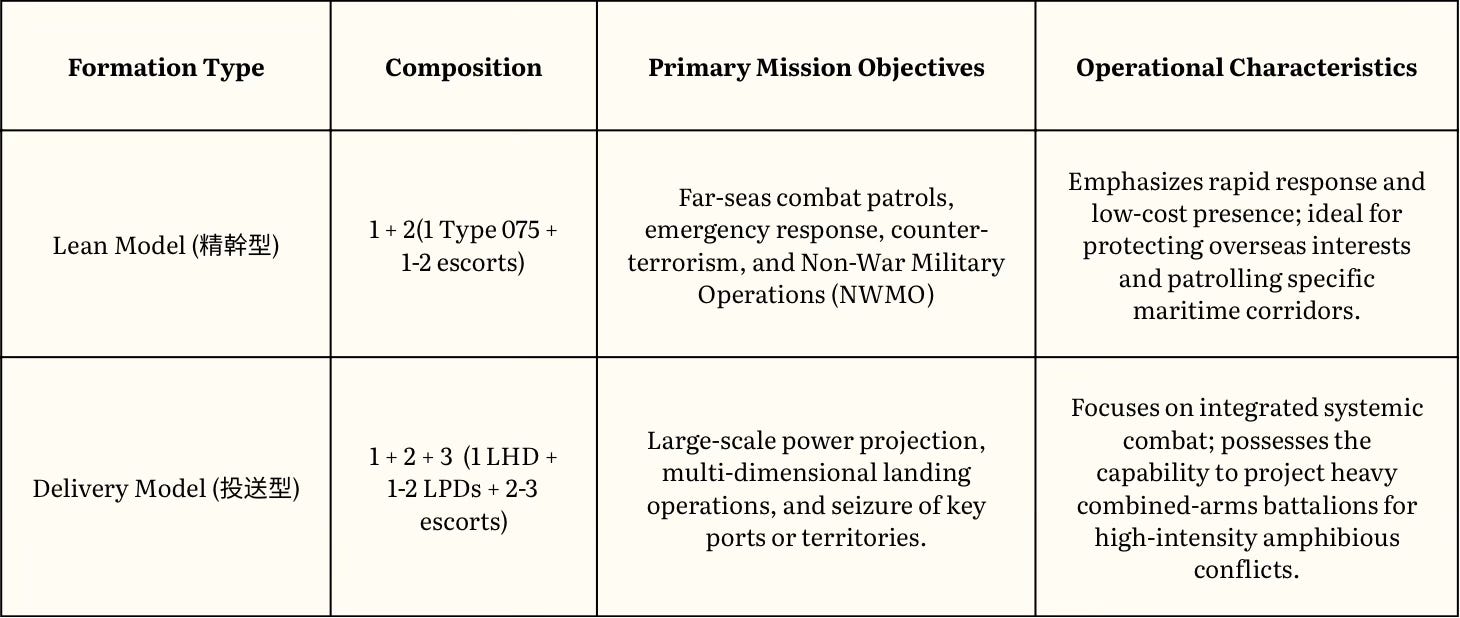
Research from the PLA Navy’s Dalian Naval Academy suggests that, partly informed by U.S. Amphibious Ready Group (ARG) experience, the PLA groups Type 075 formations into two broad categories— “lean” and “delivery”—for missions such as far-seas combat patrols and emergency contingency response:
“Lean” formation (1+2): one Type 075 plus 1–2 escorts (destroyers/frigates), optimized for flexible far-seas patrol, contingency response, overseas presence, special operations forces carriage, and limited equipment packages.
“Delivery” formation (1+2+3): one Type 075 plus 1–2 amphibious landing platforms (“LPDs”) and 2–3 escorts (destroyers/frigates), emphasizing larger-scale troop delivery and battalion-sized air-assault and amphibious assault forces (see Figure 1).
Figure 1: Type 075 Task-Group Categories and Mission Patterns
The recent deployment timeline of Type 075 vessels reinforces this interpretation. Reporting indicates that a task group including the Type 075 (Hainan) and a Type 055 surface combatant was detected north of Palau as early as December 5, 2025, suggesting a far-seas operating radius and mission set not limited to Taiwan (USNI News, December 5, 2025).
Placing “Justice Mission-2025” into the broader context of far-seas activities in 2025, the Type 075 appears more likely to have operated first as part of a far-seas task group, before being folded into a Taiwan exercise framing. This would be consistent with PLA practice and discourse, which emphasizes “one action, multiple missions” (一次行动兼容多类任务). PLA educational materials describe this as “killing two birds with one stone” (“一箭双雕”). [2]
Treating the Type 075’s appearance in “Justice Mission-2025” as proof that the PLA’s primary training objective was amphibious assault therefore likely overestimates the “delivery-type” landing component of the exercise. A more conservative and analytically useful interpretation is that the Type 075 formation served outer-line denial/interdiction needs east of Taiwan.
Anti-Submarine Warfare at Core of Strategy East of Taiwan
The PLA’s operational aim has remained consistent across Taiwan-focused exercises, whether it has deployed an aircraft carrier or a Type 075 task group east of Taiwan. That aim has been to provide an outer-line presence intended to disrupt Taiwan’s external connections and complicate external reinforcement. State media described “Justice Mission-2025” training as including joint formations operating in Taiwan’s north, east, and southwest areas, with items such as joint anti-submarine warfare (ASW) and maritime strike, as well as coordination with the Type 075 Hainan formation to validate inner-line and outer-line linkage (CCTV, December 29, 2025).
If the PRC were to attempt containment or blockade-like pressure against Taiwan, ASW would become indispensable, particularly because the most consequential uncertainty in an intervention scenario is the entry of external attack submarines, including nuclear-powered submarines, into the waters east of Taiwan. In such a scenario, undersea forces could impose outsized risk on PLA surface task groups attempting to sustain outer-line presence. Consistent with this logic, U.S. assessments and comparative analyses often regard PLA Navy ASW as a persistent challenge, while treating U.S. undersea warfare as a relative advantage in far-seas operations (T2COM G2, December 6, 2024).
Chinese research indicates that the PLA is working to operationalize ASW as a calculable task rather than a conceptual aspiration. In a 2024 paper on optimizing ASW defensive formations during amphibious task-group transits published in the journal Command Control and Simulation (指揮控制與仿真), the researcher Chengyi Yin (尹成義) treats “amphibious platform survivability” and “task-group ASW” as a modeling and optimization problem, suggesting a drive to systematize tactics and formation design. [3] Other parts of the PLA research ecosystem discuss extending maritime containment through human-machine teaming and unmanned autonomy, implying that outer-line denial may increasingly include lower-visibility undersea control through unmanned underwater vehicles and distributed sensing. [4]
This trend connects to PLA platform modernization. The PRC Ministry of National Defense (MND) framed the Type 076 amphibious assault ship “Sichuan” in a recent press briefing as an important platform to enhancefar-seas combat capability, signaling that amphibious aviation platforms are being institutionalized as part of the navy’s broader transformation (MND, November 27, 2025). These comments form part of a parallel agenda in which the PRC displays new equipment in order to raise the risk and cost for other states considering intervention in a Taiwan contingency. For instance, Chinese analysis linked some of the systems showcased in the September 3, 2025 parade to reconnaissance and blockade tasks in key maritime corridors, implying that Beijing is building an operational concept to compete with the U.S. idea of turning the Taiwan Strait into a “hellscape,” but with Chinese characteristics emphasizing corridor control, blockade options, and layered denial (Prospect Foundation, October 8, 2025). In this context, a Type 075’s outer-line presence—especially if it enables higher-tempo helicopter operations and ASW-related training—should be interpreted primarily as a mission-driven capability rehearsal aimed at shoring up a far-seas shortfall while embedding ASW into a broader strategy of containment.
Conclusion
For Taiwan, the Type 075 amphibious assault ship remains a major security threat. But the training emphases highlighted in “Justice Mission-2025” and the overall operational pattern of the Type 075 task group in the Western Pacific earlier in the year, indicate that its core role in this context is not amphibious assault but as part of a broader effort to push Taiwan-related military pressure toward a layered framework of inner-line containment plus outer-line denial.
At the same, time, the decision to send a Type 075 task group forward in the most recent drills represents a departure from previous activities, in which aircraft carriers were the most visible platform east of Taiwan. This indicates that the PLA is experimenting with outer-line employment using different large combat platforms. By leveraging the amphibious assault ship’s sustained helicopter operations, integrated support functions, and multi-mission composite characteristics, the PLA can generate an alternative, more durable model of outer-line presence and denial—one that is complementary to, rather than a replacement for, carrier operations.
More importantly, the Type 075 formation’s timeline and order-of-battle logic point to a far-seas mission first, Taiwan exercise second pattern. By reframing an already deployed far-seas group within a Taiwan-focused drill narrative, the PLA can simultaneously reduce marginal deployment costs while achieving multiple objectives. This complicates partner warning indicators and makes it harder to interpret intent based solely on whether an activity is labeled a “Taiwan drill.”
Operationally, the most consequential implication centers on ASW-oriented containment east of Taiwan. If external undersea forces constitute the largest uncertainty in an intervention scenario, the PLA must treat ASW as a core enabling condition for outer-line denial. The Type 075, as a large helicopter platform, can serve as a node for sustained aviation operations and maritime control, while also functioning as a mechanism for mission-driven “catch-up” in a domain where the PLA perceives persistent gaps. As Type 076 and unmanned/undersea systems mature, outer-line deterrence may increasingly evolve into more comprehensive multi-domain containment rehearsal aimed at strengthening the integrity and durability of a future blockade chain.
The views expressed are solely those of the authors and do not represent the positions of the National Defense University, the Ministry of National Defense, or the government of ROC (Taiwan).
This article originally appeared in China Brief. Check it out here!
Yu-cheng Chen is an associate professor at the Graduate Institute of China Military Affairs Studies, Fu Hsing Kang (FHK) College, National Defense University (Taiwan). He is also a member of the Research Project on China’s Defense Affairs (RCDA). His research interests include the PRC’s political warfare, PLA maritime power, and East Asian security. He received a scholarship for “Overseas Academic Diplomacy Program 2020 and 2023” from the Ministry of Foreign Affairs, Taiwan.
Yang Shang-wei is a graduate student at National Defense University. He previously served as the Combat System Officer (CSO) aboard a Cheng Kung-class frigate, a first-class vessel in the Republic of China (Taiwan) Navy.
Notes
[1] Chengyi Yin [尹成義], “Research on Optimizing Amphibious Assault Ship Formation Composition Models and Decision Models” [兩棲攻擊艦編隊組成模式與決策模型優化研究], Fire Control and Command Control [火力與指揮控制] 47, no. 7 (July 2022): 63–64.
[2] Tianliang Xiao [肖天亮], ed., The Science of Military Strategy [戰略學] (Beijing: National Defense University Press, 2020), 322–23
[3] Chengyi Yin [尹成義], “Research on Optimizing Anti-Submarine Defense Formation Configuration for Amphibious Assault Ship Formations During Maritime Transit” [兩棲攻擊艦編隊海上航渡對潛防禦對形優化配置研究], Command Control and Simulation [指揮控制與仿真] 46, no. 2 (April 2024): 157–60.
[4] Fei Luo [羅飛], “Trends in the Evolution of Future Naval Warfare Forms and Their Implications” [未來海戰形態演進趨勢與啟示], National Defense Science and Technology [國防科技] 45, no. 3 (June 2024): 33–35.