

Executive Summary:
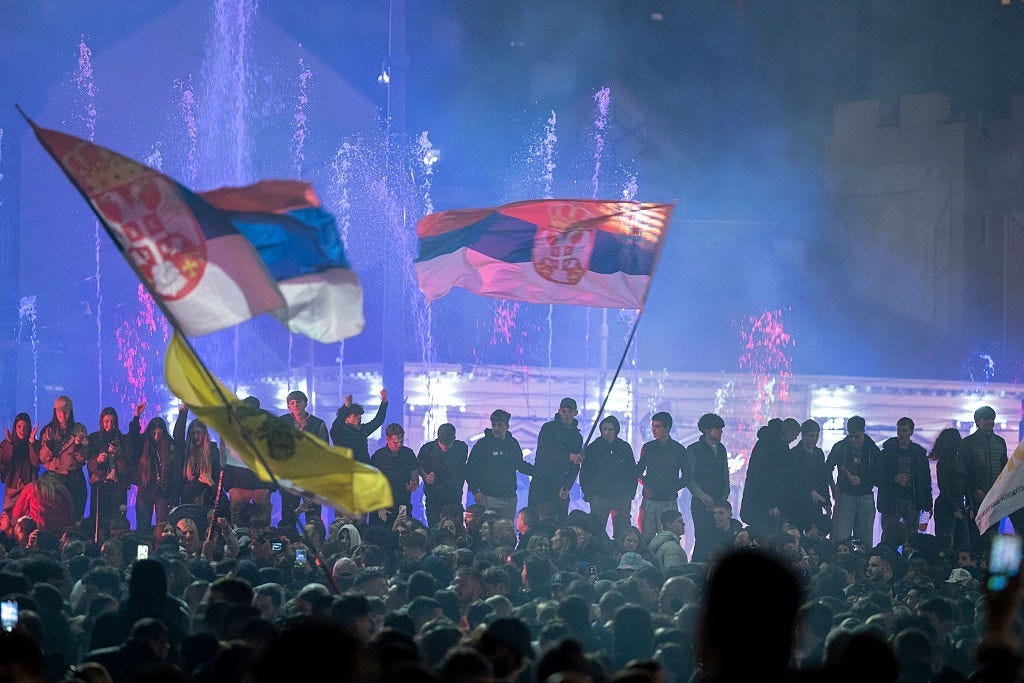
Serbia’s Student List, a student-led protest movement and electoral list, won Serbia’s October 25 snap parliamentary elections with about 53 percent of the vote, ending 14 years of Serbian Progressive Party rule under former Serbian President Aleksandar Vučić.
The victory grew out of protests following the November 2024 Novi Sad railway station canopy collapse that killed 16 people. The decentralized movement campaigned on fighting corruption, strengthening democratic institutions, and improving media independence, transparency, healthcare, education, and housing.
Student List is expected to maintain Serbia’s opposition to sanctions on Russia and support for Ukraine’s territorial integrity while seeking closer ties with the European Union. Its planned referendum on EU membership and potential refusal to recognize Kosovo, which unilaterally broke away from Serbia in 2008, could complicate Serbia’s accession path.
On October 25, former Serbian President Aleksandar Vučić conceded defeat in the country’s snap parliamentary elections after a student-led protest movement, Student List, won the elections with about 53 percent of the popular vote. Student List is on course to secure a comfortable majority of at least 140 seats in the 250-seat National Assembly. The Vučić-led Serbian Progressive Party (SNS), which ran under the United Serbia list with other allied formations, received 39 percent and 103 seats, down from the SNS-led Serbia Must Not Stop lists’s 47 percent and 129 seats secured in the last election in 2023. The remaining six seats were picked up by political parties representing the Hungarian, Albanian, and Bosniak minorities (The Government of the Republic of Serbia, October 26).
The election ends 14 years of SNS rule under Vučić, who first served as prime minister in 2014 and then as president from 2017 until now. Serbia saw considerable democratic backsliding during the second half of his years in power as SNS expanded its influence over state institutions and the media, used public resources to bolster its electoral campaigns, weakened checks on executive powers, subjected opposition figures and independent media to harassment and intimidation, and presided over expanded corruption linked to the ruling elite (N1 Srbija, March 19). Largely due to his institutional advantage, the extensive use of state resources, and the highly fragmented nature of the Serbian opposition prior to the student-led movement, Vučić was able to first consolidate and later maintain his dominance over Serbian politics.
This dominance was broken on November 1, 2024, by the fatal collapse of a newly renovated railway station canopy in the city of Novi Sad, resulting in the death of 16 people. The public outrage over the tragedy quickly transformed into widespread anger against alleged systemic corruption under Vučić, the mismanagement of public development funds, and negligence by the state. As a result, university students organized a decentralized movement demanding political accountability and electoral reform, often attracting hundreds of thousands of protesters through continuous rallies over the past two years. Recognizing the political momentum after Vučić called snap elections for October 25 and resigned as president to run for prime minister, the student-led movement transformed itself into the Student List, while most other non-systemic opposition parties decided not to run independently to support its chances (Danas, September 9).
Despite fears of voter intimidation and other irregular efforts by SNS, Vučić swiftly acknowledged defeat, confirming the peaceful transition of power. This comes after allegations that the former president was preparing to crack down on the opposition and declare SNS victory regardless of the results, which Vučić has categorically denied (The Times, October 27).
What comes next for Serbia is going to be a never-before-seen political experiment. Unlike Péter Magyar’s Tisza party in Hungary that ended 16 years of Fidesz rule under former Hungarian Prime Minister Viktor Orbán, Student List is a heavily decentralized political movement transformed into an electoral list rather than a consolidated political party (see EDM, April 15). It is highly diverse both structurally and ideologically, lacking central leadership, with most of its candidates being political newcomers, primarily from academia and the non-profit sector. While the bloc did not have a candidate for prime minister in the election campaign, cardiologist and university professor Ilija Srdanovic is the favorite to lead the next Serbian government. Student List has 90 days to do so after the next parliament is formed. The constitution allows 30 days for parliament formation after the final election results are announced. Student List aims to move faster, given their absolute majority in the incoming parliament. In parallel, Serbia is preparing for a presidential election, which is expected to be a more open race held in December.
Serbia has traditionally been close to Russia. Consecutive governments under Vučić have all reinforced this relationship, a key component of which has been Russian gas and oil imports. To preserve the relationship under Serbia’s nominally multi-vector foreign policy, Vučić chose not to impose sanctions on Russia over its full-scale invasion of Ukraine but expressed continuous support for Ukraine’s territorial integrity and sovereignty while discreetly allowing munitions exports to Kyiv. The election-winning Student List, whose platform prioritizes domestic issues such as media independence, transparency, democracy building, healthcare, education, and housing, has already confirmed its opposition to anti-Russia sanctions and support for Ukraine’s territorial integrity, signaling a continuation of Vučić’s Russia policy (NIN, October 28). Student List is expected to aim to maintain Serbia’s neutrality regarding Russia’s war against Ukraine, which it views as a political necessity since its electoral coalition ranges from right-wing anti-EU, anti-North Atlantic Treaty Organization (NATO) formations to pro-EU enthusiasts.
Future relations with the European Union are similarly uncertain. Serbia has been an EU candidate country since 2012, but only 22 of the European Union’s 35 negotiating chapters have been opened, and only another two of them have been provisionally completed. The accession path has stalled for several years over rule-of-law concerns and democratic backsliding under Vučić, and the Serbian opposition grew wary of the European Union over its failure to react to his alleged wrongdoings. Serbia’s longer-than-expected accession path and persisting opposition from some EU capitals have cost Brussels much of its credibility in Serbia (Nova/Politico, October 29).
While recent polls still suggest most Serbians support EU membership, Student List has promised a referendum on the issue (Danas, March 20; Kossev, October 28). Bilateral relations are expected to improve as the incoming government focuses on strengthening the rule of law, which could be the catalyst for a bilateral reset. Kosovo, however, will remain a contentious issue, as Student List has no intention of going against the national consensus of not recognizing the country, which unilaterally broke away from Serbia in 2008. This could be a major bottleneck, as Brussels expects the two sides to fully normalize relations.
This article was originally published in Eurasia Daily Monitor.