

State-Driven Nuclear Expansion is Winning Energy Race
Christopher Nye
Executive Summary:
The People’s Republic of China (PRC) now commands the world’s largest overall nuclear construction pipeline, placing Beijing on a credible path to surpass the United States in operable nuclear capacity before 2030.
Policy continuity—including the 2024 Energy Law, the 2025 Atomic Energy Law, the 14th and 15th five-year plans, and State Council approval—has allowed the PRC to mitigate the “cost escalation curse” that has haunted Western nuclear projects.
A lower cost of capital for state-owned developers, combining record-low sovereign bond yields, staged value-added tax rebates, a centralized “spent fuel” fund, and long-term power purchase agreements, has also helped support the sector’s growth.
Provincial governments support rather than constrain the nuclear energy sector, integrating reactors into municipal heating grids, industrial parks, and regional tax bases. This, along with repressive responses to collective action, defuses most local opposition.
The People’s Republic of China (PRC) is on track to have the largest nuclear energy sector in the world by 2030. According to the latest annual blue book published by the China Nuclear Energy Association (CNEA; 中国核能行业协会), by the end of 2025 the country operated 59 commercial reactors totaling more than 62 gigawatts electric (GWe) of installed capacity, with an additional 35 units under construction worth nearly 42 GWe. This makes for a combined portfolio of operational, under-construction, and approved units spanning 112 reactors, totaling 125 GWe—more than the United States, which has 94 reactors but none under construction (World Nuclear Industry Status Report, January 18; CCTV, April 17).
The PRC has had the world’s largest under-construction fleet of reactors for 19 consecutive years, accounting for nearly half of all reactors currently under construction globally. The outline of the 15th Five-Year Plan targets approximately 110 GWe of operable capacity by 2030, and industry projections estimate 200 GWe by 2040 (Xinhua, March 13; China Energy News, April 20). This sustained success has centered on breaking the global nuclear construction “cost escalation curse.” Unlike the dramatic rise in costs for installing nuclear capacity seen in Western countries, the PRC has seen costs decline. The Washington, D.C.-based Information Technology and Innovation Foundation (ITIF) concluded in 2024 that the PRC is now 10–15 years ahead of the United States in fourth-generation reactor deployment. This is primarily due to PRC institutions carrying promising designs into construction and operation, rather than Chinese innovation (ITIF, June 17, 2024).
Top-Level Design Establishes Institutional Foundation for Nuclear Power
Policy certainty, the foundation of the PRC’s nuclear acceleration, is a commodity increasingly scarce in the West. [1] In 2024, the PRC enacted its first Energy Law (能源法), which legally mandated the state to develop nuclear power “actively, safely, and in an orderly manner” (积极安全有序). Article 27 of that law requires relevant authorities to coordinate national planning, siting, design, construction, and operational supervision (National Energy Administration [NEA], November 9, 2024). The central energy authorities described it as a foundational law (基础性、统领性法律) for the sector, anchoring long-range energy development in statute—more authoritative than administrative guidance, which is prone to shifts (NEA, December 2, 2024). The following year, Beijing adopted the Atomic Energy Law (原子能法), codifying a unified legal framework that spans safety supervision, nuclear material security, accident emergency response, and damage liability (National People’s Congress, September 28, 2025).
The legal foundation acquires operational force through national planning (国家规划) roadmaps. These encompass the State Council’s overarching five-year plans, ministry-level energy and power development blueprints, and specialized instruments such as the “Long-term Development Plan for Nuclear Power” (核电中长期发展规划), all of which are further operationalized through granular annual work goals and action plans (National Development and Reform Commission [NDRC], November 2, 2007; NEA, January 29, 2022; April 28). These provide explicit macro-to-micro capacity targets, such as requiring the approval and commencement of 6–8 new reactors annually (Xinhua, September 27, 2023). Construction can proceed over long timelines because these targets are integrated into the performance indicators of state-owned developers, such as the China National Nuclear Corporation (CNNC; 中核集团), the China General Nuclear Power Group (CGN; 中广核), and the State Power Investment Corporation (SPIC; 国家电投). These entities are insulated from quarterly earnings pressures and activist shareholders, allowing them to absorb large initial capital expenditures on the assumption that grid integration and long-term electricity purchase agreements will be guaranteed decades into the future.
The PRC’s long-horizon policy certainty and projected orders through mid-century has enabled companies like China First Heavy Industries (中国一重), China Erzhong (中国二重), and Shanghai Electric (上海电气) to justify substantial workforce and equipment investments (World Nuclear Association, January 14; ITIF, June 17, 2024). According to industry analysts in the PRC, the country has achieved the full localization of key nuclear power equipment and independent control of all key component technologies, with domestic manufacturers regularly delivering core reactor components—such as pressure vessels and steam generators to meet domestic demand and support future exports (Xinhua, April 27, 2025; National Nuclear Safety Administration, August 18, 2025).
State Council Approval Eliminates Late-Stage Cancellation Risk
Policy commitment requires an administrative system capable of sustaining repeated approvals over many years. In the PRC, approvals are granted via a dual-track process. Projects are first incorporated into a national strategic pipeline managed by the National Development and Reform Commission (NDRC) and the National Energy Administration (NEA) before the State Council grants the final authorization to begin construction.
Batch approvals have become standard practice. On April 27, 2025, the State Council simultaneously greenlit 10 new reactor units across five sites, representing a total capital commitment exceeding renminbi (RMB) 200 billion ($27 billion) (Xinhua, April 28, 2025). Between 2019–2024, it approved 46 new reactors, a frequency unrivalled globally (World Nuclear Industry Status Report, September 25, 2025). To date, no project that has received this level of authorization has been canceled.
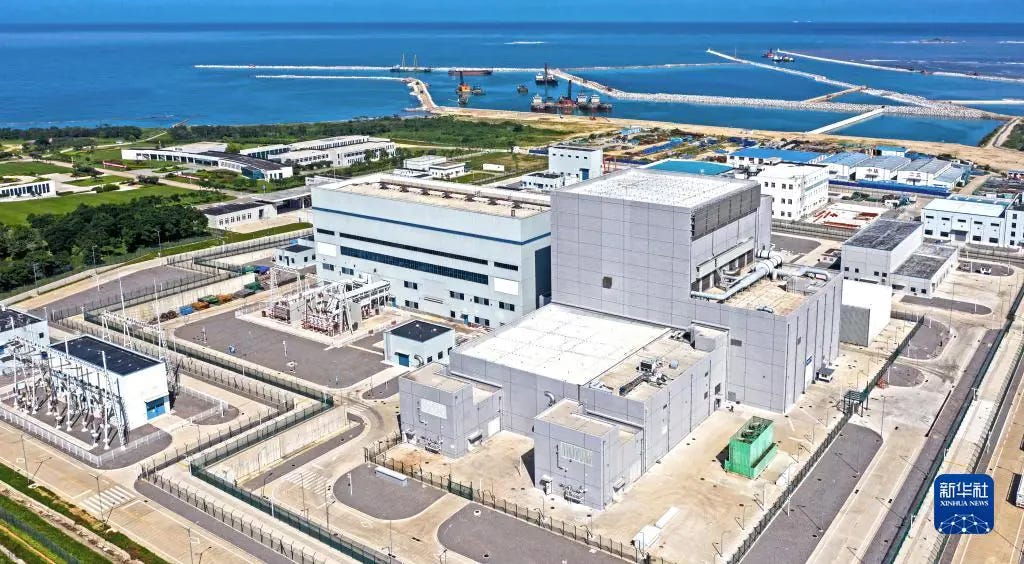
Technical safety review is managed by the National Nuclear Safety Administration (NNSA; 国家核安全局), which operates under the Ministry of Ecology and Environment. The NNSA’s 2021 annual report documents a graduated licensing regime covering site reviews, construction permits, first fuel loading permits, and operating licenses, which mirrors international practice (NNSA, June 2, 2022). What distinguishes this system is its pragmatic treatment of advanced reactors. Referring to the most recently developed reactors, the NNSA does not force fourth-generation designs to meet the same safety criteria engineered for large light-water reactors. Instead, it acknowledges the intrinsic safety features of modern designs. This approach was validated when the 200 megawatt (MW) Shidaowan Unit 1 (石岛湾一号) HTR-PM reactor entered commercial operation in December 2023 as the world’s first commercial generation IV nuclear power plant, with over 90 percent of equipment produced domestically in the PRC (Xinhua, December 6, 2023). [2]
The International Atomic Energy Agency (IAEA) has validated the effectiveness of the PRC’s regulatory framework. While noting a shortage of human resources due to the surge in operating reactors, the IAEA highlighted the NNSA’s innovative use of artificial intelligence (AI) and big data as an international benchmark that effectively mitigates this challenge (IAEA, September 14, 2016).
State Financial Mechanisms Drastically Lower the Cost of Capital
Nuclear power is capital-intensive, making its ultimate levelized cost of electricity highly sensitive to the weighted average cost of capital. The PRC wields structural macroeconomic advantages that Western markets cannot replicate. Nuclear engineering investment reached RMB 161 billion ($22 billion) in 2025, an all-time high and near $2 billion above 2024. All five nuclear projects approved in 2025 included private capital participation, showing that Beijing is broadening the financial base without relinquishing strategic control (China Securities Journal, April 17).
Macro-financial conditions have reinforced these advantages. While Western central banks raised interest rates to combat inflation, Chinese sovereign bond yields reached record lows in early 2024. This interest-rate divergence allows state-owned developers to issue long-term debt and green bonds at yields that remain below those available to Western utility companies (International Energy Agency, June 6, 2024).
Other fiscal policies have created a favorable environment to support reactor development. A policy document originally issued in 2008 and subsequently extended established a staged VAT rebate mechanism for commercial nuclear units to receive progressive rebates up to 15 years from the month of commercial operation (State Taxation Administration, April 3, 2008). Industry financial analysis indicates that the VAT rebate alone accounts for approximately 10 percent of net profits for representative listed nuclear firms (Securities Times, October 21, 2025). While the policy regime has been updated for projects approved after November 2025, the cumulative fiscal effect on operators already in commercial service is substantial (State Taxation Administration, October 17, 2025).
Beijing has also neutralized the long-tail liabilities that deter Western private investors. Five years after a pressurized water reactor enters commercial operation, a mandated fraction of its generation revenue is placed into a centralized “Spent Fuel Treatment and Disposal Fund” (乏燃料处理处置基金). This transforms opaque, multi-billion-dollar future obligations for reprocessing, geological disposal, and decommissioning into a predictable current cash flow arrangement (Ministry of Finance, September 3, 2021). Rather than forcing individual developers to finance their own waste management, the central government uses this mechanism to directly fund multi-billion dollar back-end infrastructure, such as expanding the Jinta (金塔) reprocessing and mixed-oxide fuel complex in Gansu (China Atomic Energy Authority, November 22, 2019; International Panel on Fissile Materials, December 24, 2024). Since the state is absorbing these capital-intensive obligations at the national level, reactor operators are shielded from crippling downstream financial risks because previously opaque future liabilities are now predictable cash flows.
Provincial Governments Actively Facilitate Nuclear Project Deployment
In the PRC, provincial authorities treat reactors as strategic assets that generate fixed-asset investment, employment, tax revenue, and grid stability. Although localized opposition forced project suspensions in Jiangmen (2013) and Lianyungang (2016), the Party-state’s expanding social control has preempted large-scale anti-nuclear protests for a decade (The New York Times, July 12, 2013; August 10, 2016). Today, citizens lack the institutional recourse to challenge state-mandated infrastructure, sparing these projects the protracted legal stalling endemic in many Western countries. By 2025, nuclear power supplied more than 20 percent of total electricity generation in Fujian and Liaoning—roughly on par with nuclear’s share in the U.S. national energy mix (Eastmoney, April 16). Coastal economic powerhouses, including Guangdong, Shandong, Zhejiang, Fujian, Guangxi, and Hainan, all have integrated nuclear complexes into their latest five-year plans, and preemptively have secured land quotas, water rights, and relocation approvals well before national-level authorizations are finalized (CNNPN, March 11).
Nuclear buildout has helped support municipalities’ energy transition targets. For instance, the Haiyang Nuclear Power Plant in Shandong province has helped make Haiyang the PRC’s first “zero-carbon heating” (零碳供暖) city. Over its first five winters, the project saved 810,000 tonnes of coal, reducing carbon dioxide emissions by nearly 1.5 million tonnes (World Nuclear News, November 21, 2024).
Local industrial participation is even more impactful. In August 2024, the State Council approved the world’s first integration of a high-temperature gas-cooled reactor with a major petrochemical industrial park in Jiangsu province (CNNC, August 23, 2024). By transforming reactors from standalone assets into integral providers of municipal and industrial services, local governments shift from regulatory adversaries to vested equity partners. This is a structural asymmetry that Western regulators cannot easily replicate.
Conclusion
Decades of policy finetuning have enabled Beijing to build one of the world’s most formidable nuclear power sectors. The key to this success lies in breaking the global cost escalation curse. For an identical AP1000 plant design, for instance, unit costs in the PRC are approximately RMB 20,000 ($2,600) per kilowatt, a fraction of the almost $10,800 per kilowatt in the U.S. state of Georgia (Cninfo, April 9, 2024; Georgia Conservation Voters, May 29, 2024). As global energy demand is set to rise dramatically, not least due to the requirements for AI data centers and broader human development, nuclear power is likely to be indispensable for the industries that will define the next two decades. The PRC’s successful and ongoing buildout of its nuclear sector therefore is of a piece with its ambitions to dominate the technologies of the future. If the PRC becomes the world’s largest generator of nuclear power by 2030, as current projections assess, this milestone will be seen as another indicator that it is pulling ahead in its technological competition with the United States.
This article originally appeared in China Brief. Check it out here!
Christopher Nye is a Non-Resident Fellow at The Jamestown Foundation.
Notes
[1] In 1994, the Integral Fast Reactor program at Argonne National Laboratory was abruptly canceled by Congress on the eve of commercial demonstration, leading to a multi-decade loss of institutional knowledge in liquid-metal fast reactor design. See Charles E. Till and Yoon Il Chang, Plentiful Energy: The Story of the Integral Fast Reactor (2011). Written by the project’s lead scientists at Argonne National Laboratory, this book details the 1984–1994 development of the Integral Fast Reactor (IFR). The IFR was designed as a revolutionary closed-system fast reactor featuring on-site pyroprocessing and advanced waste management to address safety, proliferation, and waste toxicity concerns. The authors document the technology’s successive scientific breakthroughs and its abrupt political cancellation by the Clinton administration in 1994.
[2] HTR-PM refers to “High-Temperature gas-cooled Reactor Pebble-bed Module” (Nuclear Energy International Magazine, February 26, 2019)