

Russians Protesting Mounting Problems, but Not Yet Against Putin
Paul Goble
Executive Summary:
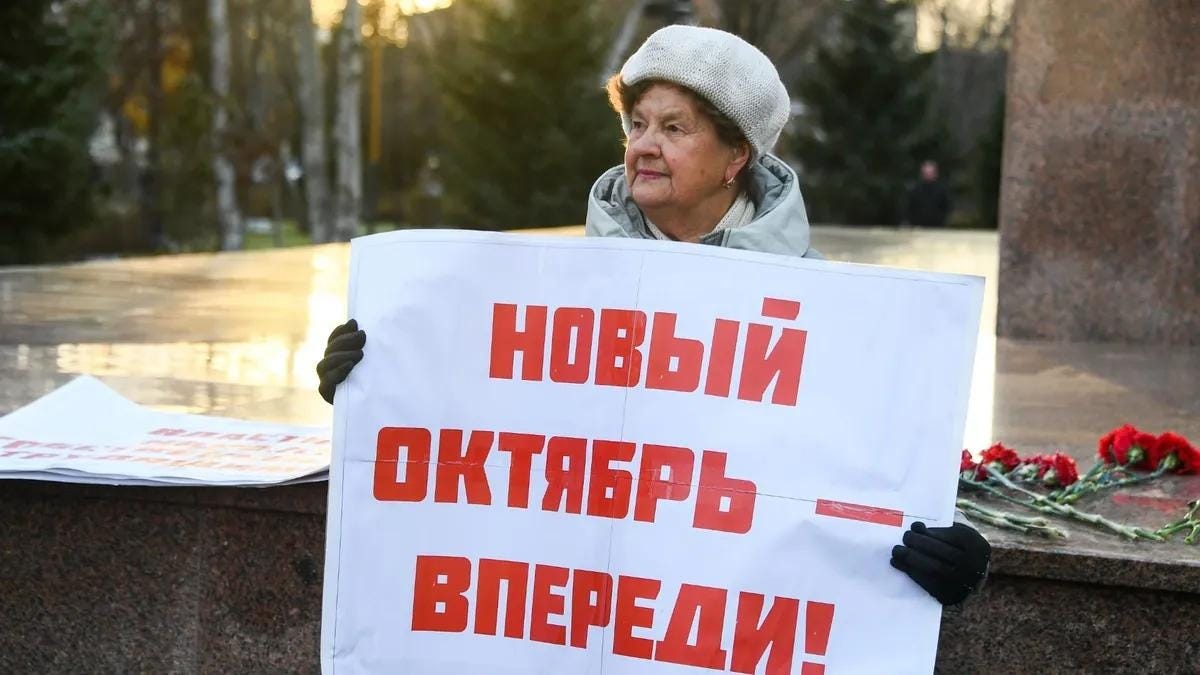
Residents of the Russian Federation are facing a growing tide of problems, and some are now taking to the streets to protest. There were more such actions over the last 12 months than in any of the previous four years.
Those protests have occurred east of the Urals, take place only with permission from local officials, and avoid attacking Russian President Vladimir Putin, giving the Kremlin another way to gauge popular attitudes and control regional leaders.
There are few signs that these protests will grow into a movement that might threaten the Kremlin leader or even lay the groundwork for solving Russia’s problems and radical change once he departs the scene.
The dimensions of the problems confronting Russians are so daunting that many assessments assume that they will sooner or later rise against the regime responsible and force radical change. Observers both inside Russia and abroad have been encouraged by the growing number of protests that have taken place, with the number of popular actions in the Russian Federation over the last 12 months exceeding the figures for any of the previous four years, and with this increase especially marked in the last three months (Novaya Gazeta, December 16). The potential effects of these protests, however, should not be overstated. Most are small and take place only when local officials give their approval and set the terms of their behavior. Moreover, most are not linked to others focusing on the same issues, and nearly all take place far from Moscow, most often east of the Urals.
These protests are confronted by a regime that has enormous coercive resources and significant reserves of support because of the improvements it made after the crises of the 1990s. The regime also benefits from widespread assumptions among Russians that politics is a dirty business they should stay out of and that, while boyars, as local and regional powers, may be bad, the tsar, whatever his title may be, is fundamentally good—even if sometimes isolated and misinformed by those who represent him. In the case of the most recent protests, participants have appealed to Russian President Vladimir Putin to intervene on their behalf against officials who are oppressing them, even though they are suffering from policies Putin has set and that regional authorities have little or no power to modify (Levada Center, November 26).
Any members of the elite who might be considering, or even exploiting, such widespread protests to force a change in policy or personnel are themselves products of that regime and share many of its values. Unless such people were to be replaced entirely—as happened in 1917, but not in 1991—there is less chance of fundamental change than many now suggest is inevitable. There is a much greater chance, however, that whoever succeeds Putin will ultimately continue his approach, regardless of promises to the contrary. Such an individual would act just as the current Kremlin leader has done (MOST.Media, December 15). That does not mean that an examination of the major problems confronting Russia is unnecessary or that the protests cannot ever play a positive role, at the margins, in transforming national culture. It means, however, that these factors must be kept in mind even as commentators, ordinary Russians, and academic experts suggest that in 2026 both the problems and protests about them will increase further (Kasparov.ru, December 4; Levada Center December 9; The Institute of Economic Forecasting of the Russian Academy of Sciences, December 16).
Russians are facing numerous pressing problems under current conditions, some of which have already sparked protests. First, the war against Ukraine and the problem of returning veterans are continuously concerning issues in Russian society. Even if a settlement is reached, Putin’s war against Ukraine is not ending as a problem for the Russian people. It is only changing shape—and perhaps becoming even more serious. Russian attention to the enormous loss of life and substantial amount of money diverted from other purposes to fund the fighting continues. Russians, however, are focusing more of their attention to the effect of returning veterans. This return appears to be sparking a radical rise in crime. Additionally, Putin’s effort to make the veterans the new elite is not only threatening the lives of ordinary Russians but raising questions about the fate of members of the current elite (see EDM, October 9; Window on Eurasia, December 1, 14; Verstka, December 9).
Second, Russia is facing mounting economic difficulties as the war continues. Russian officials have acknowledged that the country has entered a recession, and some even talk about the more serious threat of stagflation, the result of both enhanced sanctions and Moscow’s failure to repair or replace existing infrastructure and machinery. As a result, not only is production in many sectors, especially in consumer goods, falling, but workers in an increasing number of cases are not being paid or are losing their jobs. Inflation is hurting everyone, the less well-off in particular (see EDM, October 27, November 20; Window on Eurasia, November 2, December 14).
Third, Russia is experiencing a rise in collapsing housing and infrastructure. With the arrival of winter, an increasing number of Russians are living without heat, electricity, or plumbing because the authorities have failed to repair or replace aging housing and other facilities. Those problems—most widely covered when they hit apartments, hospitals, and stores—are characteristic of Russian infrastructure as a whole, including transportation and communication links, mines, and gas and oil fields (see EDM, November 4; Window on Eurasia, December 11; Govorit Moskva, December 16).
Fourth, the environment is degrading. The Putin regime has always prioritized economic development over environmental protection or the people who depend on it. For the last year, Russians have been watching as volunteers have tried to clean up oil spills both in the south and in the north without much help and often with the opposition of the government. They now face a challenge in Lake Baikal, where Putin has signed off on legislation that will open the way to almost unrestricted economic development of the shoreline, which is almost sacred to most Russians. They continue to try to cope with the construction of new trash dumps in places near where people live. Many of the protests focus on these problems as NIMBY (“Not in my back yard”) issues, but there is growing recognition that they are more than that (Meduza; The Moscow Times, December 15).
Fifth, transportation and communication problems are mounting. Rising prices and taxes are ending the era of mass car ownership in Russia, highways and railroads are in trouble, and air travel is becoming more difficult as Moscow closes airports and regional carriers shut down. Moscow has had to cancel or at least postpone various projects that Putin has personally invested in (Nezavisimaya Gazeta; Govorit Moskva, December 3). At the same time, Russians face increasingly frequent internet disruptions, which are already having grave social consequences (Window on Eurasia, October 7, 12, and December 16).
Sixth, Russia is seemingly becoming ever “less Russian.” Russians, including the Kremlin, are worried about demographic changes arising from the influx of Central Asian and Caucasian migrant workers and the high fertility rates among many non-Russians compared to the radical decline in those rates among ethnic Russians (see EDM, October 7). The combination of those two factors is leading to an ever less Russian Russia, with some predicting that the country will have a Muslim majority by 2075. Even if that is extreme, changes in the country’s demography are intensifying ethnic and religious tensions and conflicts (see EDM, December 2; Window On Eurasia, December 15).
Seventh, Russians have a sense that they are increasingly losing prestige as a country and a civilization. They now face far greater travel restrictions, the number of non-Russians seeking to acquire Russian citizenship has cratered, and signs in Chinese have gone up in the Russian Far East, one of the consequences of Putin’s turn to the east since the start of the expanded war in Ukraine (see EDM, October 26, 2023). Moreover, they have suffered several technogenic disasters that have received much attention abroad. The latest of these was an explosion at the Baikonur space facility in Kazakhstan (Svobodnaya Pressa, November 28; Novaya Gazeta, December 15; The Moscow Times, December 16).
Eighth, Russians have been facing higher and higher taxes, both direct and indirect, to finance the war against Ukraine. They have done so at a time when the government has been cutting back on medical services and other services on which Russians have traditionally relied (Window on Eurasia, November 24, December 6).
Finally, the regime in Moscow is facing problems itself. Financial stringencies resulting from the war, both in Moscow and the regions, have not only led to the cancellation or delay of many key projects but also put regional governments on the brink of catastrophe and opened the way for some governors to act more independently. It has even led to a decline in the number of police and security services on whom both the population and regime rely. The war has also led to a radical decline in the number of policemen on the beat in Russia, as officers have joined up for better-paying jobs in the military. Putin’s plan to integrate veterans into the existing elite is prompting some in the elite to wonder about their own fate (see EDM, October 9, 30, November 18; Kavkaz.Realii, December 4; Window on Eurasia, December 10; Sibirskii Economist, December 16).
In most countries, this mix of increasingly serious problems would spark massive protests, changes in government policies, or the replacement of current leaders with new ones. That has not been the case in Russia despite the sharp increase in protests over the last few months. Instead, these actions have remained small, isolated, tightly regulated by local officials, and have not spread, except in a microscopically small number of cases (Gorozontal’naya Rossia, December 15). Both individually and collectively, these protests show that while Russians are anything but happy with the situation they find themselves in now and fear that it will only get worse, they are not ready to take to the streets in massive numbers either because of longstanding cultural values or the fear of repression.
In addition to those explanations for the relative paucity of protest, there are other, more immediate reasons to think that Russians as a whole are considerably happier with their lot than many suspect and that they are less likely to support a radical revision in policies or leadership than many hope. One of the most thoughtful and significant expressions of why that is the case comes in two articles by the Levada Center’s Lev Gudkov, who has been monitoring what has changed and, significantly, what has not changed in Russian attitudes for decades (Levada Center, November 26; MOST.Media, December 15).
In the first of these articles published by the Levada Center, the pollster says that surveys his organization and others have conducted in recent years show that Russians have become more satisfied with their lot. He argues that the result is primarily due to the Kremlin’s skill in giving them a way to channel their internal aggression by attacking minorities at home and Ukraine abroad, and thus allowing them to recover the sense that Russia is a great power. He adds that the dominant attitude among Russians has changed from one that reflected the view that “it is difficult to live, but it is possible to hold on” between 1994 and 2019 to “everything is not so bad and it is possible to live” more recently. As that more positive assessment has become dominant, the formerly dominant one of despair has declined precipitously. In 1998–1999, 61 percent of Russians said it was not possible to continue living as they were. Today, Gudkov argues, the share of Russians who feel that way is down to five percent. That limits the number of people prepared to protest about things that bother them significantly (Levada Center, November 26).
He points to five changes that explain this. These include a decline in poverty, price increases for raw materials, the rejection of the heightened expectations many had in the 1990s for improvement overnight, and “the stabilization of life under conditions of a new and authoritarian regime.” This has allowed Russians to express their anger and feel that they are a great power. According to Gudkov, however, “the collapse of the basic system-forming institutions of Soviet totalitarianism … did not affect other crucial institutions of this system, including the political police, army, courts, and education, and thus did not lead to the liberalization of mass consciousness” (Levada Center, November 26).
As a result, the sociologist continues, most Russians have retained “an authoritarian structure of consciousness.” People expect, although do not demand from the state, “primarily an improvement in their standard of living, protection from arbitrary actions by the bottom of the bureaucracy and criminals, but not seeking freedom and political rights” (Levada Center, November 26). Over the last decade, he continues:
The return to great power rhetoric, to the struggle with ‘color revolutions’ and against ‘a fifth column,’ confrontation with the West after the Baltic republics joined the [European Union] and [North Atlantic Treaty Organization (NATO)] were thus greeted by ‘society’ with understanding, relief and approval (Levada Center, November 26).
This popular response helps to explain the return of authoritarianism. It is not just the product of the actions of Putin and his regime, but also about the response of the still authoritarian Russian people to what he is doing. Putin pursues a more aggressive foreign policy abroad,as in Ukraine, and a more repressive one at home against migrants and other minorities to vector popular discontent away from his regime (Levada Center, November 26).
In his second article, published by MOST.Media, Gudkov argues that the hopes that Russia will fundamentally change course after Putin’s departure from power are often overstated (MOST.Media, December 15). Both the degradation that Russian society has experienced under Putin and the authoritarian temptation will almost certainly continue long into the future. Given the disappointments Russians have suffered from the failure of reforms in the 1990s, they do not see any real alternative to the authoritarianism they defer to. Gudkov continues, “all preceding culture which we have had was a hypocritical adaptation to the existing order and to a repressive state” (MOST.Media, December 15). That state weakened somewhat in the 1990s, “but our people then wanted not freedom but an increase in consumption and wanted to live as in Western countries.”
Even in the 1990s, he points out, only a few organizations, primarily supported by grants from abroad, genuinely wanted democracy. As a result, “the main institutions of a totalitarian society, that is, the army, [Committee for State Security (KGB)], and judicial system,” remained in place even if they were renamed. The Russian population accepted this as “as a given” rather than seeing it as something that must be changed. The Putin regime has done everything it can to encourage such attitudes, the sociologist says. Any change in the bureaucracy or the population is unlikely anytime soon. There is a chance, of course, “but it is weak.” Expecting that it will happen without some cataclysmic event is almost certainly an illusion (MOST.Media, December 15).
Levada Center polls show that “80 to 85 percent of Russians do not want to take part in politics, viewing it as ‘a dirty business’ or something for which they do not have time.” Russians are unlikely to mobilize and put pressure on the state for real change and will continue to defer to it, something Putin’s successors will exploit as he has. Gudkov concludes, therefore, that:
The most likely scenario is a gradual decline of Russia to the status of a regional power, weak and corrupt, a type of pariah state dependent on more powerful countries like China. In response, democratic countries will erect some kind of fence, a barrier, to isolate this disaster zone (MOST.Media, December 15).
Gudkov’s arguments explain much of what is now happening in Russia, especially the relations between the Russians and their rulers, and his predictions are persuasive. Positive change will only occur if there is a radical shock, such as the loss of a war or the wholesale collapse of order inside Russia. The new wave of protests is encouraging. By itself, however, it is not going to be enough to bring about transformation, no matter how welcome it may be to see Russians act in ways that suggest at least some of them believe that they, rather than “the powers,” should be in a position to make decisions for themselves and their country.
This article was originally published in Eurasia Daily Monitor.
Paul Goble is a longtime specialist on ethnic and religious questions in Eurasia. Most recently, he was director of research and publications at the Azerbaijan Diplomatic Academy. Earlier, he served as vice dean for the social sciences and humanities at Audentes University in Tallinn and a senior research associate at the EuroCollege of the University of Tartu in Estonia. While there, he launched the “Window on Eurasia” series. Prior to joining the faculty there in 2004, he served in various capacities in the U.S. State Department, the Central Intelligence Agency and the International Broadcasting Bureau as well as at the Voice of America and Radio Free Europe/Radio Liberty and at the Carnegie Endowment for International Peace. He writes frequently on ethnic and religious issues and has edited five volumes on ethnicity and religion in the former Soviet space. Trained at Miami University in Ohio and the University of Chicago, he has been decorated by the governments of Estonia, Latvia and Lithuania for his work in promoting Baltic independence and the withdrawal of Russian forces from those formerly occupied lands.