

Quasi-Quarantine Operations Held East of Taiwan
Ying Yu Lin
Executive Summary:
Recent coast guard and maritime patrol operations east of Taiwan are best understood as a test of a “quasi-quarantine” model. Beijing is using gray-zone tactics to create the appearance of administrative control without declaring a blockade or conducting a formal military exercise.
The operation demonstrates the People’s Republic of China’s (PRC) wish to project maritime jurisdiction beyond the Taiwan Strait and into the Western Pacific. Large vessels from the China Coast Guard (CCG) and other agencies show that Beijing is building an interagency toolkit for gray-zone pressure around Taiwan.
Although the PRC frames the operation as a response to Japan–Philippines maritime delimitation talks, Taiwan is the central target. If normalized, these operations could support future isolation, blockade rehearsal, and cognitive warfare against Taiwan.
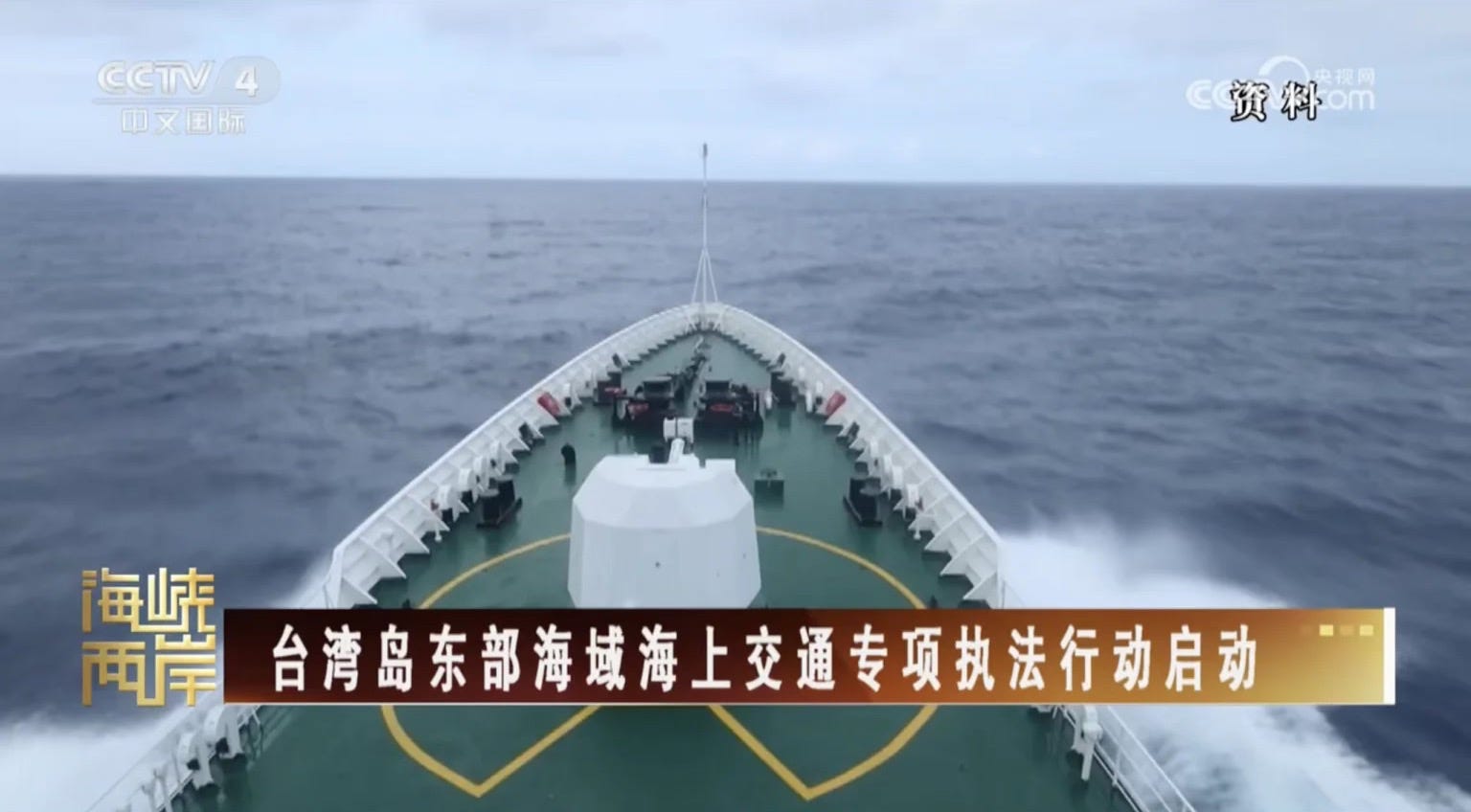
On June 1, the China Coast Guard (CCG) announced that it had launched “law enforcement patrols” in waters east of Taiwan (WeChat/CCG, June 1). CCG vessels entered Taiwan’s restricted waters around Dongsha Island a few days later on June 5. On the following day, the Ministry of Transport of the People’s Republic of China (PRC) announced that multiple agencies under its Maritime Safety Administration (海事局), including the Fujian Maritime Safety Administration, Guangdong Maritime Safety Administration, East China Sea Navigation Security Center, and East China Sea Rescue Bureau had begun a “special maritime traffic law enforcement operation” (海上交通专项执法行动) in the waters east of Taiwan (Xinhua, June 6).
Beijing framed the operation as “fully exercising [the PRC’s] maritime administrative law enforcement jurisdiction” (全面履行我国海上行政执法管辖权). This was, it claimed, a “necessary action” (必要行动) in response to Japan and the Philippines initiating negotiations on maritime boundaries east of Taiwan, which “seriously infringed” (严重侵犯) upon its territorial sovereignty and maritime rights. The operation also aimed to strengthen deep-sea and far-sea patrol capabilities, improve traffic control in key waters, and safeguard maritime traffic safety (Xinhua, June 6). This framing is part of a growing trend of maritime lawfare in which the PRC enforces de facto jurisdiction over waters that it claims (China Brief, September 20, 2024). Although previously occurring in the Taiwan Strait, it has now expanded to waters to the east of Taiwan.
PRC Tests ‘Quasi-Quarantine’ East of Taiwan
Beijing is experimenting with maintaining the appearance of PRC administrative jurisdiction while seeking to avoid designating its actions as a formal blockade or military exercise. Its latest maritime operations east of Taiwan should be seen as an attempt to test a new form of “quasi-quarantine” pressure against Taiwan. By deploying coast guard and maritime patrol vessels into waters east of Taiwan, broadcasting instructions to commercial and fishing vessels, and demanding navigation-related information, Beijing hopes to deploy civilian law enforcement agencies to shape the legal, operational, and psychological environment around Taiwan (China Brief, November 1, 2024, June 21, 2025, December 4, 2025).
The operation constituted the heaviest deployment of PRC government vessels seen in waters surrounding Taiwan. Six maritime patrol and coast guard vessels came as close as 32 nautical miles from Taiwan’s eastern coast. The formation included four large government vessels: the 13,000-ton Haixun 09, operated by the Guangdong Maritime Safety Administration; the 6,600-ton Haixun 06, operated by the Fujian Maritime Safety Administration; the 7,500-ton survey vessel Haixun 08, operated by the East China Sea Navigation Security Center; and the 8,000-ton Donghai Jiu 113, operated by the East China Sea Rescue Bureau. Haixun 09 is the PRC’s first 10,000-ton-class deep-sea and far-sea comprehensive command vessel, equipped with a helicopter deck and a global satellite command system (CNA, June 9).
The Taiwanese government traditionally has viewed the waters east of Taiwan as its strategic rear area and a potential corridor for foreign support in a crisis. If the PRC can normalize maritime law enforcement operations in this area, it would gain a new gray-zone tool for pressuring Taiwan without immediately escalating to a PLA-led military operation. During the most recent activities, the CCG reinforced a “quasi-quarantine” by using high-powered radio broadcasts to contact nearby commercial and fishing vessels, demand information on port entry, departure, and navigation, and present PRC agencies as the responsible authority in the area (CNA, June 9).
The operation’s current iteration does not constitute a full blockade as not all vessels were stopped and force was not used to deny access. The actions nevertheless are a form of coercive maritime presence designed to habituate ship operators, local audiences, and both Japan and the Philippines to the presence of PRC law enforcement east of Taiwan. If these practices become routine, they could eventually support boarding inspections, selective interference with shipping, or a broader isolation campaign against Taiwan (Foreign Affairs, April 29).
Maritime Law Enforcement Projects Jurisdiction Beyond Taiwan Strait
The PRC has claimed that its maritime actions were a response to a May 28 meeting in Tokyo between Japanese Prime Minister Sanae Takaichi (高市早苗) and Philippine President Ferdinand Marcos Jr. that launched negotiations on the delimitation of the two countries’ respective exclusive economic zones and continental shelves. Beijing argued that the waters in question east of Taiwan overlap with its own maritime rights and interests (CNA, May 31; China Brief, June 11). On June 3, Zhu Fenglian (朱凤莲), spokesperson for the PRC’s Taiwan Affairs Office (TAO), characterized the meeting as an illegal and invalid “maritime delimitation negotiation” (划界谈判) (TAO, June 3).
Beijing’s response, a deployment east of Taiwan, marked an expansion in the geography of the PRC’s law enforcement claims. PLA Navy vessels have long operated beyond the First Island Chain, but the PRC’s maritime law enforcement agencies have generally concentrated their jurisdictional assertions in the Taiwan Strait, the Yellow Sea, the East China Sea, and the South China Sea.
CCG vessels asserted jurisdictional claims in Japanese waters for the first time. According to Japanese media, two CCG vessels that sailed off Taiwan’s eastern coast on June 3 before entering Japan’s exclusive economic zone south of Yonaguni Island in Okinawa Prefecture claimed that the area fell under Chinese jurisdiction (CNA, June 9). At the same time, the PLA Navy’s Liaoning aircraft carrier strike group was operating farther east in the Philippine Sea, roughly 400 nautical miles northeast of the Philippines’ main island, Luzon. These simultaneous activities suggest a “three-sea linkage” designed to apply maritime and military pressure against Japan, Taiwan, and the Philippines at the same time.
The PRC’s narrative framing also sought to position it as a defender of Taiwan in response to the hostile actions of Japan and the Philippines. In doing so, it implicitly suggested that Taiwan is unable to protect its own maritime space. In her press conference, Zhu also called upon “compatriots from both sides of the Strait” (两岸同胞) to “jointly safeguard the overall interests of the Chinese nation” (维护中华民族的整体利益) (TAO, June 3). Although Foreign Minister Lin Chia-lung (林佳龍) stated that Taiwan welcomes the establishment of a comprehensive strategic partnership between Japan and the Philippines, he also emphasized that any consultations or negotiations among the parties must not undermine Taiwan’s rights and interests (UDN, June 4). At the same time, Taiwan also maintains that any negotiations between Japan and the Philippines would have no legal effect on Taiwan under international law (Ministry of Foreign Affairs, June 9).
Gray-Zone Coercion Offers Political Cover
The quasi-quarantine operation is part of a broader gray-zone campaign against Taiwan. Rather than relying only on large-scale PLA exercises and drills, Beijing is increasingly using gray-zone tactics such as repeated joint combat readiness patrols, coast guard deployments, maritime safety operations, and media narratives to maintain sustained pressure. In May 2026, the PRC conducted four “joint combat readiness patrols” against Taiwan. Another took place on June 3. Judging by frequency alone, the PRC has not yet shown signs of launching a new large-scale Taiwan-specific military exercise in the first half of 2026, opting instead for maintaining constant pressure through lower-intensity activities. The result is a more continuous form of coercion that can be increased or reduced without the political cost of announcing a major military exercise. (Republic of China (Taiwan) Ministry of National Defense, 2026).
The CCG and maritime patrol vessels under the Maritime Safety Administration, rather than the PLA, are currently taking responsibility for maritime law enforcement, maritime isolation, and blockade-rehearsal functions around Taiwan. This allows Beijing to practice interagency joint operations while avoiding some of the escalation risks associated with a direct PLA-led operation. It also reduces the likelihood of coordination problems between gray-zone and military actors, a concern highlighted by past incidents involving PLA and CCG vessels in the South China Sea (The Diplomat, August 30, 2025).
Beijing Aims for Near-term Jurisdictional Normalization
Establishing permanent naval sea control east of Taiwan is likely not the immediate goal of the latest maritime activity. Sustained PLA Navy operations in Taiwan’s eastern approaches would face operational risks, including exposure to Taiwanese, Japanese, and U.S. forces operating in the vicinity from Okinawa and the wider first island chain. Beijing’s near-term objective instead appears to be jurisdictional normalization: making Chinese maritime law enforcement activity east of Taiwan appear routine, legitimate, and expected.
Maritime gray-zone activity like this allows for a continuing ratcheting up of pressure without drawing reciprocal actions in response. Unlike PLA Navy deployments, a coast guard or maritime patrol vessel demanding navigation information from a commercial ship are less clearly escalatory as they can be framed as administrative law enforcement, maritime safety management, or traffic control. Over time, however, these ambiguous actions accumulate to build a record of presence and a habit of compliance. They also allow Beijing to test Taiwan’s operational responses, regional reactions, and the behavior of commercial operators (China Brief, March 25, 2022). This objective is reflected in Chinese commentary claiming that Beijing has already “filled in” (补齐) its seabed map of Taiwan’s eastern waters, that management of the area will move toward “normalization” (走向常态) and that law enforcement operations around Taiwan will enter a “near-seas governance model” (近海治理模式) (Yuyuan Tantian, June 10).
Compared with previous Taiwan-encirclement exercises, the current operation may be more significant in long-term political and legal terms. Military exercises are limited in time and geography, even when they generate intense pressure. Law enforcement operations, by contrast, can be repeated, routinized, and presented as normal governance. If the PRC can establish the perception that it has the right to patrol, question, and potentially inspect vessels east of Taiwan, it would gain a powerful tool for future coercion (China Brief, December 4, 2025).
This pattern recalls the PRC’s behavior after then-U.S. House of Representatives Speaker Nancy Pelosi’s visit to Taiwan in 2022. Beijing used military exercises around Taiwan to erode the median line of the Taiwan Strait, challenge Taiwan’s surrounding maritime space, and normalize combat patrols. The current operation takes a similar approach to maritime law enforcement. It seeks to break past previous practices around Taiwan’s prohibited and restricted waters to establish a new law enforcement zone east of Taiwan (CNA, August 8, 2022). [1]
The danger is that these operations may create a bridge between peacetime gray-zone pressure and wartime blockade. The PRC does not need to declare a blockade in order to begin shaping the conditions for one. Radio warnings, vessel identification demands, navigation reporting requirements, and selective enforcement can all generate a quasi-quarantine effect. In a crisis, such practices could be expanded into boarding inspections, denial of access, or coercive traffic control around Taiwan’s eastern waters (FountMedia, June 10, 2026).
Conclusion
Beijing’s maritime law enforcement operations east of Taiwan shows how Beijing exploits every diplomatic, legal, and operational opening to pressure Taiwan. Although its stated targets in this instance were Japan and the Philippines, its tactics involved projecting Chinese forces into waters east of Taiwan and testing whether Beijing can normalize administrative control in an area that is vital to Taiwan’s security.
Beyond the hard power on display during the operations, Beijing also deployed information media and cognitive operations, arguing that Taiwan and the PRC should “jointly defend maritime rights and interests,” thereby framing Chinese coercion as national protection. This was underscored by the decision to conduct the operations on June 6, the day before the PRC’s National Ocean Day (CNA, June 5).
The PRC’s quasi-quarantine approach east of Taiwan demonstrates how gray-zone coercion can move from military exercises to administrative control and from temporary pressure to normalized presence, all while deterring regional powers from intervening. It seeks to fold Taiwan into its “near-seas governance” operations, absorbing it by default as part of its regular law enforcement activities. As such, Taiwan cannot afford to treat operations as isolated maritime incidents and must pay attention not only to PLA aircraft and warships, but also to the behavior of the CCG, maritime safety, navigation security, rescue, customs, and other government vessels.
This article originally appeared in China Brief. Check it out here!
Dr. Ying Yu Lin is an Associate Professor at the Graduate Institute of International Affairs and Strategic Studies at Tamkang University in New Taipei City, Taiwan. He is also a Research Fellow at the Association of Strategic Foresight. His research interests include PLA studies and cybersecurity.
Notes
[1] Taiwan has designated “prohibited waters” as maritime territory extending 12 nautical miles from the territorial sea baseline. Without prior notification and authorization, foreign vessels and vessels from the mainland PRC are strictly prohibited from entering or remaining in these waters (Mainland Affairs Council, Taiwan, accessed June 18). “Restricted waters” correspond with Taiwan’s contiguous zone, extending 24 nautical miles from the territorial sea baseline. These designations were enabled by Article 29, sections 1 and 2, of the Act Governing Relations between the People of the Taiwan Area and the Mainland Area (臺灣地區與大陸地區人民關係條例) (Ministry of Justice, Taiwan, accessed June 18). For offshore islands such as Kinmen and Matsu, “prohibited waters” and “restricted waters” are separately defined due to their proximity to the PRC mainland (China Times (Taiwan), February 18, 2024).