

PRC Supply Chain Ecosystem Behind Iran's Drone Campaign
Christopher Nye & Charles Sun
Executive Summary:
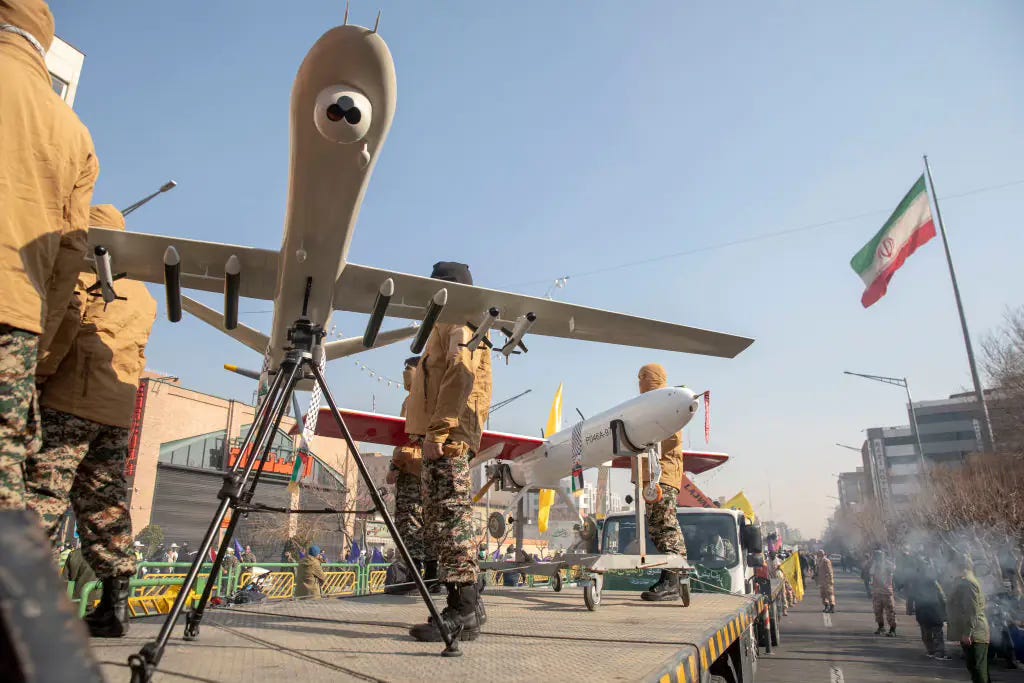
In March 2026, Iran’s drone campaign consumed thousands of expendable unmanned aerial vehicles (UAVs). The critical technologies, manufacturing equipment, and components underpinning these platforms trace to the civilian manufacturing ecosystem of the People’s Republic of China (PRC), channeled through private capital acquisition, reverse engineering, and the systematic exploitation of dual-use trade ambiguities.
The PRC’s drone supply chain operates as a “manufacturing plain”—a flat landscape of interchangeable micro-enterprises, as distinct from the “mountain peak” defense contractors that sanctions are designed to neutralize. Individually targetable but collectively inexhaustible, with minimal staffing and nominal business scopes unrelated to aviation, these firms channel drone-applicable materiel to sanctioned end-users at scale.
Western sanctions targeting these supply chain entities are unable to meet this challenge. Designation lists expand rapidly while adversary drone production accelerates, because enforcement models designed to neutralize large, identifiable defense contractors cannot suppress a diffuse network of expendable nodes that regenerate faster than regulators can act.
Under sanctions pressure, the drone supply chain has evolved across three dimensions: network regeneration, supply chain substitution, and end-user production localization, each compounding the obsolescence of entity-list enforcement.
The ongoing conflict in the Persian Gulf has been characterized by massive Iranian drone deployments. When questioned specifically about these strikes in mid-March, the Ministry of Foreign Affairs (MFA) of the People’s Republic of China (PRC) officially expressed its concern, condemning indiscriminate attacks and urging all parties to return to dialogue (MFA, March 13). Beneath this diplomatic posture, the PRC’s role in Iran’s drone supply chain has been a structural one. The transfer of critical technologies, manufacturing equipment, and components has occurred through private capital acquisition, reverse engineering of foreign technologies, and the systematic exploitation of dual-use trade ambiguities. Beijing’s consistent non-enforcement against known proliferators constitutes a form of strategic permissiveness that is itself a policy choice.
A complex, decentralized ecosystem of Chinese enterprises is currently working to support Iran’s war effort against the United States and Israel. Using open-source enterprise registration data from the platform Tianyancha (天眼查) and cross-referencing it with U.S. Office of Foreign Assets Control (OFAC) designation documents, it is possible to profile sanctioned PRC entities and reveal their functional roles within this supply chain. [1] Together, they constitute what this article terms a manufacturing plain: a decentralized landscape of interchangeable micro-enterprises that operates differently from the identifiable defense contractors traditional sanctions are designed to target. This topographical analogy highlights a vulnerability in current Western export control enforcement mechanisms. Like radar, these mechanisms are designed to strike highly visible objects, whereas this decentralized PRC network operates entirely beneath the regulatory line of sight.
PRC Suppliers for Iranian Drone Components
The Shahed-136’s MD550 engine can be traced back to the German Limbach L550E, a civilian ultralight aircraft engine that Iran covertly acquired and later reverse-engineered through a company called Mado, which is linked to the Iranian Revolutionary Guard Corps (Iran Watch, December 17, 2025). But scaling production of expendable platforms requires access to a stable manufacturing base, a role the PRC excels at. In 2011, Chinese businessmen acquired the financially troubled Limbach Flugmotoren GmbH and established Xiamen Limbach Aviation Engine (厦门林巴贺航空发动机) in Fujian Province the following year (Tianyancha, March 26). Around 2013, a firm called Beijing MicroPilot UAV Control System (北京麦克普特无人飞行器控制系统) began openly marketing MD550 engines internationally, while Mado established trading companies in Hong Kong and the PRC to procure engine-related goods. By 2017, Fujian Delong Aviation Technology (福建德龙航空科技) had completed a full buyout of the German parent company (Tianyancha, March 26; Iran Watch, December 17, 2025). Whether through direct supply or the accumulation of manufacturing know-how, the result was that Iran used PRC commercial channels to secure the propulsion technology that underpins its expendable drone arsenal. The same ecosystem also supports the newer Shahed-107, which uses the DLE 111 engine manufactured by PRC firm Mile Hao Xiang Technology (弥勒浩翔科技) (Defense Express, November 27, 2025; Mile Hao Xiang Technology, March 26).
With core propulsion technology acquired, Iran’s continued dependence on the PRC shifted to manufacturing equipment and components. Iran lacks the full industrial chain required to produce drone platforms at the scale it demands. That dependency is serviced by a diffuse ecosystem of micro-enterprises. The acquisition of manufacturing equipment is exemplified by Changzhou Joemars Industrial Automation (常州乔懋工业自动化). It was established as a subsidiary by Taiwan’s Joemars Machinery and Electric Industrial (台灣喬懋機電工業), held through an offshore entity, Best Technology Industries Limited (Tianyancha, March 26). Registered as a wholly foreign-owned enterprise, the company has only four employees and $150,000 in capital—a scale typical of an evasion shell company. Its registered business scope—“production of electrical discharge machining computer numerical control [CNC] machine tools and technical consulting and maintenance services” (生产电火化数控机床及技术咨询、维修服务)—references a narrow category of machine tools but not the high-precision models applicable to aerospace manufacturing (Tianyancha, March 26). But Iran-based firm Control Afzar Tabriz procured high-precision CNC machine tools and equipment for the state-owned Iran Aircraft Manufacturing Industrial Company (HESA). It did this through Joemars Machinery and fellow Taiwanese firm Mecatron Machinery (龍馬精機), using Hong Kong-based Clifton Trading Limited as an alternative consignee to obscure the Iranian end-user. The parties knowingly circumvented sanctions and export controls in routing these transactions, channeling advanced foreign tooling into sanctioned proliferation networks (U.S. Department of the Treasury, July 31, 2025).
Core components for Iranian drone platforms also depend on PRC suppliers. Shenzhen Caspro Technology (深圳嘉思博科技), a micro-enterprise with merely RMB 100,000 ($14,500) in registered capital and operating behind a civilian façade of selling e-cigarettes and chewing gum, was in practice exporting thousands of aerospace components for Iranian UAV and military applications (Iran Watch, February 26, 2024; Tianyancha, accessed March 26). Other small PRC firms registered for seemingly unrelated civilian businesses—including Guilin Alpha Rubber and Plastics Technology (桂林阿尔法橡塑科技) and Hangzhou Fuyang Koto Machinery (杭州富阳科拓机械)—also supplied precision aviation components to HESA through Hong Kong-based front companies (Tianyancha, accessed March 26, [a], [b]; U.S. Department of the Treasury, March 9, 2023; September 19, 2023). These entities are small, commercially camouflaged, and difficult for conventional risk screening to detect.
Evasion Strategies Render Sanctions Impotent
Between 2024 and 2025, OFAC and U.S. Department of Commerce’s Bureau of Industry and Security (BIS) repeatedly expanded sanctions and Entity List designations targeting Iranian and Russian unmanned aerial vehicle (UAV) procurement networks across the PRC, Hong Kong, Turkey, the UAE, and other jurisdictions (U.S. Department of the Treasury, October 17, 2024, February 26, 2025, April 1, 2025, July 31, 2025, November 12, 2025; Federal Register, April 11, 2024, August 27, 2024, October 23, 2024, March 28, 2025). Yet over roughly the same period, Russian production of the Garpiya UAV—assembled with PRC-supplied L550E engines—rose from about 2,000 units in 2024 to a contracted 6,000 in 2025 (Reuters, July 24, 2025). This suggests that expanding designation lists is largely ineffective in achieving the required policy effect. It is a reactive measure in a losing battle against the adaptive reorganization of the PRC’s lower-tier supply chains. This mismatch is a result of policy instruments failing to evolve and modernize.
Traditional name-list enforcement was built to target large, capital-intensive, and irreplaceable defense contractors. But as forensic work by Conflict Armament Research (CAR) in Ukraine shows, these systems rely overwhelmingly on non-serialized commercial off-the-shelf components that are mass-produced and difficult to track at the end-user level (CAR, July 2025). Rather than being limited to a few vulnerable choke points, the network consists of interchangeable micro-trading nodes scattered across industrial hubs. When one entity is sanctioned, another in the same ecosystem can often replace it within weeks.
The specific evasion strategies employed by the entities profiled above expose how the manufacturing plain defeats name-list enforcement in practice. In 2021, Xiamen Limbach executed a shell-switching maneuver, establishing a subsidiary under a near-identical name before transferring full ownership of that subsidiary to a related company whose controlling shareholder also chairs the sanctioned parent. This ensured that when OFAC’s October 2024 designation landed, it struck a zero-employee corporate shell while production capacity continued uninterrupted under a separate legal person. The individual controlling both entities remains unsanctioned, and the operating successor’s 67-percent beneficial-ownership link to the sanctioned parent remains unaddressed (Tianyancha, accessed March 26). [2]
Other profiled entities reveal complementary vulnerabilities in the sanctions framework. Changzhou Joemars illustrates how multi-jurisdictional structuring complicates enforcement even after designation. OFAC identified and sanctioned the full chain in a single action—the Taiwanese parent, its mainland subsidiary, and the Hong Kong intermediary used to obscure the Iranian end-user. Yet executing that designation requires asset freezes and business prohibitions across three separate legal jurisdictions, none of which has a legal obligation to enforce U.S. sanctions—diluting the practical impact of a designation that was analytically successful.
Post-designation responses proved equally adaptive. Shenzhen Caspro exploited identity dislocation, using its registered business scope (selling electronic cigarettes and chewing gum) as a shield against automated “know your customer” screening (Tianyancha, accessed March 26). [3] Guilin Alpha deployed a burn-after-reading strategy, swiftly completing a simplified deregistration (Tianyancha, accessed March 26). By dissolving the legal entity before enforcement mechanisms could be activated, the designation was rendered moot: OFAC’s asset freeze applied to an entity that no longer held assets, and its transaction prohibition targeted a company that no longer existed as a legal person. Hangzhou Koto similarly appears to have been abandoned and replaced by a new proxy (Tianyancha, accessed March 26). For micro-enterprises of this scale, corporate identity is effectively disposable: whether through camouflage, dissolution, or shell replacement, equivalent nodes within the same industrial ecosystem can quickly resume the supply role.
This same pattern played out with Xiamen Limbach and Redlepus Vector Industry Shenzhen (红兔矢量实业深圳). Following their designations, Beijing Xichao International Technology and Trade (北京希超国际技术贸易) stepped in to supply the same L550E engines to the Russian Garpiya assembly line (U.S. Department of the Treasury, October 17, 2024). Export documents identified the engines as “industrial refrigeration units,” a false classification that helped sanctioned goods move through international logistics channels with reduced scrutiny (Reuters, July 23, 2025). European security officials cited by Reuters said the declarations were meant to evade PRC customs scrutiny. But given Beijing’s demonstrated ability to enforce export controls in other sectors, the misclassification also served to preserve plausible deniability. Customs authorities did not need to be deceived if they merely required a formal reason not to act.
Adaptive Evolution Under Sanctions
The PRC’s civilian manufacturing ecosystem underpinning this drone component pipeline is characterized by the ability of the network of enterprises to regenerate, the increasing prevalence of PRC-manufactured technologies that can substitute for Western alternatives, and the provision of machine tools for production to be localized in Iran. All three of these characteristics degrade the effectiveness of export controls directed against the PRC’s manufacturing ecosystem.
When OFAC dismantled the Hong Kong-based procurement infrastructure of Iran’s Pishtazan Kavosh Gostar Boshra (PKGB) and its subsidiary Narin Sepehr Mobin Isatis (NSMI) in February 2024, the network immediately reconstituted (U.S. Department of the Treasury, February 26, 2025). Dingtai Industrial Technology (鼎泰工业技术) stepped in to procure U.S.-origin valve assemblies and radio frequency (RF) connectors. Multiple previously sanctioned front companies began using Yonghongan Trade (永鸿安贸易) as a false purchaser to secure millions of dollars in Western-origin turbine parts. Hong Kong Tianle International (天乐国际) facilitated the acquisition of U.S.-origin electronic components and served as the nominal buyer for thousands of micro servos. Concurrently, PRC-based Shenzhen Zhiyu International Trade (深圳市智宇国际贸易) operated as a direct supplier, exporting production and testing equipment to NSMI (U.S. Department of the Treasury, February 26, 2025). This “sanction–dormancy–reconstitution–resumption” cycle operates faster than the enforcement timeline required to re-identify successor entities.
Western regulators and original equipment manufacturers have also attempted to address trade diversion through strict end-user verification requirements. These mechanisms were initially effective. They forced Iranian and Russian procurement networks to rely heavily on East Asian intermediaries to acquire restricted Western electronics (CAR, July 2025). Fast forward to the present, however, and PRC manufacturers have now enabled direct technological substitution that bypasses Western export controls entirely. For instance, Beijing Microelectronics Technology Institute (北京微电子技术研究所) now supplies integrated circuits that functionally replace U.S.-manufactured Xilinx Kintex-7 programmable logic devices previously found inside Shahed platforms (Defense Express, February 19, 2025). The entity is affiliated with the Ninth Academy of China Aerospace Science and Technology Corporation (CASC), a key state-owned military aerospace firm. Russian manufacturers assembling Shahed-derived variants are actively integrating these PRC-manufactured alternatives, as a representative of Ukraine’s military intelligence recently observed. While U.S.-made components could account for up to 80 percent of the parts in some 2023 Shahed-136 variants, up to 60 percent of the components are now of PRC origin (Kyiv Post, February 17).
Finally, Iranian defense contractors have begun producing functional copies of restricted foreign components, including a servo motor reproducing Japanese firm Tonegawa Seiko’s SSPS-105 and a fuel flowmeter mimicking one manufactured by another Japanese firm, Oval Corporation (CAR, July 2023). This production localization remains fundamentally dependent on the PRC, as Iran has had to import foundational industrial equipment to reverse engineer these processes at scale. High-precision CNC machine tools routed through nodes like Changzhou Joemars provide the type of physical milling capacity that underpins such localization efforts. The PRC’s vast secondary market for electronic components supplies the unrestricted generic circuit boards and calibration instruments required to populate the localized electronics. The PRC supply chain has evolved from providing finished commercial components to exporting the underlying industrial capacity required for Iran’s defense industrial base.
Conclusion
Iran’s drone campaign has delivered an empirical verdict on the structural limits of the current non-proliferation architecture. The PRC’s manufacturing plain is diffuse, adaptive, commercially camouflaged, and reinforced by a deliberate posture of strategic permissiveness. This has enabled it to sustain adversaries’ drone industrial bases through years of intensifying Western pressure. Automotive electronics firms export military radar. Shell companies deregister within weeks of designation. Aviation engines move to sanctioned assembly lines labeled as cooling units.
Until controls shift upstream to target the manufacturing capacity that enables network regeneration, expanding sanctions lists will function less as a constraint on proliferation than as a record of its progress, and the structural mismatch between enforcement tools designed for identifiable defense contractors and a supply ecology of expendable micro-enterprises will persist.
This article originally appeared in China Brief. Check it out here!
Christopher Nye is a Non-Resident Fellow at The Jamestown Foundation. He previously served as a Professor and directed a university think tank in China. He holds a Ph.D. in Law and specializes in Chinese legal institutions, elite politics, U.S.-China technology competition, and local governance.
Charles Sun is a China-focused policy analyst specializing in technology governance and the political economy of elite-state relations. He is a Yale Sinovation Fellow at the Yale School of Management and was a visiting fellow at the Shorenstein Asia-Pacific Research Center (APARC), Stanford University. His Stanford research introduced the Proactive Elite Alignment Theory (PEAT) framework for analyzing anticipatory compliance in China’s tech sector. He holds master’s degrees from Stanford University and Columbia University.
Notes
[1] All enterprise registration data cited in this article—including employee headcounts, registered capital figures, business scope classifications, and registration/deregistration records—is drawn from Tianyancha, a PRC open-source corporate credit information platform, accessed March 26. While direct links are provided, readers outside the PRC will encounter access barriers, as the platform restricts foreign IP addresses and mandates real-name registration via a domestic mobile number.
[2] OFAC’s October 17, 2024 designation targeted Xiamen Limbach Aircraft Engine Co., Ltd. (厦门林巴贺航空发动机股份有限公司), USCC 91350200051193084R, a joint-stock company established November 20, 2012 (U.S. Department of the Treasury, October 17, 2024; Tianyancha, March 26). The corporate registry records show that in June 2021, this entity created a wholly owned subsidiary under a legally distinct name and company form: Xiamen Linbach Aviation Engine Co., Ltd. (厦门林巴赫航空发动机有限公司), USCC 91350212MA8TFAJB8H (Tianyancha, March 26). The two names differ by a single Chinese character—贺 (hè) versus 赫 (hè)—and by corporate form (股份有限公司 versus 有限公司), but they carry separate Unified Social Credit Codes (USCCs) and constitute independent legal persons. Additionally, their registered English names employ deliberate typographical substitution (“Limbach Aircraft” versus “Linbach Aviation”) to bypass Latin-alphabet compliance screening. On October 28, 2022, the parent transferred 100 percent of its equity in the subsidiary to Fujian Delong Aviation Technology (福建德龙航空科技股份有限公司, USCC 913502005949592772) for RMB 20 million ($2.9 million). Chen Congming (陈聪明), who serves as chairman and legal representative of the sanctioned parent (贺), is simultaneously executive director and legal representative of the subsidiary (赫) and chairman and 57.18-percent shareholder of the transferee, Fujian Delong—giving him a 67.33-percent ultimate beneficial interest in the subsidiary, per Tianyancha’s beneficial-ownership calculation. By the time of OFAC’s designation, the sanctioned entity (贺) reported zero employees, zero outward investments, and zero active patents in its 2024 annual filing; all professional certifications, including its high-tech enterprise designation, had lapsed. The subsidiary (赫), by contrast, reported 63 employees, 107 patents, active military-procurement contracts, and was constructing a new aviation engine production park in Xiamen’s Xiang’an district. The designation thus struck a hollowed-out corporate shell while productive capacity continued under a separate legal person controlled by the same individual.
[3] The corporate structure of these entities is highly fluid, designed to evade tracking through constant shell-switching. OFAC’s March 2023 designation targeted Shenzhen Caspro; and PRC corporate registry data shows this entity was subsequently deregistered. The BIS Entity List, however, explicitly identifies “Shenzhen Casp Technology” (深圳市卡斯普科技, frequently stylized as Cusp) as an active alias operating within the exact same procurement network and sharing physical addresses (Tianyancha, accessed March 26; eCFR, Title 15, Subtitle B, Chapter VII, Subchapter C, Part 744, Supplement No. 4).