

PLA Reshapes Military Theory Development System for Future Warfare
K. Tristan Tang
Executive Summary:
In March, the People’s Liberation Army’s (PLA) Regulations on Military Theory Work officially took effect. The regulations fundamentally reshape the Chinese military theory development system.
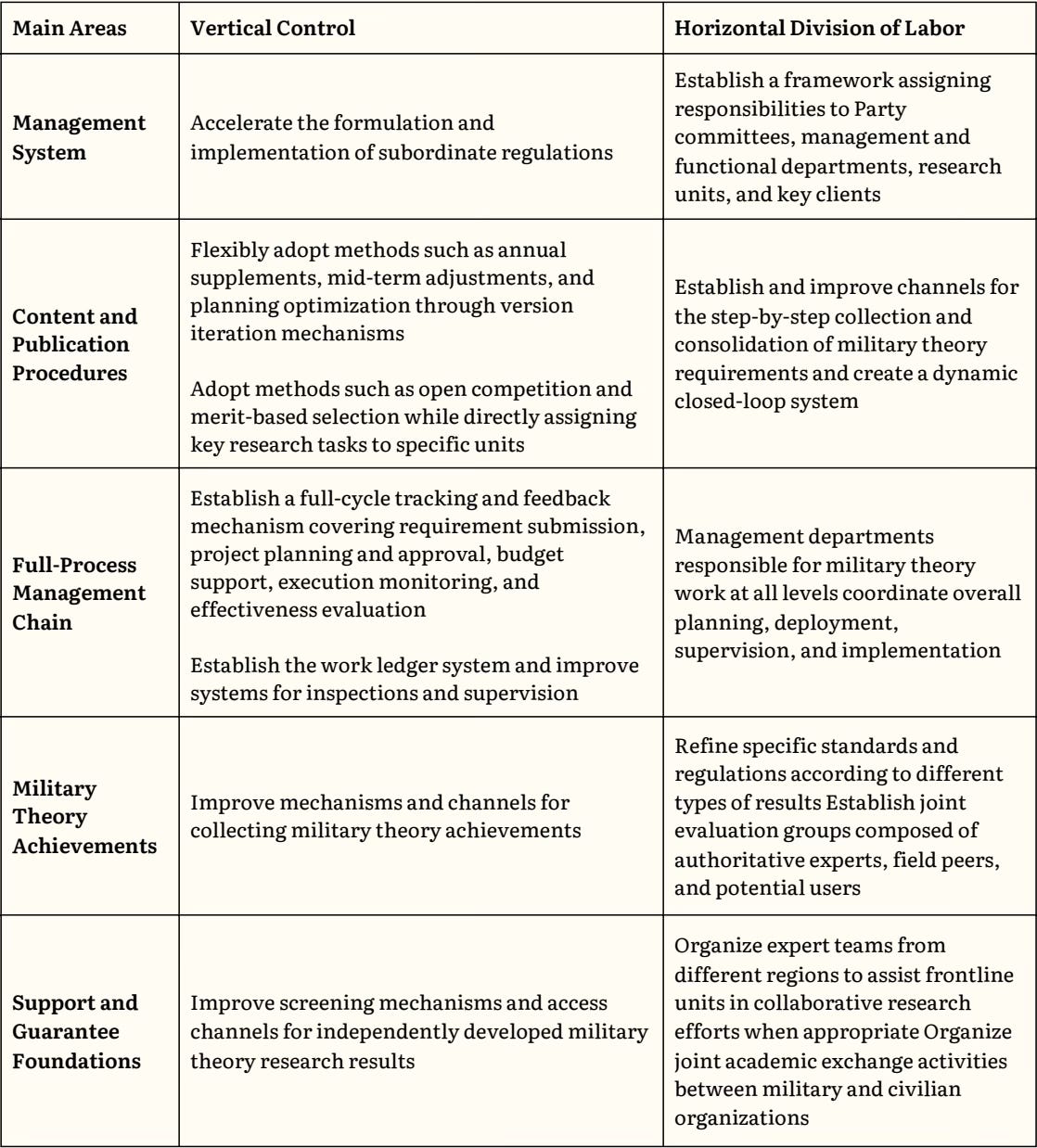
The regulations mainly divide military theory work into two major categories: vertical control and horizontal division of labor. These categories cover five major areas: the management system, content and publication procedures, the full-process management chain, military theory achievements, and support and guarantee foundations.
The regulations focus on building a joint operational theory system capable of adapting to future warfare. They also emphasize changes in technology, warfare, and adversaries to understand the mechanisms of victory in informatized and intelligentized warfare.
In the short term, the PLA likely does not plan to conduct military operations within the next one to two years. Over the longer term, however, observers should pay close attention to changes in PLA operational concepts and doctrine, including ideas such as dissipative warfare.
On January 22, Xinhua released the Regulations on Military Theory Work (军事理论工作条例) for the People’s Liberation Army (PLA), which officially took effect on March 1 (Xinhua, January 22). Military theory, according to the PLA Military Terminology (中国人民解放军军语), refers to the rational understanding and knowledge system (理性认识与知识体系) that inform thinking about issues of war and national defense. [1] In other words, military theory shapes doctrine, informs operational concepts, and sets the direction for force development. The PLA has not released the full text of the regulations, but its substance can be adduced by drawing on the initial Xinhua press release announcing the new regulations, an explanation of the regulations provided by the Ministry of National Defense spokesperson, and a series of articles in the PLA Daily Military Forum titled “Study and Implement the Regulations on Military Theory Work” (学习贯彻《军事理论工作条例》).
The regulations call for accelerating the modernization of military theory and creating a system that is better equipped to produce theoretical innovations and research models that can be applied to the conduct of military affairs (Xinhua, January 22; January 29; PLA Daily, February 10). In practice, they will lead to strengthening vertical control over military theory research across different levels of organizations and to establishing horizontal divisions of labor for military theory development across different organizations (see Table 1). Their ultimate goal is to lay the groundwork to underpin joint operational capabilities, resolve issues that have plagued military development over the past decade, and build a framework that emphasizes military theory development for future warfare.
Table 1: Key Areas of the Regulations on Military Theory Work
Building Stronger PLA Joint Operational Capabilities
The regulations are a product of a Military Theory Work Conference (全军军事理论工作会议) that took place on October 15, 2024. At the time, the PLA was likely wrapping up its experimentation with combined-arms training reform and a week later, it hosted an on-site conference on combined training (全军合成训练现场会), likely to demonstrate the results of its progress to date (Xinhua, October 22, 2024). The next phase in combined-arms training was a transition toward joint training reform and this transition required new developments in military theory to ensure that it continued to be applicable to actual joint operational conditions.
One key objective of the new regulations therefore is to improve joint operational effectiveness by establishing a system of operational theory to complement reforms to joint operational training. By mandating the study of issues such as the “winning mechanisms” (制胜机理) of informatized and intelligentized warfare, the PLA hopes to develop a theoretical framework for joint operations that is capable of adapting to future warfare—or, in the words of the regulations, closely tracking “changes in technology, warfare, and adversaries” (科技之变、战争之变、对手之变) (PLA Daily, February 10; February 26).
To achieve this, the PLA first plans to establish “channels for the step-by-step collection and consolidation of military theory requirements” (军事理论需求逐级收集汇总渠道) (PLA Daily, February 24). This entails reviewing problems across operations, force development, and readiness; assessing which areas require military theory to be updated; and then submitting these findings up the chain of command for approval. At the same time, data gathered from troop experiments and combat training will supplement these findings to help improve the precision and effectiveness of military theory development (PLA Daily, February 24; February 26).
Judging the utility and effectiveness of developments in military theory is difficult. The regulations seek to tackle this by creating new mechanisms for testing “military theory results” (军事理论成果). These include platforms and channels for inputting and sharing results of new reforms, as well as new metrics for evaluation and certification. The PLA will also better coordinate research and management lines and clarify organizational responsibilities. It will create special tasks, exercises, and training activities to handle these processes, assigning dedicated personnel for managing the new information flow that they will generate (PLA Daily, February 24).
Addressing Long-Standing Problems Over the Past Decade
The PLA has long grappled with a number of problems that the new regulations seek to resolve. Since 2016, Central Military Commission Chairman Xi Jinping has repeatedly addressed issues in the development of military theory. In 2018, for instance, he instructed the PLA to “build an advanced operational theory system that conforms to modern warfare” (符合现代战争规律的先进作战理论体系) (PLA Daily, March 7). The fact that he has continued to repeat these calls, including at the Military Theory Work Conference in 2024, indicates that he has so far been unable to resolve these chronic problems. By issuing formal written regulations now, Xi is trying to finally standardize military theory development and supervision through regulatory force.
Recent PLA Daily reporting indicates that the PLA believes its current military theory system cannot effectively address emerging challenges in operations, force development, and readiness. Barriers between services and weak integration between operational experience and research work also limit the effectiveness of theory. To mitigate these issues, the PLA aims to restructure research programs to be more connected to battlefield needs, in turn correcting problems such as “self-directed agendas, shortsightedness, and exaggeration [of results]” (自我设计、急功近利、虚夸浮夸) (PLA Daily, February 26; March 10).
Aligning with broad trends across the military system under Xi Jinping, the regulations move to strengthen top-level leadership and coordination mechanisms for work on the development of military theory. Reforms to the management system (管理体制) aim to build an organizational management system in which both vertical authority and responsibility and horizontal division of labor are clearly defined. The formulation and implementation of further subordinate but complementary regulations are expected to improve control over the development of military theory. Perhaps aware of the potential issues of excessive bureaucratic prescriptions, the PLA Daily warns that these must avoid “mutual conflicts and friction” (彼此冲突、相互掣肘) after implementation, and emphasizes that they must improve operational practicality and facilitate execution (PLA Daily, February 10). In terms of the horizontal division of labor, each organization is expected to handle the planning and deployment, process control, evaluation and certification, and promotion and application of military theory work within its respective field. The regulations assign overall responsibility to unit Party committees, coordination responsibilities to management departments (管理部门), domain responsibilities to functional departments (业务部门), project responsibilities to research units, and application responsibilities to “key clients” (关键客户) (PLA Daily, February 10; February 26).
The entire process for developing military theory involves “project initiation, proposal review, implementation, validation, and acceptance” (立项、开题、实施、验证、验收). The PLA states that managing this process requires a combination of centralized control and delegated authority, along with classified management. Subordinate projects are to be monitored through a further process of pre-project assessment, in-process supervision, and post-project evaluation, and a full-cycle tracking and feedback mechanism will cover requirement submission, project approval, budget support, execution monitoring, and effectiveness evaluation (PLA Daily, February 24; February 26). At the same time, the PLA plans to establish a “work ledger” (工作台账) system, improve systems for inspections and supervision to reinforce accountability and supervisory responsibility. [2] This will be enforced by management departments at different levels, who will supervise projects through a variety of “targeted, special, and comprehensive” (重点、专项、综合) inspections (PLA Daily, February 10; February 24).
To ensure quality work in the development of military theory, research projects will be assigned through methods such as “open competition and merit-based selection” (揭榜挂帅、竞争择优), including by assigning tasks directly to units with clear professional advantages. Assignments will come with clear specifications for who will handle each task, what each task requires, and what outcomes each task should achieve (PLA Daily, February 24). This could ensure that units assigned to specific theory development tasks hold clear responsibility for completing designated tasks and meeting specific standards, thereby ensuring accountability for results and improving the rigor of the responsible units.
Ensuring Theory Development Adapts to Future Warfare
Reforming military theory today is geared toward shaping the Chinese military to be able to more effectively fight the battles of tomorrow. The new regulations therefore place significant emphasis on aligning not just with current operational conditions but also on accounting for the conditions of future warfare.
The procedures outlined above for the content and publication of theory-related research aim to ensure that plans for developing military theory conform with the PLA’s strategic planning system in the new era. The PLA Daily points out that rapid advances in current and future technology continue to change the nature of battlefield operations. As a result, a theory of operations that is suited to current operational conditions may quickly fall behind when the next key technological breakthrough emerges. The PLA therefore plans to adopt flexible methods for developing military theory, with mechanisms for supplementing theoretical interventions on an annual basis, making mid-term adjustments, optimizing planning processes, and iterating frequently to ensure that military theory can adapt to changes in warfare and remain consistent with the actual needs of the military (PLA Daily, February 24; March 24). The focus on “foresight” (远见) in the regulations extends to the development of systems for evaluating and certifying disruptive and original theories that could lead to paradigm shifts in the way the PLA understands military affairs. Achieving these longer-term aims requires a separate set of research programs that can protect early-stage “prototype” achievements that may not receive broad recognition at first but have the potential to produce transformational changes further down the line (PLA Daily, February 26).
At the heart of discussions around the need for adaptability in response to changes in the nature of warfare is the current rapid speed of technological change, as well as the importance of the diffusion of modern technology across different fields of military endeavor. Much as the military–civil fusion system has sought to integrate cutting-edge hardware from the civilian domain into military systems, the Party is now calling for those outside the PLA to contribute more diverse inputs to the development of military theory. The PLA seeks to focus cross-domain efforts in particular on key bottleneck problems, integrating exploratory research on advanced foundational theories from multiple disciplines. To develop a system for supporting this line of effort, it plans to improve screening mechanisms and access channels for independently developed military theory research, support innovation, and promote open exchange (PLA Daily, February 24; February 26). The regulations also encourage this cross-pollination of ideas by mandating that units involved in military theory development organize expert teams from different regions at appropriate times to assist frontline units in collaborative research efforts. In addition, units at all levels are tasked with regularly organizing joint academic exchanges between military and civilian organizations to engage intellectually and debate viewpoints with experts from different domains (PLA Daily, February 10).
Conclusion
The Regulations on Military Theory Work signal that Xi Jinping intends to change what he perceives as deficiencies in the PLA’s operational capabilities through institutionalizing enforceable rules. Their release, therefore, implies that both Xi Jinping and the PLA recognize deficiencies in the military’s current capabilities. These problems are especially acute as the nature of warfare continues to undergo rapid changes, requiring a comprehensive overhaul of the system underpinning how the PLA thinks about and understands contemporary warfare.
The fact that the process to revamp the PLA’s approach to developing military theory is in its early stages, combined with a similar state of play in its reforms to the military training system, suggests that the PLA likely does not have clear plans to conduct military operations, including an invasion of Taiwan, in at least the next 1–2 years. Even after the PLA completes the development of new military theory and translates it into operational concepts and doctrine, force structure and equipment employment methods may still require adjustment. As a result, the PLA would likely require at least an additional several months to one year of training and operational familiarization.
In the coming years, observers should pay attention to changes in the PLA’s operational concepts and doctrine, not least because this issue forms one of the key focus areas of the defense component of the 15th Five-Year Plan (China Brief, April 10). For example, “dissipative warfare” (耗散战), which emphasizes levels of energy disorder rather than rates of material consumption, deserves significant attention. The PLA Daily discussed this concept in both 2023 and 2025, and again on March 31, 2026, connecting it to changes in the PLA’s logic of victory under the conditions of intelligentized warfare (China Brief Notes, September 19, 2025; PLA Daily, March 31).
This article originally appeared in China Brief. Check it out here!
K. Tristan Tang is a co-founder of the Taiwan Defense Studies Initiative (TDSI) and serves as Project Lead for Wargaming, as well as the designer of KTT’s Wargame. He is also a Nonresident Fellow at the National Bureau of Asian Research and a Nonresident Vasey Fellow and Young Leader at the Pacific Forum. In addition, he serves as an Associate Fellow at the Secure Taiwan Associate Corporation and an Associate Fellow at the Center for China Studies at National Taiwan University. His research focuses on China’s defense industry, the People’s Liberation Army, and Chinese foreign policy. You can connect with him on X: @KTristanTang.
Notes
[1] Academy of Military Science [军事科学院], ed. Chinese People’s Liberation Army Military Terminology [中国人民解放军军语]. (Beijing: Junshi kexue chubanshe, 2011), p.1.
[2] The work ledger refers to a measure used to clarify work responsibilities. It clearly records information such as work plans, deadlines, and responsible personnel. This system facilitates quantitative and task-specific evaluations of work, thereby strengthening supervision and promoting implementation (CPC News, January 18, 2018).