

PLA Reorganizes Space Information Support and Assurance Mission
Kristin Burke
Executive Summary:
The People’s Liberation Army’s (PLA) restructuring of its space information support and assurance forces further deepens its reliance on space for communications, navigation, and reconnaissance.
The PLA is transitioning most—but not yet all—of the battlefield space information support and assurance mission to the Information Support Force (ISF) and the growing Chinese commercial space sector, freeing up the Aerospace Force (ASF) to build specialized capabilities and plans for offensive and defensive ground and space-based operations.
The Chinese Communist Party’s (CCP) approval for a new civilian university to support communications, navigation, and reconnaissance ground-to-space integration not only helps smooth the handoff between the ASF and the ISF, but also demonstrates progress towards the PRC’s national plan for “air-space-ground integration.”
The People’s Liberation Army (PLA) is currently transitioning between “informatization” (信息化) and “intelligentization” (智能化) as part of its modernization agenda. As an important intermediate step—and following the 2024 reorganization of the Strategic Support Force into three separate arms (兵种) directly subordinate to the Central Military Commission (CMC)—it is transitioning the military space information support and assurance mission area from the Aerospace Force (ASF) to the Information Support Force (ISF). This will reduce organizational and technological “bottlenecks” (卡脖子) that impede timely fusion of multi-sensor information for joint warfighting. The transition is not yet complete, and it is unclear whether the PLA intends a full transition.
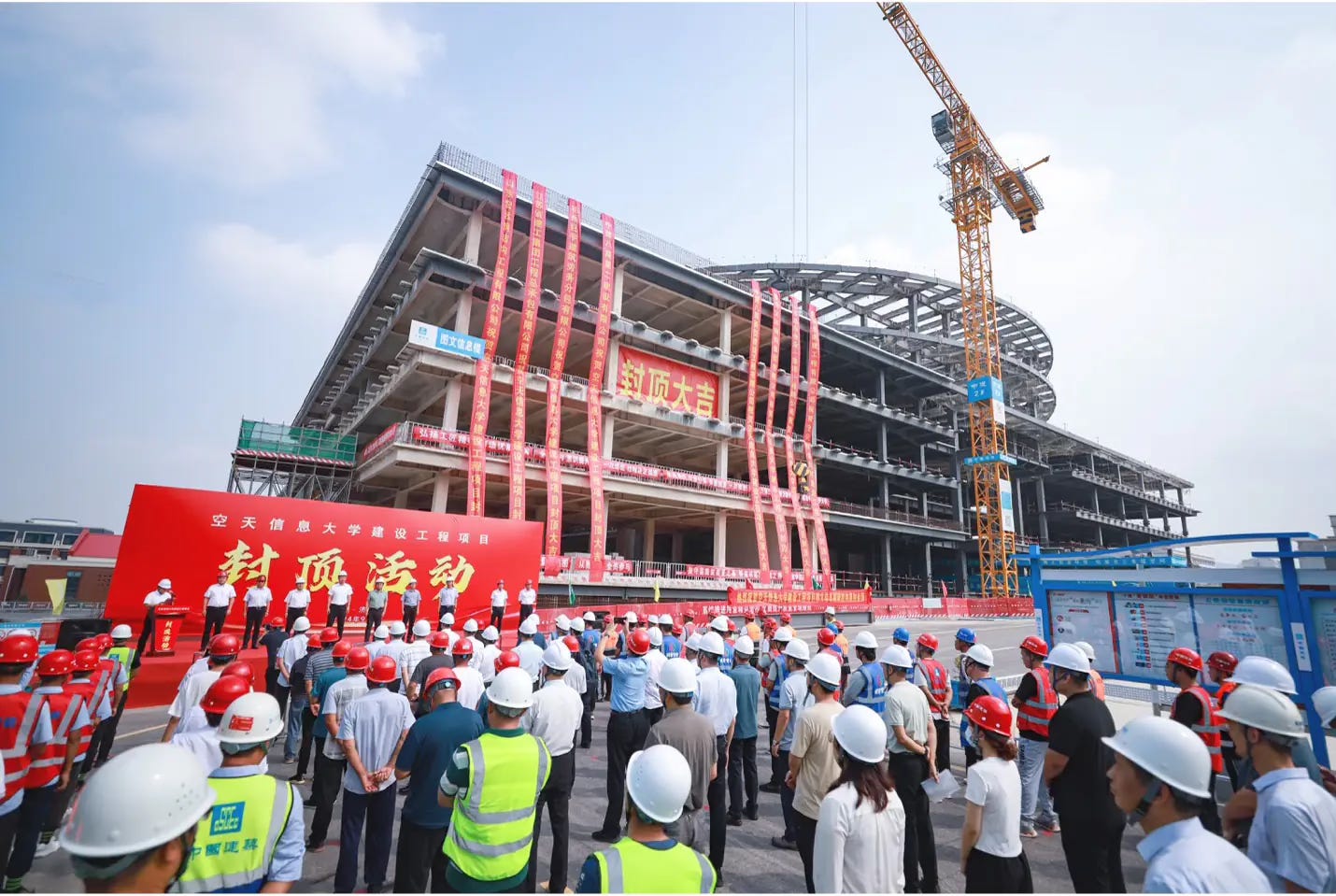
A new civilian university in Jinan, the Aerospace Information University (空天信息大学), is part of this overhaul. The institution aims to train ISF talent and the growing commercial space sector with the requisite capabilities to achieve PLA and broader Chinese Communist Party (CCP) goals in the 15th Five-Year Plan period (2026–2030). This will support deepening the “integration of communication, navigation, and remote sensing” (通导遥一体化) (Chinese Academy of Sciences [CAS], August 18, 2025; Xinhua; Jinan Daily, January 9).
PLA Reorganizes Space Operations
In recent years, the PLA has gradually adjusted the mission areas it includes under space operations. [1] According to a key 2024 text, Introduction to Space Operations (太空作战概论), space information support and assurance operations (太空信息支援保障作战) is now one of five such mission areas. [2] This newer mission is a combination of space information support, one of the oldest mission areas, and assurance, which previous PLA texts had described as needed but lacking. [3]
The CMC, the military’s top decision-making organization, is currently transitioning units responsible for the space information support and assurance mission to the ISF, which oversees PLA network information systems and provides force-wide communications support, including secure strategic and tactical communications. This move is a logical one, as one of the CMC’s goals for the ISF is to address the PRC’s patchwork of information security and assurance efforts. The CMC also expects the ISF to lead integration and fusion of survey, mapping, remote sensing, meteorological, and positioning ground and space-based sensor data to provide battlefield intelligence support to PLA theater commands and services (U.S. Department of Defense, December 23, 2025). It is not transitioning all space information support units to the ISF, however, due to the PLA’s division of units to support mission areas. For example, telemetry, tracking, and control (TT&C) for satellite and launch operations that underpin separate PLA mission areas will remain under the ASF.
The PLA has traditionally organized units under the space information support and assurance mission area into five or six functional groups. This has been done to create a division of labor for managing its space-based and ground-based infrastructure. [4] As of February 2026, most but not all of the space information support and assurance functional groups listed below have transitioned to the ISF. The groups are as follows:
Space information acquisition units: These collect battlefield information from reconnaissance, ocean surveillance, early warning and detection, meteorological, and mapping satellites.
Positioning and navigation units: These support reliable transmission of Beidou satellite information to ground, air, sea, and other military users’ equipment.
Space information transmission units: These support the construction of space-to-ground communications links, integration, and fusion with space and ground reconnaissance intelligence, command and control systems, and various combat platforms, to include strategic and tactical satellite communication networks.
Space information resource management units: These ensure ground-based systems for receiving, processing, distributing, and providing access to information. They include service centers for managing marine environment remote sensing, meteorological data, and mapping, all of which catalog satellite information to provide users with standardized information for search and application.
Ground application units: These include two groups, an application support group and an end-user support group. The former manages the ground infrastructure that supports military applications of satellites; the latter converts the information into end-user applications, directly interfacing with commanders or weapon platforms.
Space information security and protection units: These units will eventually be composed of assigned, attached, or reinforced information security and assurance units, according to a 2014 PLA textbook. If needed, space information assurance will also be coordinated with other services and arms’ space information defense capabilities.
The CMC requires these functional groups to create workflows to support four space information support requirements for joint warfighting, according to the 2020edition of the PLA’s Science of Military Strategy (战略学). These requirements are as follows: [5]
All-weather, near real-time space reconnaissance and surveillance, space surveying and mapping, and meteorological support capabilities to acquire and fuse information about enemy targets and combat environment, discover signs of war, monitor combat progress, evaluate combat effectiveness, and provide relevant information for force building, deployment, and use.
Secure satellite communication (SATCOM) capabilities to ensure the reliable, real-time, and confidential transmission of various intelligence information.
Satellite navigation, positioning, and timing capabilities globally for agencies, troops, weapon systems, and other spacecraft.
“Certain information integration and combat management capabilities.”
Incremental Transition of Space Information Support and Assurance to the ISF
The PLA likely continues to organize its space information support and assurance mission area in this way, using the above six groups to support the four joint warfighting space information requirements (see Figure 1). The CMC has probably transitioned all spectrum and communications management to the ISF, including ground-to-ground connections and ground-to-space SATCOM links. But the ISF’s control of space information support for other joint warfighting requirements is incomplete. Going forward, it may remain shared with the ASF and the growing civilian sector.
Figure 1: ASF and ISF Space Information Support and Assurance Missions Under Transition (2026)
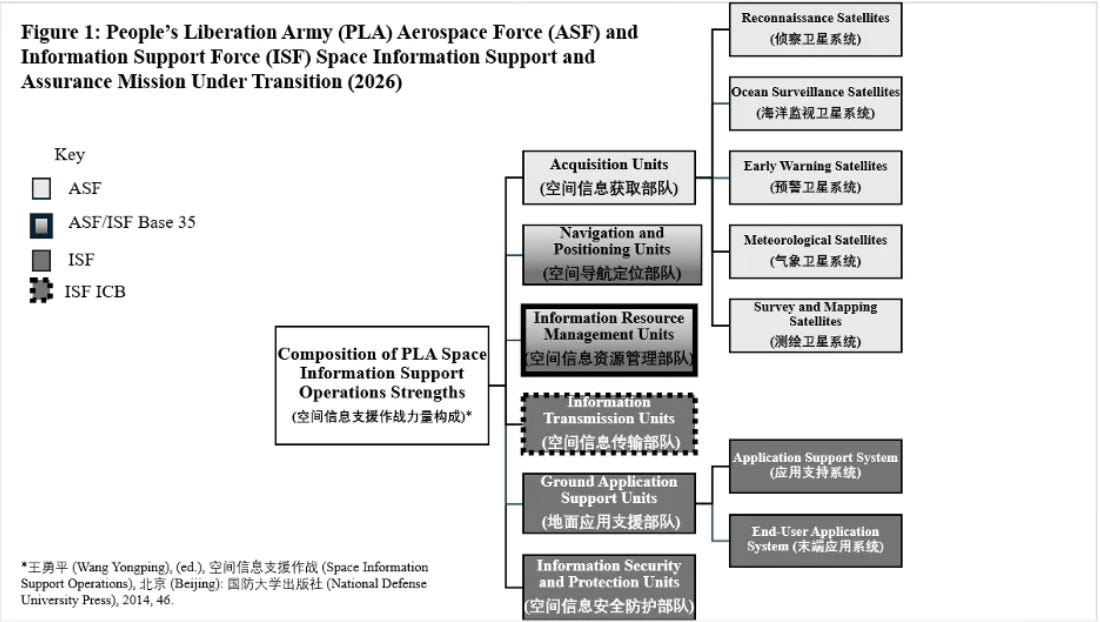
The ISF is involved to varying degrees in all four of the PLA’s joint warfighting requirements. Its role in supporting the first likely centers on managing the former Strategic Support Force’s Base 35 (战略支援部队第三十五基地) and subordinate battlefield environment support brigades (战场环境保障大队) (China Brief, July 11, 2025; author research, 2026). Current Western understanding of the ISF and PLA military unit cover designators (MUCD) implies that the CMC would reorganize Base 35 under the ISF. But there are multiple indications that the transition is incomplete or that Base 35 will remain a joint ASF and ISF base in the near term. First, the ISF’s new military unit cover designators (MUCDs) start at 32001; and the MUCD for Base 35 is 32020, which starts to abut what current Western researchers believe to be ASF MUCDs (CASI, December 11, 2023; China Brief, July 11, 2025). [6] As of February 2026, the author could not find clear designation of new Base 35 MUCDs as ISF units, which is inconsistent with the availability of information on the ISF more generally (author research, 2026). Second, while it is clear that the PLA’s meteorological, survey, and mapping brigades fall under Base 35, the ASF and the ISF both continue to recruit applied meteorological technology experts (DXSBB, May 2025). Given that the ASF does not build meteorological satellites, they are likely recruiting meteorologists for launch centers.
The ISF’s primary role in ensuring the second joint warfighting requirement is reflected in its management of the Information Communications Base (ICB) and subordinate communications and spectrum brigades (Xinhua, June 30, 2011; China Brief, April 26, 2024; PLA Daily, May 19, 2024; Xinhua July 25, 2025). This was evident during the September 2025 military parade, which featured mobile SATCOM trucks within the ISF column. These trucks equip troops and theater commands with secure SATCOM links (CASI, September 15, 2025). The ICB primarily manages terrestrial communication infrastructure but also some ground-to-space links. It is too early to determine the fate of space-to-space links.
The ISF’s role in ensuring the third requirement centers on positioning, navigation, and timing (PNT) applications. Remote sensing, mapping, and meteorology satellites all require PNT data from Beidou satellites to provide battlefield environment intelligence to commanders. But it is unclear if Base 35 currently manages the entire Beidou ground segment outside of receiving stations. This would include TT&C satellite control still under the ASF and time correction stations, which the PRC refers to as “injection stations” (China Argo Real-Time Data Center, October 8, 2018). These injection stations correlate all Beidou downlink data and then process and correct for normal timing errors before sending updates directly to satellites. Facilitating the Beidou inter-satellite data links and short message service that contribute to PLA missile reconnaissance and targeting will likely remain a joint effort.
For the fourth requirement, the ISF’s role is probably a catch-all for the remaining and still evolving ways that spectrum management and space information support and assurance interface for joint warfighting. Potential indicators for this could include fusion between Beidou missile guidance and missile early warning satellite links, wider use of space-based space situational awareness in theater command planning, and adaptation to accelerating trends in remote sensing and communications satellites in Very Low Earth Orbit (VLEO). [7]
New Aerospace Information University
The restructuring of the PLA and national space information support and assurance mission area is ongoing. One piece of evidence for this is the approval in 2020 of a new civilian university in Jinan City, Shandong Province: Aerospace Information University. The project is a joint venture by Shandong Province and the Aerospace Information Research Institute of the Chinese Academy of Science (CAS). Since its approval, the university’s construction was highlighted as a part of the province’s 14th Five-Year Plan (2021–2025) and it has recruited its leadership team (Shandong Higher Education Circle, July 6, 2023; Baidu, July 23, 2025). But it is yet to properly begin operations.
Aerospace Information University will contribute to the PRC’s national education ecosystem with a focus on “aerospace information networks, aerospace information materials and devices, earth observation, satellite navigation, and the Internet of Things” (空天信息网络、空天信息材料与器件、对地观测、卫星导航与物联网等领域) (Shandong Provincial Government, March 1, 2024). It is actively engaging with the PLA’s Base 35, and other Wuhan City and Hubei Province-based universities, to support the base’s geospatial and spatiotemporal workforce needs, both directly and through its collaboration with other Shandong-based universities (Shandong University, May 19, 2020; author research, 2026).
Approval for the university does more than support PLA readiness and promote the economic efficiencies of dual-use technologies. It signals the progress that the PRC has made on what it calls “air–space–ground integration” (空天地一体化) over the last decade (Posts & Telecom Press, November 11, 2025). The 13th Five-Year Plan (2016–2020) envisioned connecting the space, low-altitude, and ground economies with 5G, Beidou, and quantum security capability.
The new university is well positioned for its work on remote sensing technologies to contribute to this goal. Its leadership team includes Wu Yirong (吴一戎), the president of the CAS institute involved in the project. Wu recently led the development of the country’s first VLEO synthetic aperture radar (SAR) satellite, Haishao-1 (海哨一号) (CAS, June 4, 2025). The world’s first quantum microsatellite, Jinan-1 (济南一号), is also named for the city of Jinan. If successful, it could lead to enhanced security for the PLA’s tactical and strategic communications, as well as national border and public security (Shandong TV News, August 1, 2022). The university is also one of a handful of projects supporting Shandong Province’s Aerospace Industry Development Plan (山东省航空航天产业发展规划) for 2035. This plan focuses on creating applications for the integration of communications, navigation, and remote sensing data (通导遥一体化) (Shandong Provincial Government, March 1, 2024).
Conclusion
The organization of the PLA’s information support and assurance units is an important signpost of PLA joint warfighting readiness and of the extent to which the ASF can deepen its expertise in other areas. Transitioning large portions of this mission to both the ISF and the growing commercial space sector frees bandwidth for the ASF to develop techniques, tactics, procedures, and operational plans for terrestrial and space-based operations. These are plans the ASF is obliged to make, given that the world has not yet experienced a war with tactical space-based confrontations and there are no historical lessons from which the PLA can draw.
The CCP’s goals for the national space program extend well beyond the PLA’s needs. Deepening civilian use and reliance on space systems beyond traditional PNT integration is aligned with CCP national innovation and economic development goals. These intertwining goals create research opportunities to understand the state of PLA readiness and Beijing’s risk tolerance for instability in space.
Opinions, conclusions, and recommendations expressed or implied within are solely those of the author and do not necessarily represent the views of the Air University, the Department of the Air Force, the Department of Defense, or any other U.S. government agency. Cleared for public release: distribution unlimited.
This article originally appeared in China Brief. Check it out here!
Kristin Burke is the Senior Space and Counterspace Researcher at the China Aerospace Studies Institute (CASI), under the U.S. Air Force’s Air University. Prior to joining CASI she was a Deputy National Intelligence Officer for Space at the Office for the Director of National Intelligence and a China Science and Technology Analyst at the U.S. Department of State. She is proficient in Mandarin and studying aerospace engineering.
Notes
[1] Joel Wuthnow et al., eds., The PLA Beyond Borders: Chinese Military Operations in Regional and Global Context(Washington, DC: National Defense University Press, 2021), https://ndupress.ndu.edu/Publications/Books/PLA-Beyond-Borders/.
[2] Jiang Lianju [姜连举], Taikong Zuozhan Gailun [太空作战概论] (Introduction to Space Operations) (Shanghai: Shanghai Shehui Kexueyuan Chubanshe, 2024), 136–144. Jiang is also the editor of Kongjian Zuozhan Xue Jiaocheng [空间作战学教程] (Lectures on the Science of Space Operations) (2013).
[3] Wang Yongping [王勇平], ed., Kongjian Xinxi Zhiyuan Zuozhan [空间信息支援作战] (Space Information Support Operations) (Beijing: Guofang Daxue Chubanshe, 2014), 57–58.
[4] Ibid.
[5] Xiao Tianliang, ed., The Science of Military Strategy, rev. ed. (Washington, DC: National Defense University Press, 2020), 397 (PDF 410), https://www.airuniversity.af.edu/CASI/Display/Article/2913216/in-their-own-words-2020-science-of-military-strategy.
[6] Kristin Burke, PLA Counterspace Command and Control (Maxwell Air Force Base, AL: USAF Air University, China Aerospace Studies Institute [CASI], 2023), https://www.airuniversity.af.edu/CASI/Display/Article/3612979/pla-counterspace-command-and-control/
[7] VLEO refers to altitudes below 400 kilometers.