

PACE Establishes Platform for Russian Opposition Delegation
Vadim Shtepa
Executive Summary:
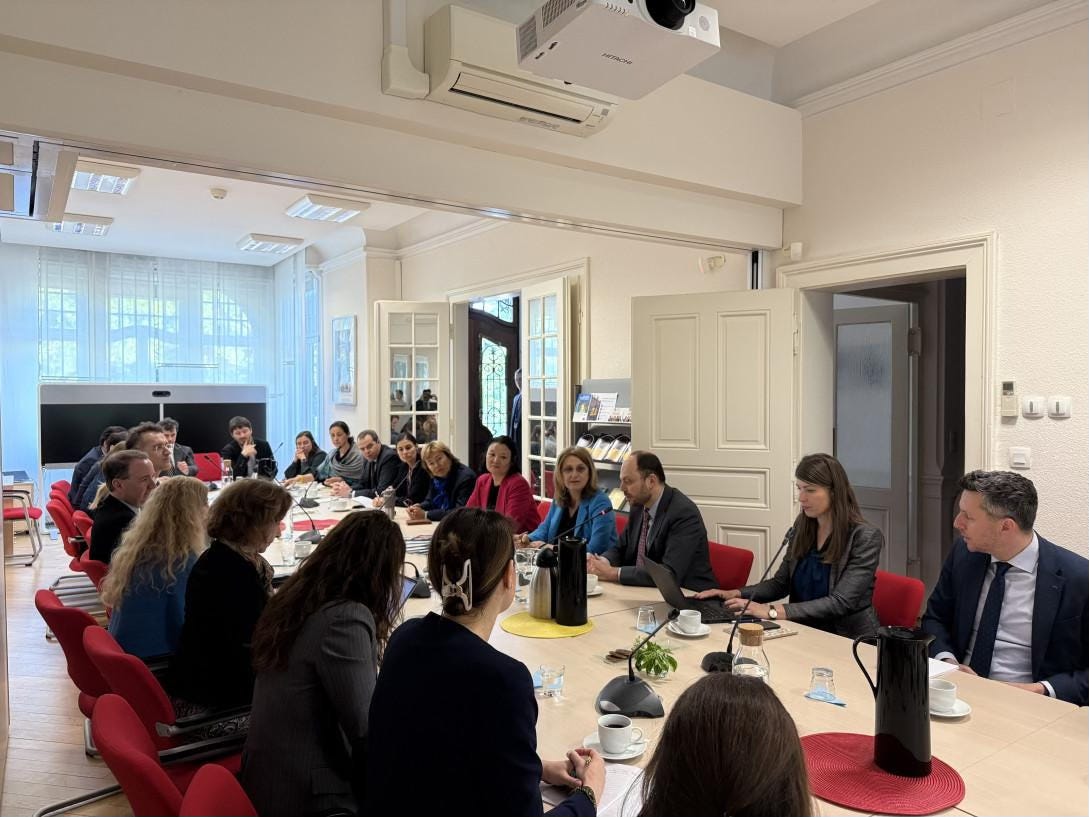
Participants of the Platform for Dialogue with Russian Democratic Forces in Exile—established in the Parliamentary Assembly of the Council of Europe (PACE) on January 26 as the first Russian delegation officially recognized since Russia’s full-scale invasion of Ukraine—attended PACE’s spring session in Strasbourg on April 20–24.
Prominent Russian opposition leaders remain divided over the Strasbourg Declaration, which calls for transforming Russia into several democratic states and maintains that the national republics and peoples currently within the Russian Federation have the right to self-determination apart from Moscow.
Ethnic divides have hindered the effectiveness of some national movements. The end of the current Russian regime and potential decolonization of Russia will likely only be possible through joint interregional projects of various republics, oblasts, and krais, based on mutual support.
The Parliamentary Assembly of the Council of Europe (PACE) established the Platform for Dialogue with Russian Democratic Forces in Exile on January 26 (BBC Russian Service, January 26). This marked PACE’s first official recognition of a Russian delegation since Russia’s full-scale invasion of Ukraine in 2022 and the subsequent expulsion of Russia from the organization. The establishment of the new platform follows PACE’s 2024 declaration, which stated, “Decolonization of the Russian Federation is a necessary condition for the establishment of democracy” (PACE, April 17, 2024). The composition of this platform was determined by the PACE administration itself. It includes ten known federal oppositionists (all Muscovites) and five representatives of ethnic minorities and indigenous peoples of Russia. Participants in the Russian Platform will not be able to vote on PACE resolutions—as representatives of various national parliaments do. Their role is limited to advisory and human rights functions. Participants of the platform participated in PACE’s spring session in Strasbourg on April 20–24 (X/@vkaramurza, April 20).
Russian oppositionists were required to sign the Berlin Declaration—recognizing Russia’s war against Ukraine as criminal and Russian President Vladimir Putin’s regime as illegitimate—to participate in this platform (Antiwar Committee of Russia, April 30, 2023). The Berlin Declaration also demanded that Russia’s internationally recognized borders be restored. This implies the withdrawal of Russian troops from the annexed territories of neighboring countries such as Ukraine, Georgia, and Moldova. For many regionalists, however, this formulation was ambiguous as it maintained Russia’s Moscow-centric unity.
After the platform began functioning, the much more radical Strasbourg Declaration of Citizens of a New Russia was published (Free Russia Forum, April 20). The Strasbourg Declaration allowed for Russia’s transformation into several democratic states, maintaining that the national republics and peoples currently within the Russian Federation have the right to self-determination. Not all members of the Platform of Russian Democratic Forces in PACE, however, signed the Strasbourg Declaration.
Prominent opposition figures Garry Kasparov and Mikhail Khodorkovsky disagree over the Strasbourg Declaration. Kasparov—who has long aimed to dismantle the Russian Empire—has signed it (Oboz.ua, May 17, 2024). Khodorkovsky, on the contrary, opposes the Strasbourg Declaration, believing that Russia’s unity must be preserved and, if he were to come to power, has threatened to deploy troops to “separatist” regions (Idel.Realii, August 18, 2023). The Free Russia Foundation’s leaders, Natalia Arno and Vladimir Kara-Murza, who are members of the platform, also did not sign the Strasbourg Declaration. They are not in favor of de-imperialization, but rather of a future Russia that functions as a true federation.
Many representatives of ethnic minorities and indigenous peoples who joined this platform hold the opposite view. For example, Lana Pylayeva, a civil society activist and journalist from the Komi Republic now living in the Netherlands, speaks of the need to “dismantle Moscow-centrism.” Pylayeva argues that Russia’s Moscow-centric system suppresses political freedoms and cultural identities in the regions and engages in a colonial-style plundering of their resources. Pylayeva also criticizes Western politicians, who are accustomed to viewing the situation in Russia “through a Moscow prism” and underestimate the interests of various peoples and regions (Idel.Realii, February 16).
Yekaterina Kuznetsova—another platform participant—represents the Vod people, a minority group living in northwestern Russia. She currently heads the “House of Ingria” cultural center in Narva, Estonia. In April, she proposed at PACE that Russia’s Leningrad oblast be renamed Ingria on European maps, thereby returning the region to its historical name and abandoning the designation established during Soviet times. Kuznetsova believes this toponymic change could significantly impact the processes of de-imperialization and decolonization in Russia. The Russian government often seeks to avoid referring to Ingria. For example, in 2025, the Evangelical Lutheran Church of Ingria, which has existed since 1611, was renamed the Russian Lutheran Church by government order (Region.expert, April 24).
Not all statements by representatives of Russian national minorities at the PACE platform appear to be a struggle for the liberation of all peoples. Sometimes they continue the same logic of suppressing civil liberties, only framing it in their own ethnic and religious terms. For example, on April 29, Ruslan Kutayev, a Chechen member of the platform and president of the public organization “Assembly of the Caucasus Peoples,” was suspended from the platform due to comments against LGBT individuals and a refusal to condemn so-called “honor killings” in the North Caucasus (X/@PACE_President, April 29; The Moscow Times, April 30). He previously stated that he does not intend to combat violence against women and members of the LGBT community because he respects “traditional values.” This position drew sharp criticism from Kasparov’s Free Russia Forum, and some human rights organizations demanded that Kutayev be excluded from the PACE Platform (Free Russia Forum, April 27; Radio Svoboda, April 28). Kutayev also claims that Muslims are capable of seizing power in Moscow, where, by his estimates, they already number 4 million. Such attempts, however, would likely lead to ethnic and religious clashes rather than dismantle imperial practices.
Russia’s current state cannot be called “ethnically Russian,” as representatives of numerous ethnic groups actively participate in it. For example, Secretary of the Russian Security Council Sergei Shoigu, a Tuvan, served as Russia’s minister of defense during the annexation of Crimea in 2014 and the launch of the full-scale invasion of Ukraine in 2022. Russian Deputy Prime Minister Marat Khusnullin, a Tatar, is a “curator” of Ukraine’s occupied territories. The heads of Bashkortostan, Radiy Khabirov; Buryatia, Alexei Tsydenov; and Yakutia, Aisen Nikolaev, are sending their fellow countrymen en masse to fight in Ukraine. Their militaristic rhetoric, furthermore, is sometimes even louder than that of the governors of ethnically Russian regions (Bash.news, January 30; Radio Svoboda, July 4, 2023; Yk24.ru, April 24).
Some national movements in Russia are more focused on the need for cultural diversity than Russian regionalists. When these movements focus solely on ethnic grievances, they can end up ignoring political reality. The perspective that Russians are to blame for everything can deprive these movements of potential allies in the Russian regions, many of whose residents are also dissatisfied with Moscow’s hyper-centralism. The decolonization of Russia would likely only be possible as a joint interregional project of various republics, oblasts, and krais, based on mutual support. Putin’s Russia would likely simply crush all national and regional movements individually in the absence of such civic coordination (Radio Svoboda, May 2, 2024).
This article was originally published in Eurasia Daily Monitor.