

Executive Summary:
A June exercise conducted by Southern Theater Command minesweepers and drones shows how the People’s Liberation Army Navy (PLAN) would use both unmanned and manned vessels in Mine Countermeasures (MCM) operations.
The PLAN views the use of drones such as Unmanned Surface Vehicles (USVs) and Unmanned Underwater Vehicles (UUVs) as a force multiplier that would enhance their three-dimensional MCM system.
The integration of drones into MCM operations is part of the PLAN’s efforts to implement intelligent warfare, but the branch would encounter issues in doing so.
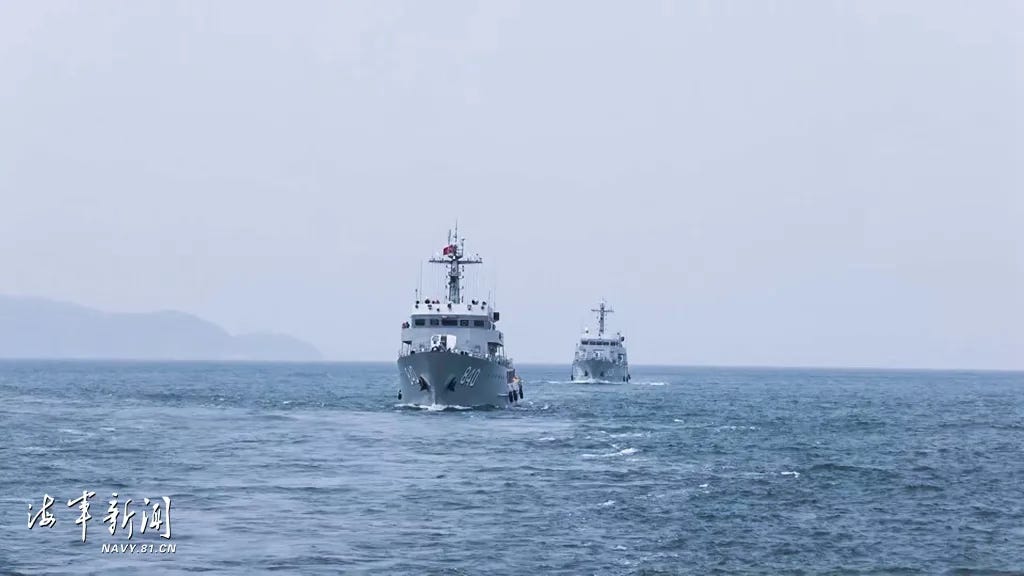
The People’s Liberation Army (PLA) Southern Theater Command’s 10th Minesweeping Squadron conducted an exercise along the coast near Jiangmen, Guangdong, in late June. The exercise involved at least one Type 081A minesweeper, the Taishan, and one Type 082II, the Kaiping, conducting various minesweeping drills under complex electromagnetic conditions both during the day and night. These drills included detecting simulated mines using visual methods and H/TJM-01 Unmanned Underwater Vehicles (UUVs), launching depth charges, and firing the 30mm autocannons at targets. At least one Type 529 minesweeping Unmanned Surface Vehicle (USV) that was controlled by the Type 082II, as well as two Type 073 Amphibious Transport Docks, provided support to the other ships (CCTV13, June 20). At least two USVs equipped with new mine-neutralization charges were also used, which were first unveiled during the military parade to mark the 80th anniversary of the end of World War II in September 2025 (China Brief, August 28, 2025).
The exercise shows that the PLA Navy (PLAN) is advancing its integration of various drones to conduct Mine Countermeasures (MCM) missions as part of wider efforts to incorporate intelligent warfare into its operations.
Drones a Force Multiplier for Minesweeping
The PLAN views the use of drones for mine clearance operations as a force multiplier that would enable the service to more effectively conduct these missions. This force multiplier concept is based on the view that unmanned systems are a new type of combat force and would be key in future MCM operations (Xu, Liu, Xiao, et al, 2022). [1] For example, the PLAN introduced both the H/TJM-01 UUV and Type 529 USV in the early 2000s and 2010s to enhance their mine-clearing capabilities by providing them with additional detection and clearance options. The drones also provide the PLAN with the ability to increase the capabilities of their three-dimensional MCM system that consists of aerial, surface, and underwater platforms that would conduct integrated minesweeping and hunting missions in the various naval operations they conduct during future conflicts (Wang, 2022). [2]
These unmanned systems would be crucial because they would act as connectors between the three levels that make up the MCM system. The use of these systems, however, also reflects the PLAN’s view that new technologies could be leveraged to increase capabilities in areas in which the branch is deficient. The PLAN understands that mine-clearance operations are inherently dangerous and seeks to incorporate technologies, such as new materials, detection methods, and intelligent control systems, to reduce these risks (Cheng and Xu, 2019). [3]
Drone-Integrated MCM Operations in Intelligent Warfare Face Obstacles
The continued emphasis on unmanned systems in MCM operations is part of PLAN efforts to enhance its intelligent warfare capabilities. The PLAN is integrating intelligent warfare into its operations by using Manned-Unmanned Teams (MUM-T) that would consist of various drones and operators (PLA Daily, June 21). This combination would greatly enhance the PLAN’s capabilities in the various operations it conducts, including MCM. For example, the minesweeping squadrons are incorporating new USVs and UUVs that would use the PLA concept of “human strategic guidance + machine tactical execution” (人类战略指导+机器战术执行) (PLA Daily, March 31). The drones would likely be used to both conduct minesweeping operations and be a connector that provides information sharing and other types of assistance to the three levels. Additionally, the USVs and UUVs would have the ability to conduct autonomous operations if certain aspects of the mission, such as the risk of using manned minesweeping assets, are high (PLA Daily, May 9).
The PLAN would likely encounter obstacles when trying to incorporate the new drones into their MCM operations. These include the challenges of integrating and operating the drones for intelligent warfare and, most substantially, the increased emphasis that the Chinese Communist Party places on controlling all aspects of military operations. The Northern Theater Command’s 11th Minesweeping Squadron encountered issues in learning how to operate new drones and a command system during an exercise. The members emphasized that the party organization’s cohesion and combat effectiveness should be stronger compared to the necessity of learning to operate the drones and associated systems as well as coordinate operations (PLA Daily, March 31). This emphasis on party control also bled into the unit’s training plan, which included lessons to ensure that decisions about drones were made under party guidance. Another obstacle is the lack of understanding surrounding intelligent warfare and its operational requirements in a future conflict (PLA Daily, May 9, 2023). The lack of understanding could lead to units emphasizing tactics instead of technology, which would hinder their ability to employ intelligent warfare.
Conclusion
The continued integration of drones in the PLAN’s three-dimensional MCM systems illustrates how the service is developing its intelligent warfare capabilities. The PLAN views the integration of drones into its mine-clearance operations at all levels as important since it would enable them to leverage key aspects of the intelligent warfare concept, such as using artificial intelligence and big data. Furthermore, the PLAN views the drones as a necessary force multiplier that could be used to enhance their MCM operations while reducing the number of risks posed to its personnel.
The PLAN believes that current and future drones will be leveraged in these areas to successfully conduct MCM operations. Its ability to incorporate the drones into its method of conducting intelligent warfare, however, would likely be hindered by several obstacles, such as the emphasis on party control and the ability to understand the fields that make up the concept.
This article originally appeared in China Brief Notes. Check it out here!
Joaquin Camarena is a former United States Marine Corps intelligence analyst who runs Sino Talk, an entity devoted to monitoring the PLA’s developing capabilities. His main focuses are PLAN and PLANMC expeditionary capabilities and PLA modernization efforts.
Notes
[1] Xu Tongle [徐同乐], Liu Fang [刘方], Xiao Yujie [肖玉杰], Wang Shen [王慎], Bai Yihui [白一惠], and Luo Rong [罗荣], “Foreign Unmanned Equipment and Technology Development in Mine Countermeasures [国外无人反水雷装备及技术发展],” Acta Armamentarii [兵工学报], no. S2 [2022]: 64–70, DOI: 10.12382/bgxb.2022.B019.
[2] Wang Song [王松], “Discussion on Application of Unmanned Underwater Vehicle in MCM [无人水下航行器在反水雷中的应用探讨],” Digital Ocean & Underwater Warfare [数字海洋与水下攻防] 5, no. 3 [2022]: 260–265, DOI: 10.19838/j.issn.2096-5753.2022.03.012.
[3] Sun Cheng [孙诚] and Xu Yang [徐阳], “Discussion on the Future Development of Mine Countermeasures Support Ships in China [我国未来发展反水雷支援舰的探讨],” Ship Electronic Engineering [舰船电子工程] 39, no. 7 [2019]: 4–6, 112, DOI: 10.3969/j.issn.1672-9730.2019.07.002.