

Middle Corridor Development Lacks Security Component
Emil Avdaliani
Executive Summary:
The Middle Corridor is expanding through new transit agreements, railway links, and the development of Georgia’s Anaklia Deep Sea Port, strengthening its role as an alternative route between Central Asia and Europe.
The corridor has gained strategic importance amid the war against Ukraine, the conflict in Iran, and the Armenia–Azerbaijan peace process, including the U.S.-led Trump Route for International Peace and Prosperity (TRIPP) initiative.
These developments have highlighted a major security gap. Azerbaijan has pushed for greater security cooperation among Turkic states through the Organization of Turkic States, arguing that a defensive component could help protect the route from external threats.
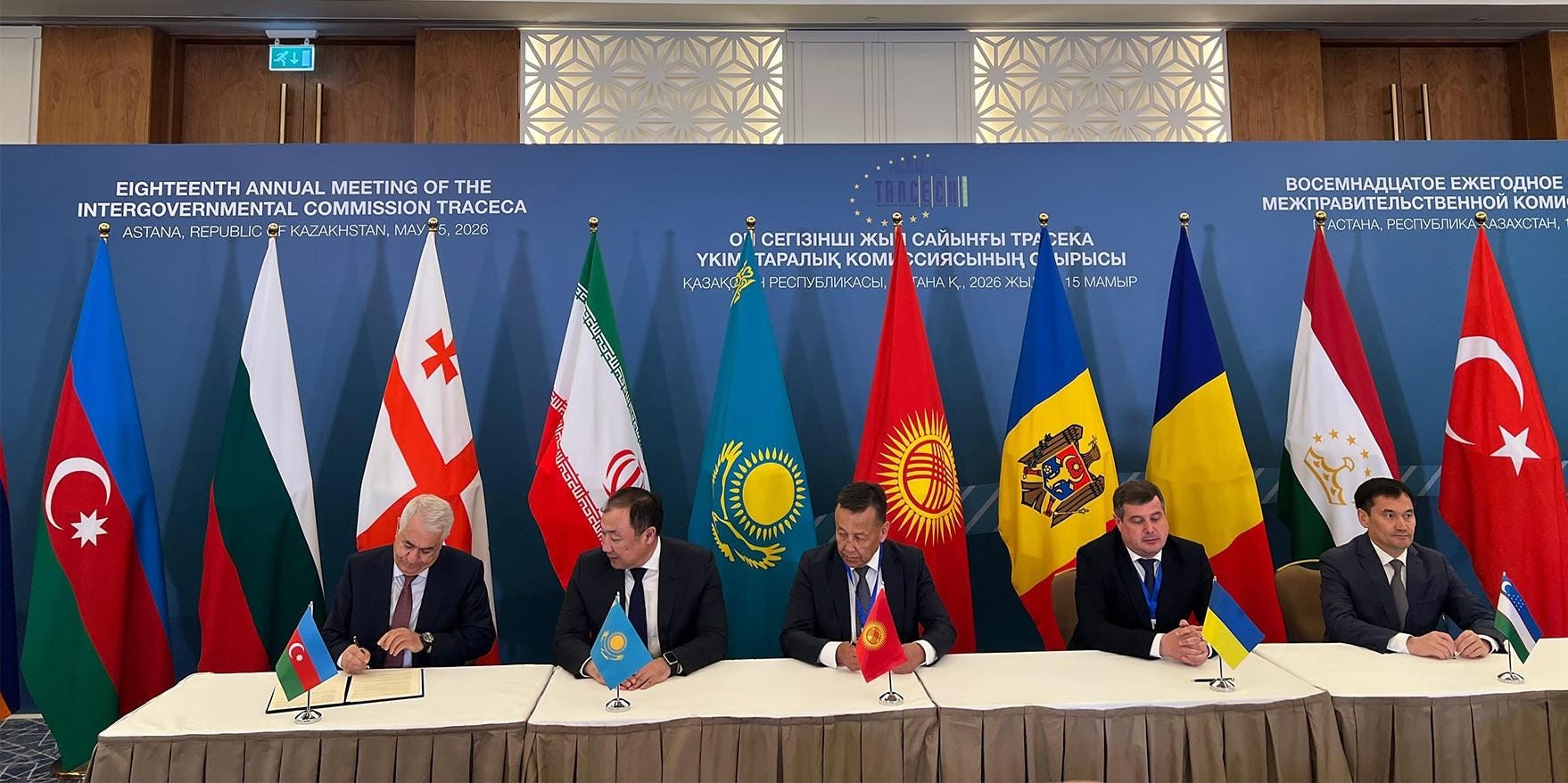
Middle Corridor countries have made numerous efforts over the past few years to expand and strengthen the project. Kazakhstan and Georgia signed an agreement on July 20, introducing a testing period for an e-Permit system for international road freight transport between the two countries. This is one move that works to improve logistics along the Middle Corridor (Kazakh Ministry of Transport; Inbusiness.kz, July 20). Earlier, Kazakhstan, Kyrgyzstan, Uzbekistan, Azerbaijan, and Ukraine signed an agreement in Astana on May 15 during the Eighteenth Annual Meeting of the Intergovernmental Commission TRACECA to introduce a single transit document for the Middle Corridor (Open KG; TRACECA, May 18). The document is expected to simplify cargo transportation along the corridor by allowing shipments to move under a single permit. These recent agreements follow positive developments in South Caucasus transport connectivity. Azerbaijan and Georgia launched the Poti–Baku Express Block Train on January 30, followed by an official ceremony on June 3 inaugurating the Baku–Tbilisi–Kars railway (Azerbaijan Railways, January 30; The Astana Times, June 3).
Together, these projects aim to reduce transit times, improve cargo reliability, and strengthen the Middle Corridor’s competitiveness against alternative routes through Russia and Iran (Organization for Economic Co-operation and Development, December 13, 2023). Russia’s war against Ukraine boosted the route’s importance over the past several years, the conflict involving the United States, Israel, and Iran in 2026 has further highlighted the impetus to develop a corridor that passes across the South Caucasus and lies between Russia and Iran (see EDM, April 19, August 2, 2022, October 28, 2024, January 28, December 4, 2025, March 24, 25, 31).
In Georgia, the development of the Anaklia Deep Sea Port has entered a new phase after the Georgian government announced on July 6 that it would develop and own the port under a state-led “landlord model” following the withdrawal of a People’s Republic of China (PRC)-led consortium selected in 2024 (Georgian Ministry of Economy and Sustainable Development, July 6; see EDM, July 16). Georgian Minister of Economy and Sustainable Development Mariam Kvrivishvili said that the port is expected to receive its first ship in 2029 and handle approximately 600,000 containers annually (Transport Corridors, October 28, 2024).
The Middle Corridor has gained further strategic importance from ongoing peace efforts between Armenia and Azerbaijan and the U.S.-led Trump Route for International Peace and Prosperity (TRIPP) initiative, which calls for the establishment of a secure connectivity link across Armenia’s southernmost Syunik province (see EDM, August 12, 2025, March 25, June 1, 2, 17, July 21). Once implemented, TRIPP will serve as a complementary route to the traditional Middle Corridor pathway through Georgia and its Black Sea ports, potentially increasing connectivity between the South Caucasus and Central Asia (The Times of Central Asia, February 13).
The corridor remains structurally constrained. Regardless of the level of efficiency achieved among participating countries, geography remains a powerful hindrance (see EDM, April 28). The corridor’s multimodal structure, combining rail, maritime, and road links, particularly across the Caspian Sea, makes it difficult to navigate (Organisation for Economic Co-operation and Development, December 13, 2023). These vulnerabilities also create additional security challenges because disruptions at any single point along the route could significantly affect the movement of goods across the entire corridor.
The most important and rarely discussed aspect of the Middle Corridor is security. The route has undoubtedly expanded since 2022, but this growth has also increased exposure to terrorist attacks, cyberattacks, and external military threats. The expansion of the Middle Corridor raises questions about how Russia and Iran may react to a route that increasingly bypasses their territories and reduces their influence over regional connectivity. The Iranian drone attack on Azerbaijan’s Nakhchivan exclave on March 5, during the active phase of the conflict, highlighted the vulnerabilities facing major trade routes (TRT World, March 5; see EDM, March 11).
Neither the United States, PRC, nor European countries have appeared willing to defend the Middle Corridor militarily. Türkiye and its fellow Turkic states, ranging from Azerbaijan to Central Asian countries, could potentially emerge as the actors best positioned to assume such a role. Geographically, the Organization of the Turkic States (OTS) largely overlaps with the Middle Corridor’s extension. Following the 2025 OTS Summit in Azerbaijan, participants placed greater emphasis on expanding military, security, and trade cooperation (see EDM, February 19, October 23, 2025). The increased emphasis on military cooperation was particularly notable, as defense issues had previously remained outside the OTS’s primary agenda. Following the summit, Azerbaijani leadership even mentioned that the OTS should develop a military component focused exclusively on defensive purposes (Anadolu Ajansı, October 7, 2025).
Achieving this level of coordination among Turkic states would require the OTS to become more inclusive and engage non-Turkic partners, such as Georgia and Armenia, thereby creating a more integrated geographic corridor stretching from the Black Sea to Central Asia. Such cooperation remains difficult to achieve since it is unclear how Tbilisi and Yerevan would respond to deeper involvement with the organization. The OTS has a long way to go in establishing and developing a credible military component. Central Asian states likely remain cautious about expanding such cooperation given their close ties with Russia, and Moscow’s generally suspicious view of Türkiye’s growing influence among Turkic communities across Russia’s southern borderland (see EDM, April 28, May 19). From a balance-of-power perspective, Russia remains militarily far superior to the Turkic states collectively.
The Middle Corridor remains a project with significant potential. From Georgia to Central Asia, major steps are being taken to strengthen cooperation. The route’s ultimate success will depend not only on digital, financial, customs, infrastructure, and political coordination among participating countries, but also on the development of a viable security component capable of protecting the corridor from external threats.
This article was originally published in Eurasia Daily Monitor.