

Kremlin Suspends Internal Russian Passport Issuance in Abkhazia
Irakli Laitadze
Executive Summary:
In early February, the Kremlin suspended the issuance of internal Russian passports inside Abkhazia, a breakaway territory of Georgia, after concerns from local authorities about sovereignty, relocating the offices to nearby Sochi, Russia. The move highlights tensions surrounding Moscow’s long-running “passportization” campaign in Abkhazia, where 80 percent of residents are dual citizens of Abkhazia and Russia.
Since Russia’s 2008 war with Georgia, Moscow has steadily integrated Abkhazia through security cooperation, financial systems integration, infrastructure investments, and legal harmonization. These mechanisms embed the territory within Russian systems—direct financial transfers from Russia constituted 30 percent of Abkhazia’s 2025 budget, for example—without pursuing formal annexation.
Russia is continually hollowing out Abkhazia’s genuine sovereignty while maintaining its nominal independence. This incremental integration strengthens Moscow’s leverage in the South Caucasus and entrenches long-term Russian control over Georgia’s breakaway territory.
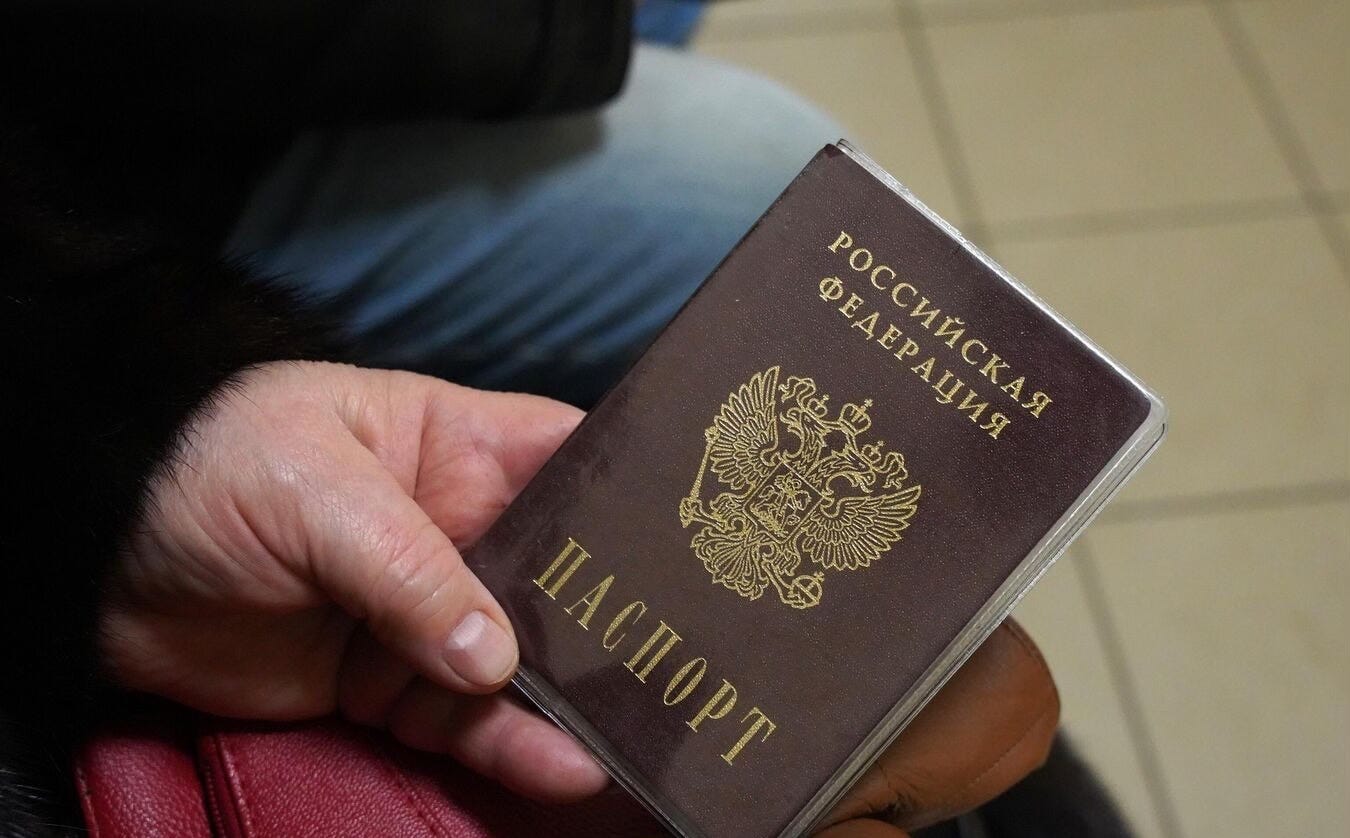
In early February, the Kremlin suspended the issuance of internal Russian passports in Abkhazia—a breakaway region of Georgia effectively under Russian control since the Kremlin’s 2008 invasion—to dual citizens over concerns about Russian “passportization” (Caucasian Knot, February 6; February 7). Passportization refers to the mass, fast-track naturalization of a territory’s population by distributing passports (see EDM, January 22). Of the approximately 224,000 residents of Abkhazia, 190,000, approximately 80 percent, hold dual “Abkhaz” and Russian citizenship (The Moscow Times, February 6). Abkhazians do not automatically hold Russian citizenship, but they have access to a simplified acquisition program that broadened after legislation changes in 2002 and grew further after the Russian–Georgian war in 2008 and Russia’s recognition of Abkhazia’s “independence” (see EDM, October 21, 2021). Abkhazia’s “independence” is only recognized by Nicaragua, Russia, Syria, Tuvalu, and Venezuela, so obtaining Russian citizenship and an international Russian passport is one of the only ways for residents of Abkhazia to travel to other countries. In Russia, the internal and international passports are distinct, with the internal passport mainly designed for identification within Russia, access to Russian state services, and travel to a few other members of the Commonwealth of Independent States (CIS), and the international passport designed for international travel. In July 2025, Russian President Vladimir Putin signed a decree allowing the issuance of internal Russian passports to citizens inside of Abkhazia and South Ossetia (Official Legal Acts of Russia, July 17, 2025). Passportization is a direct threat to Abkhazia’s marginal independence, eroding it through legal and demographic means with each successive expansion.
On February 4, the Abkhazian parliament held a closed session questioning the legal basis of allowing Russian documents to be issued through Abkhazian institutions (Apsadgil.info, February 4). No official statement was issued from the Abkhazian parliament, but some ministers told journalists that the parliament would recommend that the interior ministry halt the process. Kan Kvarchia, a member of the Abkhazian parliament, questioned the legality of the issuance of internal Russian passports in Abkhazia, which he stated constitutes interference in the internal affairs of a “sovereign state” (Telegram/@apsnypress, February 6). Two days later, Russian Ambassador to Abkhazia Mikhail Shurgalin announced that the embassy would stop issuing internal Russian passports in Abkhazia, saying that “now, obtaining a passport is only possible in Russia and requires a state fee of 4,000 to 6,000 rubles ($50 to $76)” (Russian Embassy in Abkhazia; Telegram/@apsnypress, February 6; JAM News, February 9). Shurgalin said that both Putin and Abkhaz authorities had greenlit Russian internal passport and driver’s license offices in Abkhazia, and that closing the office in Abkhazia would limit dual citizens’ access to Russian government services and social benefits (The Moscow Times, Telegram/@apsnypress, February 6). The Russian embassy in Abkhazia halted the passportization process in Sokhumi, the capital of Abkhazia, only to relocate the issuance process to Sochi, Russia (BPN, February 18). The episode exposed unease within Abkhazia about the implications of Russian citizenship (Abkhaz Inform, December 25, 2025).
Since its 2008 invasion of Georgia, Russia has consolidated its military, security, institutional, and bureaucratic presence in Abkhazia (Gogov, February 7, 2024; Vedomosti, December 31, 2025). Russia is using hard and soft power to gradually solidify its control (Georgian Ministry of Foreign Affairs, December 4, 2025). Unlike Crimea’s open and rapid annexation in 2014, Abkhazia’s integration into Russia has crawled, a slow diminution of Abkhazian “statehood” by military, financial, legal, and demographic mechanisms. Although Abkhazian leaders have sought to convince the Abkhaz public that Russia and Abkhazia are equal partners, crucial government functions are increasingly controlled by Moscow (Apsnypress, June 8, 2024).
Russia’s military and security footprint in Abkhazia is the cornerstone of Moscow’s control. The military base in Gudauta is incorporated in the Southern Grouping of Russia’s Ministry of Defense, and the Russian Federal Security Service (FSB) guards the border between Abkhazia and the rest of Georgia. Russia is upgrading Abkhazian infrastructure—including the Sukhumi airport and other communication centers—and regularly carries out joint military exercises with local forces. Moscow also plans to build a military seaport in Ochamchire capable of giving safe haven to Russia’s Black Sea Fleet vessels (TASS, October 5, 2023; Sova News, December 23, 2025). A cargo terminal under construction in the Gali region carries the risk of becoming a hub for military or dual-use goods smuggled to Russia through essentially non-existent customs controls (Abkhazeti Info, December 10, 2025). Incorporation into Russian defense systems makes Abkhazia profoundly dependent on Moscow (see EDM, November 20, 2023; Sova News, September 30, 2024). These developments will facilitate Russia’s war against Ukraine while transforming Abkhazia’s sea and land into potential war zones. In October 2023, Ukrainian President Volodymyr Zelenskyy did not rule out striking Russian naval assets at the new base (Ukrainska Pravda, October 24, 2023). In July 2025, Ukrainian drones allegedly entered Abkhazian airspace for the first time (OC Media, July 24, 2025). Kremlin-affiliated news recently reported that the Russian and Abkhazian militaries recorded 30 drones of unclear origin in a “massive, unprecedented air raid” on Abkhazia on March 4 (RIA Novosti, March 5).
According to Mikheil Ukleba—former first deputy minister of foreign affairs of Georgia and former Georgian ambassador to Ukraine and the People’s Republic of China (PRC)—economic dependency is another instrument that Russia uses to integrate Abkhazia into Russia (Author’s interview, February 17). Direct financial transfers from Moscow financed 30 percent of Abkhazia’s state budget in 2025 and are expected to cover 28 percent of expenditures in 2026, making the government directly responsible to the Kremlin (Vedomosti, December 30, 2024; Sputnik Abkhazia, December 29, 2025). Russian investments in Abkhazian infrastructure develop the territory’s transportation and energy sectors. Russian companies are securing long-term leases along the Black Sea and are actively engaged in the hospitality business. Pensions and social allowances paid by Russia directly build the population’s loyalty to Moscow (Apsnypress, March 12, 2025).
The 2014 Agreement on Alliance and Strategic Partnership established the legal framework governing Russian–Abkhazian relations (Government of the Russian Federation, November 24, 2014). The agreement’s key provisions formalized the gradual harmonization of Abkhazia’s legal framework with Russia’s—including military and security regulations, tax alignment, banking standards, and health policy—significantly curtailing the scope of autonomous local decision-making (Civil Georgia, August 15, 2024). The expansion of Russian security agencies’ jurisdiction over Abkhazian territory has deepened Moscow’s direct presence. Russian banks are replacing local financial institutions, while financial reporting and budgetary planning are aligned with the Central Bank of the Russian Federation.
Passportization is one of the most consequential instruments in the steady erosion of Abkhazia’s so-called statehood. Russian passportization of the population of Abkhazia is a basis for powerful political rhetoric about “defense of Russian citizens,” and can easily serve as a justification for Russian military presence in the South Caucasus. Passportization can also worsen fissures in local populations and form distrust between different layers of society. Russia has a large degree of control over Abkhazia’s economy, security, and politics. The Kremlin has methodically rearranged political, military, economic, and legal mechanisms to gradually dissolve the remnants of Abkhazia’s independence. Over the long term, Russia’s effective control over Abkhazia and South Ossetia, 20 percent of Georgia’s territory, will restructure the balance of power in the South Caucasus. According to Ukleba, Abkhazia is an instrument of Russia’s geopolitical strategy in the region (Author’s interview, February 17). Abkhazian state institutions are empty shells, while Moscow makes all the meaningful decisions—a serious security threat for the South Caucasus.
This article was originally published in Eurasia Daily Monitor.
Irakli Laitadze is a former career diplomat and academic. He served as Senior Counsellor at the Mission of Georgia to the European Union and previously headed the EU Political Department at the Ministry of Foreign Affairs of Georgia. Following his diplomatic service, he worked as Chief Financial Officer at GMT Hospitality and later as Chief Executive Officer of the publishing house Artanuji.
Dr. Laitadze holds an MBA from the University of Cambridge, an MA with distinction from Tbilisi State University, and a diploma from the Diplomatic School of Madrid. He earned his PhD (magna cum laude) from Free University of Tbilisi.
He is an Adjunct Professor at Ilia State University in Tbilisi, where he lectures on politics and international relations, and a Senior Fellow at the EU Awareness Centre, a Brussels-based think tank.