

Executive Summary:
The Kremlin’s “killing” of Novaya Gazeta, Moscow’s oldest independent newspaper, is a troubling sign that Russian President Vladimir Putin’s regime is returning the Russian media to what it was before Gorbachev introduced glasnost, one where criticism was possible, but generalization was not.
Because of the paper’s prestige, the Kremlin’s forcible closure of this flagship of media freedom sends a chilling message to other outlets. They could be next if they do not fall in line, outraging many but likely leading most to avoid offending the Kremlin.
Novaya Gazeta journalists will migrate to other newspapers or, more likely, move abroad and work with their counterparts there. Still, the silencing of Novaya Gazeta in Moscow will usher in a dark new media era, one that will not end until Putin leaves the scene.
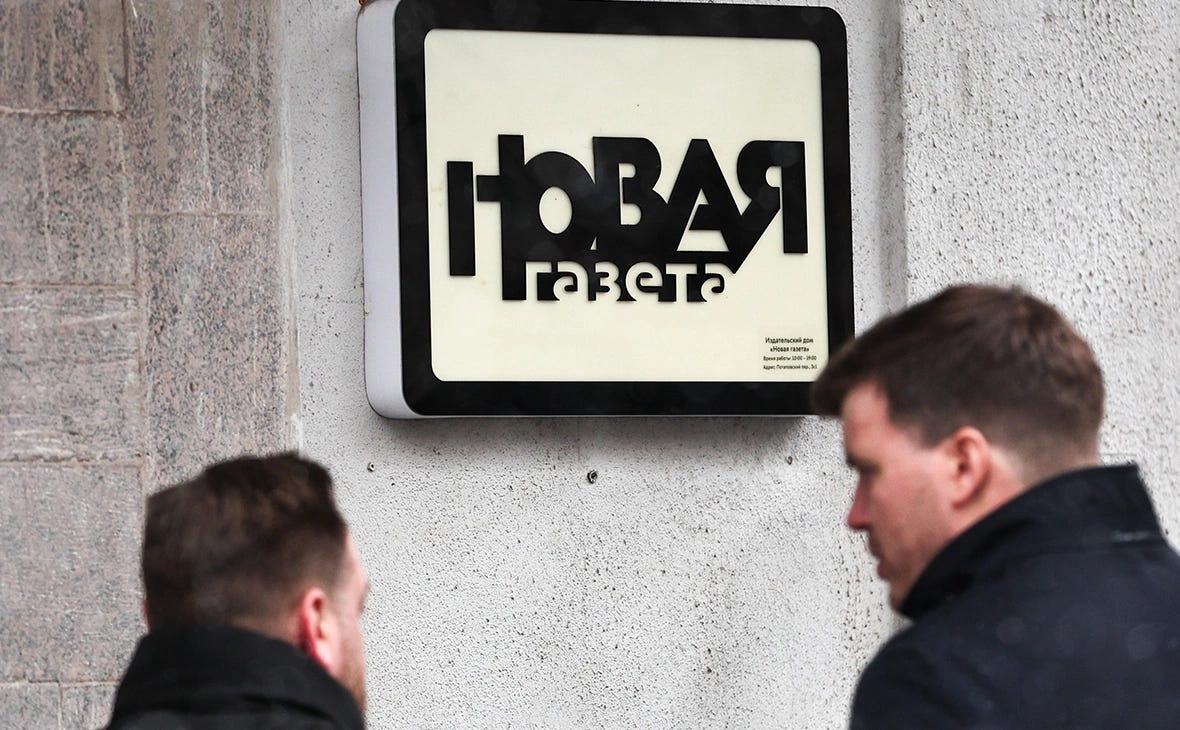
The Kremlin has “killed” Novaya Gazeta, Moscow’s oldest independent newspaper. Its editors insist on using precisely the word “kill” (Novaya Gazeta; Current Time, October 30). This development is a troubling sign that Russian President Vladimir Putin is moving to return the Russian media to what it was before Soviet leader Mikhail Gorbachev introduced glasnost, under which criticism of specific problems was possible and often tolerated but where generalizations about such problems or any linking of them to the regime was not. Drawing such generalizations is exactly what Novaya Gazeta was known for and displayed even on the occasion of its closure, pointedly noting that the paper had been destroyed along with the Russian Constitution (Novaya Gazeta, October 30). (On that Soviet-era principle and Putin’s long-standing interest in restoring it, see Window on Eurasia, December 1, 2014.) Because of the paper’s prestige, the Kremlin’s raids, bans, and investigations send—and are intended to send—a chilling message to other media outlets in the Russian Federation. They could be next if they do not fall into line. This message is especially likely to be effective because Russian media outlets without active state support face a difficult future, with many now being forced to close (Moskovskiy Komsomolets, October 13). These moves are outraging many in the media and human rights communities but are likely pushing most Russian journalists to avoid violating the Kremlin line. Novaya Gazeta journalists will migrate to other media outlets or, more likely, move abroad and work with their counterparts there—Novaya Gazeta v Kazakhstane has already announced it will continue to be released (Novaya Gazeta Kazakhstan, October 31). The silencing of Novaya Gazeta in Moscow is going to usher in the return of a dark new media era, one that will not end until Putin leaves the scene.
On October 30, the staff of Novaya Gazeta announced it would close on November 9. The paper took this step after siloviki raided its offices, the landlord ordered it to vacate the premises, and the state blocked the site through which it had collected contributions that have helped keep the paper coming out up to now (Current Time; Meduza, October 30). The newspaper issued a declaration saying that “we have not died; we have been killed together with the Russian Constitution” (Novaya Gazeta, October 30). The fate of the approximately 50 full-time staffers is currently uncertain, although many will likely move abroad and join the newspapers that share not only the Novaya Gazeta name but its principles. The 30-year history of this paper in Moscow appears, however, to have come to an end, and at least as long as Putin is in power, the newspaper’s editor Sergey Sokolov has been compelled to concede (Meduza, October 30).
Newspapers in the Russian Federation have been dying at a rapid rate. They are falling victim to rising costs, competition from the internet, and official pressure of various kinds. In the last two years alone, some 5,000 newspapers have shut down in Russia (Moskovskiy Komsomolets, October 13). That has left many parts of Russia without any newspapers and, in the view of activists, made it easier for the state to cover up what it is doing and falsify the past—dangers that a few intrepid activists are trying to limit by gathering and saving print runs of the papers that had been closed (Window on Eurasia, October 14). Novaya Gazeta’s situation is special. Its long history and courageous positions on many issues mean many people recognize that its closure marks a dangerous turn back to a very dark past. Other media outlets, opposition figures, and rights activists have denounced what has occurred (e.g., EkhoFM, October 30, [1], [2], [3], [4]; Important Stories; The Moscow Times, October 30).
In its 33 years of existence, Novaya Gazeta has won notice for its courageous coverage of events the Kremlin would prefer not to cover honestly, and it has faced harassment many times and closure twice. (On that remarkable history of survival in the face of official hostility and actions, see Agenstvo, October 30; Current Time, October 31.) Because the paper has always returned in the past, some are optimistic it will do so again, but the moves the Kremlin has orchestrated this time are far more sweeping. It has not only deprived the paper of its place of work and means of collecting contributions, but through raiding the offices of the paper it has created a climate of fear that even the most committed journalists cannot avoid being affected by. Consequently, while some Novaya Gazeta editors and staffers are putting on a brave face and hoping the paper will make a third comeback, the prevailing mood is anything but upbeat (Meduza, October 30).
The reason for that lies precisely in the kind of reporting that Novaya Gazeta has been noted for and that the Kremlin is so opposed to. Again and again, the Moscow paper has not only reported on individual horrors in Russian life but connected the dots and shown how what is happening in one area is linked to what is happening in others and how these instances are linked to the Kremlin dictator and his team. That approach has made Novaya Gazeta especially valuable, and why, in its announcement of the paper’s closure, the staff declared that Novaya Gazeta has been killed alongside the murder of the Russian Constitution and thus opened the way for a new dark age in the Russian media and Russian life more generally (Novaya Gazeta, October 30).
Novaya Gazeta’s unstinting effort to put individual stories in context by showing how they were connected to others and to state policy set it apart from many of its counterparts. This approach has made it a model for others. That made it a threat to Putin and his regime, which for a long time has wanted to go back to the Soviet-era principle of media management, one that allowed for criticism of many specific problems but blocked any generalization of those problems or exploration of how they were the result of state policy (Window on Eurasia, December 1, 2014). Putin has at least three reasons for wanting to return to this Soviet approach. First, by continuing to allow coverage of some individual problems, he can deceive many Russians and even more foreigners into believing that there is a semblance of media freedom in Russia when he is destroying precisely that. Second, by blocking any generalization in the treatment of problems and their links to the regime, he can avoid criticism of his system, especially at a time when “whataboutism” dominates most official Russian media. Third, he and his cronies can continue to act as they like with the certainty that they will not be subject to media criticism unless they offend the leader or at least those above themselves.
Putin has been moving in this direction step by step since he annexed Ukraine’s Crimea. Now, however, he has crossed the Rubicon. If his “murder” of Novaya Gazeta does intimidate all other Russian media outlets, he will have succeeded in killing the Russian Constitution even as he has redrafted it. In that event, the chief victims of this Putin policy will be the truth and the population living under his rule.
This article was originally published in Eurasia Daily Monitor.