

Georgian Dream Seeking U.S. Reset While Resisting Requisite Reforms
Beka Chedia
Executive Summary:
Georgia’s ruling Georgian Dream party has signaled its desire to restore the suspended U.S.–Georgia strategic partnership and claimed active dialogue with Washington is underway. At the same time, Georgian Prime Minister Irakli Kobakhidze rejected suggestions that Georgia must alter its domestic or foreign policies as a condition for improved relations.
Tbilisi’s simultaneous deepening of ties with the People’s Republic of China, alongside growing engagement with Iran and pragmatic relations with Russia, has intensified U.S. scrutiny over foreign influence, intelligence penetration, and democratic backsliding in Georgia.
Georgian Dream denies allegations that Georgia is drifting toward Russia, the People’s Republic of China, or Iran, arguing that economic ties with these countries remain limited. Critics, however, contend that the government’s growing engagement with non-Western powers risks undermining trust with Georgia’s traditional Western partners.
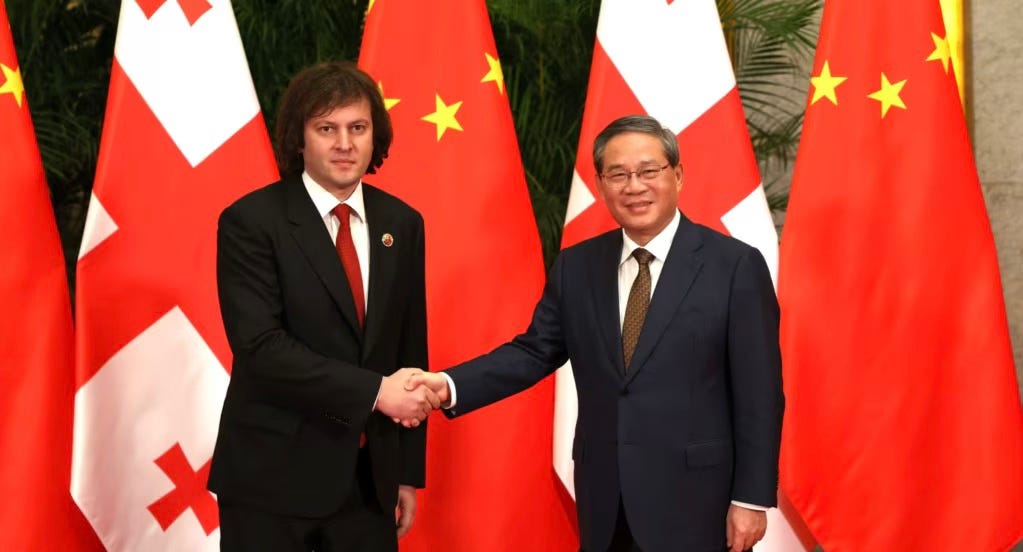
The People’s Republic of China (PRC) and Georgia have upgraded their ties to a comprehensive strategic partnership (PRC State Council, June 9). The PRC Embassy in Georgia announced the elevation of relations on June 9, timed to coincide with the 34th anniversary of the establishment of diplomatic relations between the PRC and Georgia (Facebook/ChineseEmbassyinGeorgia, June 9; Radio Tavisupleba, June 9). PRC President Xi Jinping and Georgian President Mikheil Kavelashvili exchanged congratulatory letters for the establishment of diplomatic relations between the two countries. In his letter, Xi Jinping emphasized the importance of further deepening the strategic partnership and expanding bilateral cooperation., stating, “I am confident that this will open up new prospects for the development of China–Georgia relations, mark a new chapter in the traditional friendship between our countries, provide strong momentum for mutually beneficial cooperation, and bring even greater benefits to the peoples of our two nations” (Rustavi2, June 9). Georgian Prime Minister Irakli Kobakhidze stated that Georgia–PRC relations were entering a new stage (Interpressnews, June 9). On June 10, Kobakhidze compared the PRC and the United States, stating that Georgia’s strategic partnership with the PRC has concrete substance and results. He also suggested that the United States should adopt a similar approach when renewing its strategic partnership with Georgia (Interpressnews.ge, June 10).
This unexpected rapprochement between Georgia and the PRC occurred amid increased U.S. activity regarding Georgia. On June 8, the U.S. House of Representatives passed the “Countering China’s Control of the Caucasus Act.” The bill is now being sent to the U.S. Senate for consideration. The legislation directs the U.S. administration to conduct a detailed assessment of the activities of Russian and Chinese intelligence services in Georgia. If ultimately enacted, it would require the Secretary of State, in coordination with the Director of National Intelligence and the Secretary of Defense, to submit a classified report to Congress within 180 days addressing the penetration of Russian and Chinese intelligence networks in Georgia, as well as areas of overlap and cooperation between Moscow’s and Beijing’s influence operations in the country (U.S. House of Representatives, June 8).
Before that, on June 4, the U.S. House Armed Services Committee approved two amendments to the National Defense Authorization Act (NDAA) concerning the Georgian Armed Forces (Civil Georgia, June 5; U.S. House Armed Services Committee, accessed June 9). The amendments were introduced by U.S. Congressman Joe Wilson, one of the most vocal critics of the Georgian Dream government. One of the amendments addresses political prisoners and political repression in Georgia. The committee expressed concern over the detention and imprisonment of opposition leaders, activists, and other individuals who are widely regarded as political prisoners. It argues that this issue should be consistently raised at a high level in bilateral engagements with both the Georgian government and the Georgian Armed Forces (U.S. House Armed Services Committee, accessed June 9). The second amendment focuses on security concerns and foreign influence. Similarly to the “Countering China’s Control of the Caucasus Act,” it directs the U.S. Secretary of Defense, in coordination with the Director of National Intelligence and the Secretary of State, to provide the relevant congressional committees with a classified report within 180 days of the NDAA’s enactment. The bill must now be sent to the U.S. Senate for consideration and a vote (U.S. House Armed Services Committee, accessed June 9).
On June 3, U.S. Secretary of State Marco Rubio, during a hearing in the U.S. House of Representatives, stated that Washington expects a change in Georgia’s current political trajectory and anticipates a correction of Tbilisi’s course (YouTube/@CSPAN, June 3). Russian Foreign Minister Sergei Lavrov, in contrast, described the Georgian government as pragmatic on June 5 and praised it specifically for its foreign policy course (TASS, June 5). Rubio’s statement came days before U.S. Congressman Joe Wilson said on the House floor, “The illegitimate Georgian Dream team regime is in the process of selling out the country to the Chinese Communist Party and … Putin and Iran, against the wishes of the Georgian people and the interests of the United States” (YouTube/@USHouseClerk, June 8). Rubio noted the United States had “received some positive responses [from Georgia],” and Washington hopes that it can “see a change of trajectory in the case of Georgia from where it is today” (YouTube/@CSPAN, June 3).
Rubio’s statement appears to have struck a nerve with Georgian Dream despite continued interest in improving relations with the United States. On June 2, a day before Rubio’s statements, a preliminary version of Kobakhidze’s annual report was published. The document, which he is expected to present to the Georgian Parliament at the end of June, explicitly states that Tbilisi’s goal is to reset relations with Washington. It also notes that an active political dialogue is underway with the U.S. administration to restore the U.S.–Georgia strategic partnership, which the United States formally suspended in November 2024 (Facebook/@Mtavarinow, June 2). Kobakhidze’s response on June 4 to Rubio’s statement that Georgia is expected to change its behavior, however, held a different tone. He said, “Georgia is not a school student to whom someone can give an ‘autumn grade’ and demand corrections. Georgia is a dignified sovereign state, and we have clearly stated this everywhere” (Interpressnews, June 4). Kobakhidze denied that anyone from Georgian Dream had asked U.S. representatives what should be done to reset relations (Interpressnews, June 4).
Publicly, Georgian Dream continues to present itself as a staunch defender of Georgia’s sovereignty against alleged Western interference. At the same time, it seems to seek to persuade Washington to restore ties behind the scenes. Georgian Dream publicly campaigns against U.S. influence in Georgia yet simultaneously seeks to restore close ties with Washington on terms favorable to itself, conditional on preserving its hold on power.
On May 25–28, a U.S. State Department delegation visited Georgia. The delegation met with both Georgian Dream representatives and members of the Georgian opposition. A statement from the U.S. Embassy in Georgia explains that the United States is interested in a “sustainable strategic partnership” with Georgia, including in the areas of investment, energy, and security. The embassy’s statement also said, “Functional democracy requires a political opposition that deals with public institutions to represent the interests of the citizens who voted for it” (Facebook/usingeo, June 1). Georgian Dream’s hopes that Washington would not show interest in Georgia’s domestic political crisis and limit itself to economic engagement with Georgia did not come to fruition. Georgian media suggest that Washington is likely to require the Georgian Dream government to reconsider the decision regarding the expected ban on opposition parties as a precondition for resetting bilateral relations (Interpressnews, June 4).
Kobakhidze said that talk of a possible U.S. demand that the Georgian government reverses its decision to ban political parties would be unfair (Tvpirveli, June 3). In November 2025, Georgian Dream filed a lawsuit with the Constitutional Court of Georgia seeking to ban several political parties, later adding more parties to the suit (Civil Georgia, April 20). If this initiative is carried out, it could signal the consolidation of authoritarianism in Georgia. Kobakhidze also criticized the previous U.S. administration’s stance toward Georgia, accusing it of disrespecting Georgia’s national interests and election results. According to Kobakhidze, U.S. President Donald Trump’s administration demonstrates a different approach, creating grounds to expect the restoration of a strategic partnership between the two countries “from a clean slate.” He emphasized that the foundation of relations should be respect for the country’s national interests, elections, and the will of the Georgian people. He had maintained this position before Rubio’s statement (Tvpirveli, June 3).
The embassy’s statement indicated that the United States is ready to begin a new phase of relations with Georgia based on “sincere dialogue.” It emphasized the shared U.S. and Georgian commitment to establishing “resilience to harmful external influences” (Facebook/usingeo, June 1). Kobakhidze countered the implication that Georgia is subject to harmful external influences by telling local journalists on June 4 that the U.S. administration itself has acknowledged the need and importance of deepening relations with the PRC and Russia (Interpressnews, June 3).
Regarding accusations against Georgia over its possible rapprochement with Iran, the Georgian government’s position appears ambiguous. Georgian Dream is seemingly unfazed by Iranian Ambassador to Georgia Ali Moujani’s active presence in Georgian public life and by the ambassador’s welcome at government-organized events. For example, he participated in the opening of the 16th Regional Forum for Sustainable Development in Tbilisi on June 4. Additionally, almost immediately after Rubio’s statement, Moujani wrote on Facebook in Georgian, “I believe that the United States should reconsider its view of the world. A country that seeks to destroy other civilizations must first of all correct itself” (Facebook/a.moujani, June 3). In recent months, the Iranian diplomat has become one of the most active foreign ambassadors in Georgia’s information space. In effect, he has become the first Iranian ambassador since Georgia regained independence to participate so actively in public and political discourse, regularly commenting on both international events and domestic developments. The Georgian government, however, categorically rejects accusations that Georgia is helping Iran evade international sanctions. Specifically, Kobakhidze noted that only 0.5 percent of Georgian exports go to Iran, and only 1.5 percent of Georgia’s imports come from Iran (Interpressnews, June 3).
Georgia’s growing ties with countries such as the PRC and Iran have raised concerns among its traditional Western partners. These closer relationships have yielded only limited tangible political benefits for Georgia, even on issues directly related to its core national interests. The UN General Assembly voted on June 4 on the resolution concerning the status of internally displaced persons and refugees from Abkhazia, Georgia, and the Tskhinvali Region/South Ossetia. The resolution reaffirmed the right of displaced persons and refugees to return to their homes in safety and dignity. Several countries with which Tbilisi has sought to deepen relations in recent years, however, did not provide clear support for Georgia’s position. The PRC, Iran, the United Arab Emirates, and Serbia abstained from voting on the resolution (1tv.ge, June 5). This demonstrates the limitations of a foreign policy approach that places excessive emphasis on closer engagement with authoritarian or non-Western powers. In practice, when it comes to issues such as Georgia’s territorial integrity and the rights of internally displaced persons, these states tend to prioritize their own geopolitical considerations over explicit support for Georgia’s position. As a result, Georgia risks weakening trust with its traditional Western partners while receiving limited meaningful political backing from newer partners on issues of fundamental national importance.
This article was originally published in Eurasia Daily Monitor.