

Cossacks Continue International and Domestic Resurgence
Richard Arnold
Executive Summary:
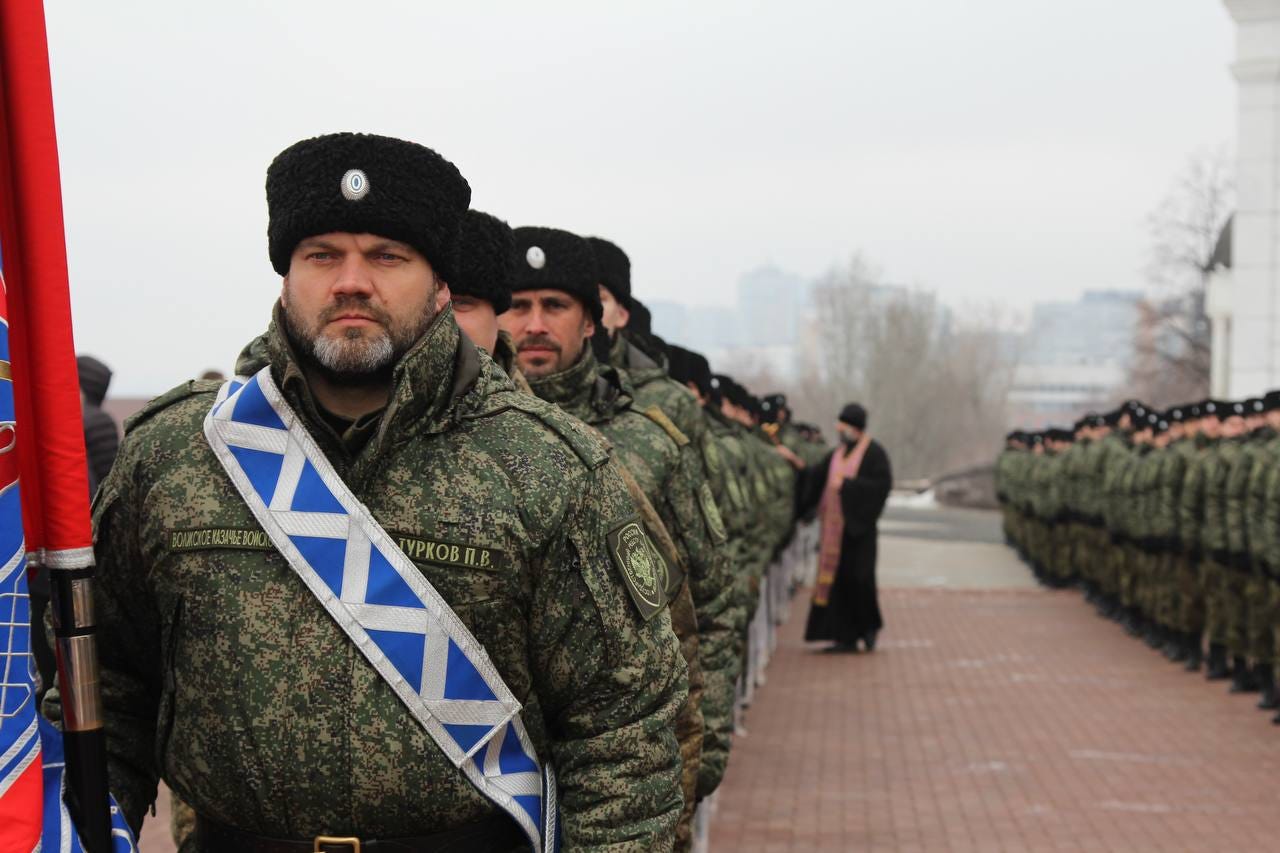
Russia is increasingly leveraging Cossack organizations as instruments of influence, linking Cossack identity to military service, patriotism, and support for the war against Ukraine while expanding their visibility through events such as Victory Day celebrations.
Domestically, ties between Cossack groups are most often associated with the Russian Orthodox Church, promoting youth engagement, pastoral programs, and academic initiatives that reinforce militarized patriotism and state-backed interpretations of Cossack heritage.
Internationally, Cossack networks across Europe and beyond are growing through cultural events, youth outreach, and embassy-linked activities, providing Moscow with potential channels for influence operations and broader mobilization in support of Russian interests.
The Cossacks continue to maintain a consistent, resurgent presence both domestically in Russia and internationally. On June 16, the 7th International Cossack Bivouac was held in Hanover, Germany, bringing together Cossacks from all over Germany and a delegation from the Spanish Association of Volga Cossacks. Sergei Bodryakov, the ataman of the All-Great Don Army, said to the attendees, “In difficult times, in a tense political situation, you, living outside the Fatherland, preserve the history and spirit of the Cossacks of Russia … All together—this is preserving the memory of our ancestors, the victories of the Russian army” (Telegram/@kazakicDona, June 16; VsKO, June 17). The Cossack’s role in Russia’s war against Ukraine, and the celebration of Russian military victories as part of preserving Russia’s role in Cossack life and culture internationally, is a lever of influence that Moscow can use to advance its goals.
The inclusion of the Cossacks in Russia’s May 9 Victory Parades throughout the country to commemorate the victory over Nazi Germany in World War II is a significant indicator of their rising status (VsKO, May 9). While there were changes to the Moscow parade at the last minute, , Cossacks from the Volga region were supposed to travel to Moscow to participate in the victory parade for the first time. The Volga Cossacks, being part of “a general formation of [Russia’s] country’s best units,” announced in March that they were prepared to send 130 Cossacks to the parade (VsKO, March 20). Further, the Orenburg Cossacks announced their intended participation in the Moscow parade and would likewise send 130 Cossacks to practice. Their number included veterans of the so-called “Special Military Operation” and students from various universities. In total, people from four regions were supposed to set out from Chelyabinsk to participate in the parade (VsKO, March 20). While Cossacks from Rostov, Stavropol, and Krasnodar have taken part in the parade before, the proposed inclusion of Cossack paramilitaries from other regions speaks significantly about the Kremlin’s expansion and revival of inauthentic Cossack societies across the country (see EDM, May 9, 2025). One presumable benefit for the Kremlin of this is that tapping into the genuine histories and emotions surrounding Cossacks in Eurasia simplifies the process of militarization.
Such a development seems in line with Nikolay D’iakonov’s prediction in 2023 that “the image of the Cossack-defender is now in the news almost every day.” He claimed that “the level of Cossack activity has increased exponentially” over the past 15 years and that “now you will get tired of surfing through news feeds or looking through many, many pages of daily news information related to the Cossacks of the Russian Federation and the activities of foreign communities” (Kazachestvo, February 17, 2023). Recent events involving the Cossack bear out these claims.
Domestically, the image of the Cossack is primarily associated with the Russian Orthodox Church, and there was a recent meeting between the chair of the synodal committee for connections with the Cossacks, hierarch Timothy Chaikin, and the head of the Cossack department for working with youth. The meeting was part of the implementation of the plan for working with Cossack youth and discussed the development of the pastoral system for youth (Kazachestvo, March 23). At the regional level, too, the Don Cossacks have debated the church’s involvement in their movement and in creating a system of pastoral care for the Cossacks, including the new Master of Arts program in Cossack studies (Kazachestvo, March 20). So too were there similar meetings for the Central Cossacks and the Krasnodar Cossacks (Kazachestvo, March 12, 17). The Cossack popularization of Russia’s revitalized spirituality is at least part of the reason for the “exponential” increase in their image—although fighting in Ukraine has not harmed their image either.
Outside of Russia, small communities of Cossack emigres are also adding to the increase. Andrey Shestakov, the Ataman of the Finnish “yurt” of Cossacks and the plenipotentiary representative of the council of European Atamans, claimed, “Cossackdom is developing in practically all of Europe.” He did not name any countries other than Finland, but he described how Cossacks outside Russia use museums as focal points of culture and work with youth to ensure a patriotic upbringing for the Fatherland (i.e., Russia) in their countries of residence. Holidays and other activities play a large role, highlighting the role culture plays in disguising groups that may be involved in Russian psyops (Kazachestvo, March 24). At least in Finland, this analyst has received questions for context and background from Finnish journalists about the community there. Cossacks have also been involved in similar campaigns as far afield as Australia, Germany, and France, including the 2024 visit by French Cossacks to the Russian Embassy in Paris (YouTube/@cosaquesdefrance7654, December 15, 2024). Likewise, in 2024, Cossacks in Germany held the 5th International Cossack Bivouac near Hannover, an earlier iteration of the recent 7th International Cossack Bivouac. Over two days, participants learned to master traditional Cossack skills, including the nagaika (Cossack whip), maneuvering, combat medicine, and sporting events. The encampment was organized by the Council of Cossacks of Europe and D’iakonov’s organization, SKWRiZ (Kazachestvo, June 19, 2024). Another Cossack meeting took place at the embassy in Madrid, where representatives from France, Spain, Germany, Russia, and Finland debated the role of the Cossacks in “important events in Russia’s history” from the seventeenth to the beginning of the twentieth century (Ministry of Foreign Affairs, October 4, 2024).
At the moment, Cossacks represent only a vector of Russian influence. They could conceivably play an important role in a hypothetical kinetic conflict. D’iakonov, however, seems to have been correct in his contention that Cossacks are truly getting stronger across practically all of Europe—and it may be an image of much greater importance in the relatively near future.