

Contract Manufacturing and Technology Transfer Risks
Executive Summary:
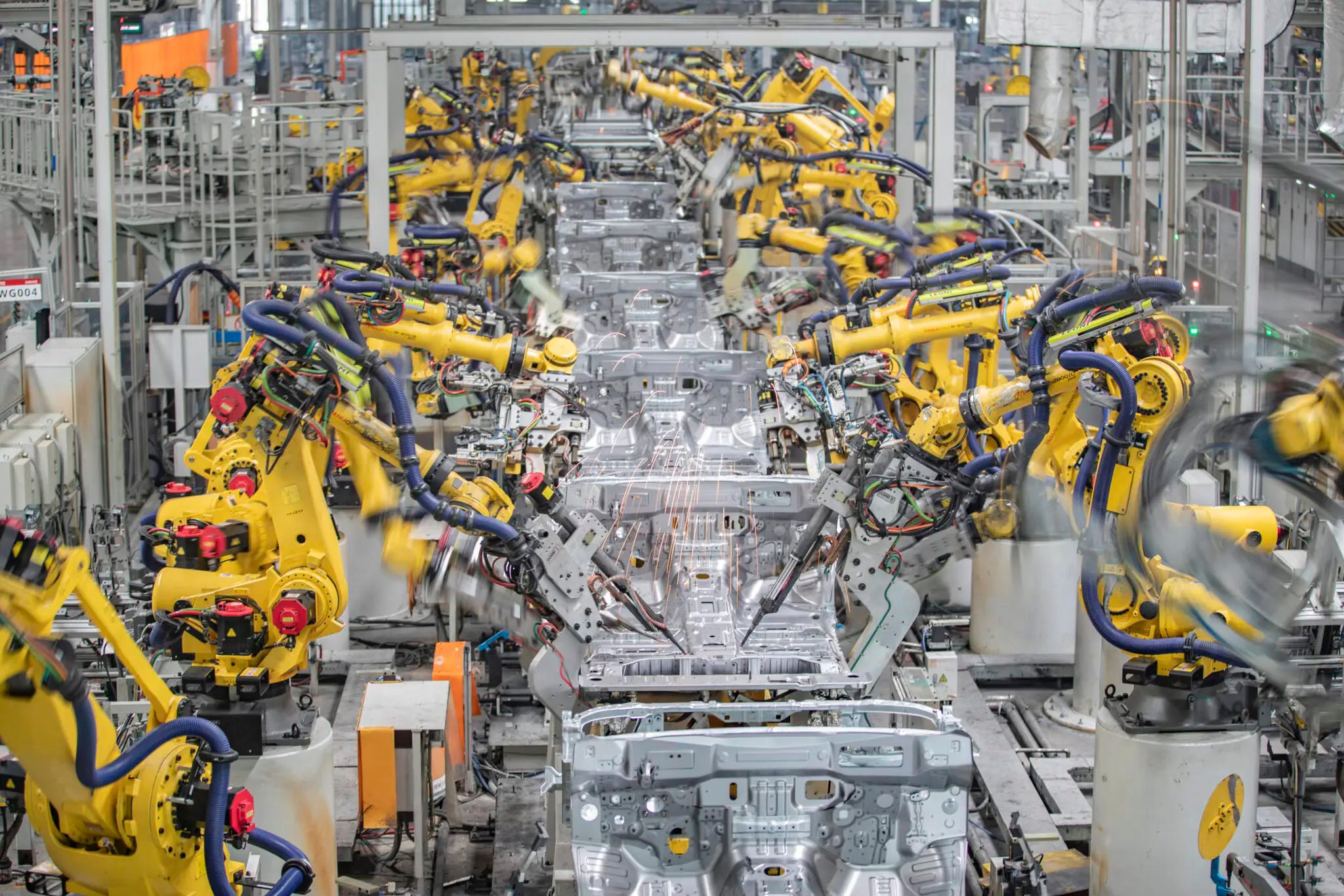
Top contract manufacturing firms may further the techno-industrial dominance of the People’s Republic of China (PRC). These firms have been important vectors of technology transfer and industrial upgrading for over three decades. Now pivoting to Beijing’s priority sectors, they risk cementing its dominance in key future technologies.
Beijing’s industrial ecosystem pressures firms to channel dual-use technologies into supporting its military. As this ecosystem develops, both contract manufacturers and their overseas clients will find it increasingly difficult to disentangle their inputs from outputs that align with the interests of the Chinese Communist Party.
Non-PRC contract manufacturers are increasingly being pulled into the PRC’s transfer and alignment ecosystem. This pattern is illustrated by Taiwanese firms that show growing links to Party organizations, even if they do not exhibit clear evidence of the highest-risk forms of military entanglement seen in PRC firms.
Western firms that work with contract manufacturers should be aware of the security and technology spillover risks in this environment and consider the necessary steps to mitigate them. Absent an understanding of the integrated ecosystem the CCP is constructing, these firms risk exacerbating patterns of behavior that have had negative effects on Western industrial strength.
Introduction
Contract manufacturing in the People’s Republic of China (PRC) poses a latent challenge to U.S. national security. Offshoring to the PRC risks turning manufacturing efficiency into a driver of strategic vulnerability by helping cement the country’s centrality to the critical technologies of the future. Since the 1990s, global technology companies have relied on Chinese and Taiwanese firms operating in the PRC to produce their goods. Those companies have, often willingly, provided intellectual property, training, and resources to local firms, taking advantage of lower costs and a friendly regulatory environment. The PRC’s status as the world’s preeminent manufacturing and industrial power is a direct result of these efforts. The growth of its contract manufacturing sector has enabled it to integrate into global supply chains, allowing the country to move up the development ladder by absorbing know-how, building supplier leverage, accumulating capital and engineering capability, and moving into higher-value and strategically significant segments of the industrial chain. At the same time, these dynamics have hastened the decline of manufacturing in the United States.
The PRC continues to refine approaches to both absorbing technology from overseas and diffusing it across both civilian and military sectors. Policy trends within the PRC over the last decade, coupled with new commercial strategies by leading contract manufacturers, could exacerbate the relative decline of manufacturing in the United States while assisting its rise in the West’s principal rival. Traditional analyses of the commercial risks Western companies face when doing business in the PRC have focused on intellectual property theft and forced technology transfer via joint ventures or other foreign direct investment (FDI) agreements. Almost no research has focused on contract manufacturers as a vector of technology transfer. Recent PRC plans to further integrate capabilities between industries and across military and civilian domains, however, make contract manufacturers especially vulnerable to Beijing’s attempts to leverage commercial capabilities to achieve its national ambitions.
Four criteria can be used to assess a firm’s level of support for PRC national strategy:
defense–contractor relationships and military–civil fusion agreements;
support for state-backed research and development (R&D) and industrial initiatives;
governance ties such as Party committees or executives with formal political positions; and
public political alignment with Party-state policies.
We apply these criteria to analyze four contract manufacturers operating in the PRC, two of which are domestic companies and two that are Taiwanese.
We find that while domestic contract manufacturers are more deeply embedded in the PRC’s defense industrial base and more closely aligned with the Chinese Communist Party’s (CCP) strategic ambitions, Taiwanese firms also contribute significantly to this ecosystem. The scale of the Taiwanese firms and their involvement in sensitive research with state-affiliated institutions give the CCP significant leverage.
Contract manufacturers are pivoting to produce technologies that PRC policymakers view as priority areas for development. These include artificial intelligence (AI), robotics, and new energy vehicles, among others. Many of these products will be exported around the world and become embedded in interconnected physical and digital infrastructure. Just as these firms have facilitated spillover innovation in the past, the danger today is that spillovers from their new commercial priorities will further facilitate Beijing’s quest to dominate the technologies of the future.
An Ecosystem to Support Party Strategy
The CCP believes a strong manufacturing base that supports both civilian and military development will enable it to win a potential “total war” against the United States. [1] This is one of the primary reasons it has doubled down on its manufacturing capabilities and steered the sector toward strategic and emerging technologies, designing an “Integrated National Strategic System and Capabilities” (INSSC; 一体化国家战略体系和能力) to achieve that end. The outline of the 15th Five-Year Plan, which dedicated an entire section to the INSSC for the first time, signals both an acceleration and a broadening of the Military–Civil Fusion Development Strategy that the Party enshrined in its constitution in 2015. [2]As leading contract manufacturers pivot toward emerging technologies, they risk supporting—and even cementing—PRC dominance in critical technologies. This would deepen Beijing’s leverage over global supply chains. The broader industrial ecosystem that exists in the PRC would also prove difficult to unwind should non-PRC firms and Western policymakers wish to do so.
The current situation is a result of decades of deliberate policy to acquire Western technology with the long-term goal of outcompeting global industry leaders across the value chain. In the early 1990s, contract manufacturers already constituted a major source of exports for the PRC and other East Asian economies. [3] Western clients of these firms transferred enormous value to the PRC through these firms: tacit knowledge, production know-how, troubleshooting methods, process optimization, supply-chain management, scaling techniques, and manufacturing culture. Some of this is difficult to measure. Knowledge flows do not leave a paper trail. [4] As experts pointed out in 2005, however, firms “must reveal critical knowledge” that create “new areas of risk for lead firms in the areas of intellectual property leakage.” [5]
A raft of scholarship, much of which has only appeared in the last few years, provides evidence of the avenues through which PRC entities have pursued the acquisition of Western technology. These include FDI, venture capital investment, joint ventures, licensing agreements, cyber espionage, and talent acquisition programs. [6] Data show that these efforts have brought significant benefits to the Chinese economy, and to its manufacturing base in particular.
Conditioning foreign firms’ market access on technology transfer has been especially effective. One paper assesses that policies that premised access to the PRC’s market on technology transfer to domestic firms rose six-fold between 2002–2012. The vast majority of that increase—85 percent—occurred in strategic industries. [7] Although such conditions are prohibited under World Trade Organization (WTO) rules, workarounds have been easy to engineer. Ownership restrictions in auto sector joint venture agreements allowed for technology transfer via implicit quid pro quo arrangements. This contributed to more than 8 percent of the quality improvement experienced by affiliated domestic auto models between 2001–2014, according to one study. [8] The PRC has made commitments to U.S. officials to remove technology transfer conditions on at least eight occasions since 2010 but has not followed through. A report from the office of the U.S. Trade Representative notes that the PRC rolled out superficial measures to address negative perceptions of its policies while attempts to acquire and absorb foreign technology became “more aggressive.” The U.S. government indicted 31 individuals and entities between 2018 and mid-2024 as a result. [9]
Academic research has established the positive spillover effects for host countries from establishing joint ventures or attracting FDI. [10] Greater FDI leads to more productive and more innovative domestic firms, mainly as a result of learning effects. According to one paper, at least 87 percent of manufacturers of electric machinery in the PRC have enjoyed significant productivity-boosting effects from FDI. [11] A 2018 study of joint ventures in the PRC assessed them to be 30 percent more productive, have higher sales, and engage in more patenting than non-joint venture Chinese firms.[12] Two 2025 studies of joint ventures conclude that domestic firms adopt the strengths of their joint venture partners, as seen in patenting activities, and that industries with more joint ventures have experienced more positive spillover effects to PRC firms in terms of faster growth and technological progress. [13] Indirect spillover effects often come from domestic partner firms’ observation and assimilation of production processes; and increased worker flow from joint ventures to other firms in the same industry can also boost a sector.
Contract manufacturers have been an important part of this story. In the early 2000s, leading domestic electronics companies, including Huawei, ZTE, and TCL, all had “substantial business” with foreign contract manufacturing firms.[14] Luxshare, now the PRC’s top smart precision manufacturer by revenue and one of the two domestic firms reviewed in this brief, was founded by a former Foxconn worker—a clear example of knowledge spillover benefiting domestic industry. Foxconn even supported Luxshare’s rise, providing the firm with half of its operating revenue in 2007–2010. Today, Luxshare has taken over a number of Apple contracts previously handled by the Taiwanese firm. [15]
Beijing’s approach to technology acquisition has damaged Western industry. This goes beyond the well-known findings regarding the first and now second “China shocks.” [16] A recent study of PRC investment overseas reveals what its authors call an “innovation spillback” mechanism. Firms that acquire Western companies experience a sharp acceleration in innovative capacity (as measured in patents granted), while the acquired firms do not generate a higher patent output and instead experience significant profitability decreases. More troubling, firm acquisitions are skewed to “[research and development]-intensive and supply-chain-linked firms” in the advanced manufacturing, information and communications technology, and natural resources sectors of developed economies—and are driven in particular by state-owned enterprises (SOEs). What the authors describe is a “distinctively state-driven model of global ownership that accepts weaker near-term performance [in acquired firms] to internalize technological capacity at home.” A second order effect of this process is a negative impact on the wider in-country sectors in which SOE acquisitions take place, as research and development (R&D) investment in non-target peer firms gets crowded out. [17] This finding is reinforced by a separate study, which calculated that a ban on U.S.–PRC joint ventures since 1999 would have boosted U.S. welfare by 1.2 percent in units of permanent consumption. [18] Additional research establishes the link between acquisitions and central government policy, indicating the strategic intent behind these dynamics. As one study shows, the 2015 “Made in China 2025” industrial policy, which emerged as a complement to the military–civil fusion (MCF) development strategy, has increased the targeted acquisition of Western firms in strategic sectors by SOEs over the past decade. [19]
Two developments over the last ten years have exacerbated the risks for contract manufacturers operating in the PRC. The first has been the advance of Party activity within private enterprises. This followed General Secretary Xi Jinping’s decision to take “firm control” over the economy, which has since elided the boundaries between the Party-state and private firms. [20] A key focus of this new model of Party-state capitalism is the promotion of innovation by aligning firms with national strategic priorities. Analysis of a dataset looking at firms’ Party-organization work and patent applications spanning 2003–2017 finds that Party organization activities and the participation of senior executives who are also Party members has significantly promoted innovation, especially since 2012. These indicators correlated strongly with firms increasing R&D investment and reducing operating risk, which was more pronounced for technology-intensive enterprises. [21]
The second development has been the cementing of the PRC’s centrality to global supply chains in high-tech sectors. This has been partly engineered via a series of regulatory measures with extraterritorial scope and policies that embed PRC firms in global markets. The implementation of extraterritorial measures has its origins back in the early 1990s. Following the Tiananmen Square Massacre in 1989, the U.S. Congress debated whether to renew the PRC’s most-favored nation status. Refusal to do so would have upended the bilateral trading relationship. Uncertainty over the outcome of this debate led a number of U.S. importers to explore diversifying manufacturing away from the PRC or curtailing direct purchases from the PRC. [22] At the time, there was little the PRC could do to prevent what would today be referred to as de-risking. That is no longer the case. The PRC’s Anti-Foreign Sanctions Law, unveiled in 2021, has been used to prevent diversification by denying access to critical inputs and technology. [23] More recently, Beijing has sought to block technology and labor transfers to India and Southeast Asia through denying exit visas to firm employees—most notably targeting contract manufacturer Foxconn. [24] In other sectors, contract manufacturers are also propelling the PRC to the forefront of global supply chains. For example, Western biopharma outsourcing to PRC contract manufacturers has helped embed local firms in biotech supply chains through providing access to key information at the cutting edge of production and innovation. [25]
The PRC’s legal and institutional architecture is built to channel commercial capability toward state priorities while obscuring the point at which ordinary industrial participation becomes strategically consequential. In the Xi era, laws including the Law on Promoting the Conversion of Scientific and Technological Achievements, the Science and Technology Progress Law, and the National Defense Law—all of which have undergone significant revisions since 2015—provide authorities with broad powers to direct implementation, licensing, and transfer of technological results in the interest of national security or other major state objectives. The Guiding Opinions of Seven Departments on Financial Support for New Industrialization and the Policy Measures to Accelerate the Construction of a Science and Technology Finance System, both enacted in 2025, further systematize the financing of high-tech innovation. In early 2026, Beijing published new Provisions on Industrial and Supply Chain Security, which empower authorities to scrutinize commercial decisions that could affect Chinese counterparties or critical supply-chain nodes. Along with the Regulations on Countering the Improper Extraterritorial Application of Foreign Laws and Measures, these could prevent foreign firms from attempting to de-risk from the PRC. [26]
In this system, formal ownership is no longer an adequate proxy for national security risk. Previously, analysts could assess the risk profile of an individual firm by its ownership structure. Today, firms need not be state-owned to support state-directed upgrading. Changes in the regulatory and legal environment, as well as dramatic increases in Party activity inside all private companies, mean that firms do not need overt direction from the Party-state to be embedded in the same mechanisms. The challenge in this environment is how to adequately assess supply chain risks. The following sections of this brief focus narrowly on contract manufacturing firms to address this analytic problem for three reasons.
These firms have been instrumental in enabling the PRC to move up the value chain and dominate high-end manufacturing, specifically in the electronics sector.
These firms are now pivoting to focus on manufacturing critical technologies that both the Party and Western governments view as having national security implications.
The presence of Taiwanese enterprises among the biggest contract manufacturing firms operating in the PRC provides meaningful points of comparison with domestic contract manufacturers to assess the extent of Party influence and control over firms’ material support for national strategies.
Four Tiers to Measure Party-State Alignment
Determining the nature and degree of a firm’s alignment with PRC policies and Party strategy is difficult. The PRC is becoming more opaque as strategic competition deepens. For instance, selective omission in authoritative Party documents can severely distort analysts’ understanding of Beijing’s plans and has at times led to serious misinterpretation of strategy and consistent underestimation of capabilities. [27] This problem is worse outside of official publications, where information that could be deemed sensitive—military procurement documents, evidence of dual-use R&D programs, or pathways through which commercial capabilities can be redirected into defense-adjacent and state-prioritized sectors—often never appears in open sources; or, if such evidence was once accessible, that is no longer the case today. By the time direct evidence of strategically meaningful technology transfer becomes public, it is often too late to mitigate the risk incurred.
This brief suggests a rubric for judging supply chain risks, which we illustrate with a comparative review of four contract manufacturers. These include two Taiwanese firms, Hon Hai Precision Industry/Foxconn (鸿海精密工业 / 富士康) and Inventec (英业达), and two PRC firms, Luxshare Precision Industry (立讯精密工业) and BYD Electronics (比亚迪电子). We argue that a firm constitutes a higher risk if it has more ties or closer links with Party-state governance institutions. We define ties as sustained patterns of political participation or policy engagement beyond baseline legal compliance. Indicators may include senior executives holding concurrent formal roles in Party-state bodies, or documented interactions with officials, such as meetings or site visits, that are aimed at advancing industrial policy objectives. Ties are not conclusive proof of risk. In the PRC context, they can be ambiguous. Firms often engage Party-state institutions out of defensive or commercial motivations, such as protection against arbitrary political interference or in order to secure preferential treatment. [28] This analysis therefore prioritizes identifying and weighting direct forms of involvement, particularly firm linkages to defense and MCF programs, as well as participation in state-supported R&D initiatives, to distinguish routine engagement from relationships with clearer strategic and national security relevance. Ordered by evidentiary weight, the four criteria are:
defense–contractor relationships and MCF agreements;
support for state-backed R&D and industrial initiatives;
governance ties such as Party committees or executives with formal political positions; and
public political alignment with Party-state policies.
Taking each dimension in turn, we use this tiered framework to help distinguish routine operating exposure from relationships with clearer strategic significance. It places the greatest weight on defense-related and MCF linkages, which pose the greatest supply chain risk. If contract manufacturers have an explicit business relationship with entities connected to the People’s Liberation Army (PLA) or the wider defense industrial base in the PRC, there is a possibility that Western technology is being channeled into the development of PLA capabilities—something that runs counter to the interests of the West. The second tier of risk is participation in state-backed R&D and industrial initiatives. Firm involvement in such initiatives that goes beyond purely rhetorical commitments directly supports the Party’s strategic ambitions, which are also inimical to the interests of contract manufacturers’ Western clients.
The third-ranked criterion we assess is governance ties and political alignment. Evidence of these are less probative on their own but more significant when they appear in combination with other criteria. While most private firms in the PRC have Party cells, branches, or committees, the extent of their activity, the resources companies provide them with, and their influence on company strategy differ widely. The most indicative evidence of alignment in this area is the existence of management- or executive-level employees who simultaneously hold positions in Party-state bodies. The final tier, public statements from companies expressing support for the Party or for government policies, is often the easiest for which to gather evidence but has the least utility in demonstrating substantive ties to the Party-state or genuine alignment that could constitute risk. This is because there are multiple reasons for firms to declare support for the Party that do not entail sharing the Party’s strategic ambitions, as discussed below.
This approach to assessing risk is designed to identify patterns of integration early, before they mature into stronger forms of technology absorption, industrial dependence, and supply-chain leverage. This kind of preemptive assessment is critical, especially as contract manufacturers are starting to develop product lines in the emerging technologies that Beijing has prioritized. For instance, Foxconn’s “3+3+3” strategic framework focuses on three major industries (electric vehicles (EVs), digital health, and robotics), three emerging technologies (AI, semiconductors, and next-generation communications), and three smart platforms (smart manufacturing, smart EVs, and smart cities). [29] BYD electronics, meanwhile, has shifted its R&D focus to new energy vehicles (NEVs) and AI-related business lines, and this year is also targeting AI computing infrastructure and AI-enabled robotics. Notably, it has expressed interest in working with international customers “to grasp industry growth opportunities and promote the continuous development of its business” (把握行业增长机遇,推动业务持续发展). [30] Luxshare, the other PRC firm reviewed here, is similarly focusing on AI computing power deployment and humanoid robotics and seeks to deepen cooperation on its AI phone business with “customers possessing disruptive innovation capabilities” (具备颠覆性创新能力的客户). [31]
An even more pressing concern in the years ahead relates to Beijing’s efforts to construct an INSSC. According to this blueprint, contract manufacturers and other firms will be enmeshed in an ecosystem that compels—and often coerces—contributions to the Party’s agenda. As a result, even when individual relationships appear purely commercial, foreign companies sourcing from PRC manufacturing supply chains become embedded in a broader process of state-directed innovation and investment. This is because they operate within a system in which corporate strategy, financing, and R&D priorities are shaped, directly or indirectly, to align with state goals. Offshoring to the PRC thus risks turning manufacturing efficiency into a driver of strategic vulnerability, by accelerating the rise of a competitor capable of challenging U.S. technological leadership.
Findings
This section applies in turn each of the four dimensions of alignment outlined above to four contract manufacturers: Luxshare Precision Industry, BYD Electronics, Hon Hai Precision Industry/Foxconn, and Inventec. It finds that non-PRC contract manufacturers are increasingly pulled into the PRC’s transfer and alignment ecosystem, and that PRC contract manufacturers appear embedded in military procurement and military–civil fusion (MCF) networks.
Defense Contractor Relationships and MCF Agreements
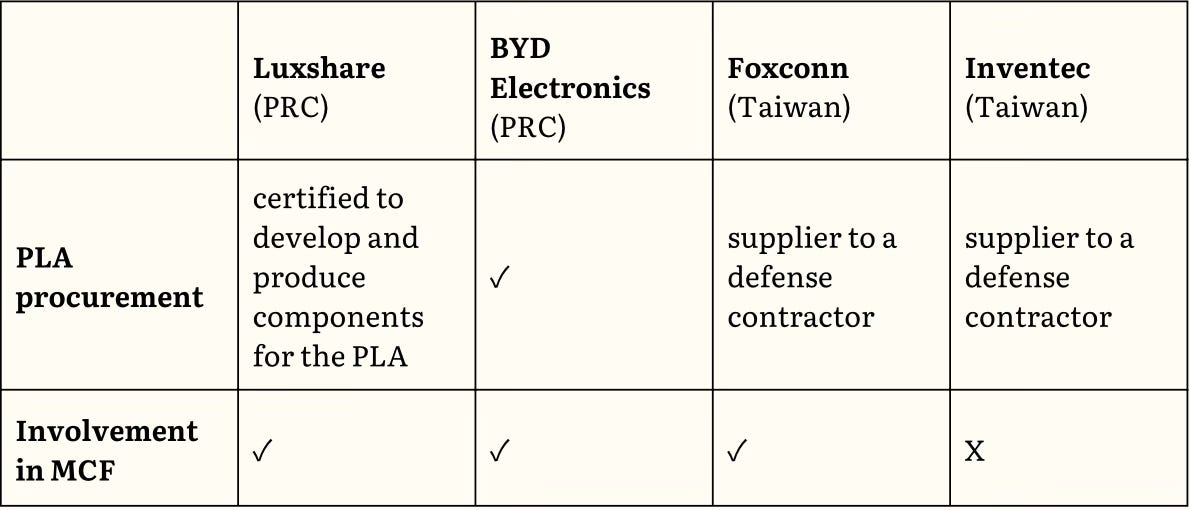
Contract manufacturers in the PRC have extensive, documented ties to the PRC’s military-industrial complex and its MCF development strategy. These encompass a broad range of activities, from agreements to produce components for weapons systems to integration in defense supply chains and involvement in military-related research. There are clear distinctions in this tier between domestic and Taiwanese firms, with the latter less directly involved in defense-related manufacturing and innovation.
BYD Electronics appears to be the most heavily involved in the direct production of inputs to military systems. Its parent firm, BYD, manufactures engines that have been used in the PLA’s armored personnel carriers. [32] The firm also has a documented strategic partnership with the China Academy of Launch Vehicle Technology (CALVT), the PRC’s largest research and production base for missile weapons and carrier rockets. (CALVT is also known as the First Academy of the China Aerospace Science and Technology Corporation (CASC; 中国航天科技集团).) This collaboration is explicitly designed to implement the MCF development strategy by leveraging BYD’s expertise in materials and electronics for defense applications. [33] A wholly-owned subsidiary of Luxshare, meanwhile, Suining Luxshare (遂宁立讯精密工业), is an officially recognized “Sichuan province military–civil fusion enterprise unit” (四川省军民融合企业 (单位)). [34] In 2020, the company secured a certification that allows it to develop and produce components for weapons and equipment, the “Weapon Equipment Quality Management System Certification” (GJB9001). [35] It is unclear whether the firm has followed through with production, but its receipt of certification to do so is strong evidence that it has done so.
The PLA does not appear to procure directly from Foxconn or Inventec, but both firms are involved in defense supply chains. This is primarily through a defense contractor called Shenzhen Prince New Material (深圳王子新材), whose regulatory filings describe “military electronics” (军工电子) as part of its core business, alongside packaging materials and thin-film capacitors for defense-related electronics manufacturing. [36] Inventec is a supplier to the firm, while it, in turn, is a supplier to Foxconn. [37] Another Foxconn supplier, Chongqing Qianwei Technologies Group (重庆前卫科技集团), is wholly-owned by the China State Shipbuilding Corporation (中国船舶集团) and tasked with supporting the defense industry. [38]
Foxconn also has partnerships with defense companies or entities involved in MCF. It has jointly invested in semiconductor packaging projects with Qingdao West Coast New Area Ronghe Holding Group (青岛西海岸新区融合控股集团), whose mission includes advancing MCF. [39] It also has helped build out a cloud industry ecosystem in Yunqi Town, a Zhejiang provincial specialty town designated as an MCF industrial base during the 13th Five-Year Plan period, and is a co-initiator of the “Digital Transformation Action for Private Enterprises” (民营企业数字化转型行动), which seeks to leverage private firms to support national security and development needs. [40] This is less extensive than Luxshare, however, which has led funding rounds for XLOONG (北京枭龙科技), a Beijing-based startup whose augmented reality smart glasses are used for military training and aerospace overlays by defense giants NORINCO (中国兵器工业集团) and CASIC (中国航天科工集团). [41] Luxshare also co-founded a silicon-carbide joint venture with battery giant CATL (宁德时代新能源科技), which the U.S. Department of Defense designates as a Chinese Military Company, and with SAIC Motor (上海汽车集团), which is one of the PRC’s biggest auto manufacturers and is also a direct supplier to the PLA. [42]
Support for the defense sector is also found in the research sector. Here, too, Foxconn appears to play a prominent role. The company has engaged in collaborative research, talent cultivation, and training with several of the “Seven Sons of National Defense” (国防七子)—universities affiliated with the Ministry of Industry and Information Technology (MIIT) that are known for conducting defense-related R&D. These include Nanjing University of Aeronautics and Astronautics, Harbin Institute of Technology, Harbin Engineering University, and Northwestern Polytechnical University. [43] These collaborations, which often run through Foxconn’s premier research organization, the Hon Hai Research Institute (HHRI), include work on quantum, AI, cryptography, and photonics—and are usually funded by PRC government grants. [44]Luxshare has also participated in high-level MCF matching conferences alongside defense giants like CETC (中国电子科技集团) and CASIC. [45]
Despite these research programs, Foxconn’s HHRI does appear to insulate itself from adverse PRC influence. Its leading research team is entirely Taiwanese, and all members have studied or worked outside the PRC, in Taiwan, the United States, the United Kingdom, Australia, and Japan; only one has spent a brief period working within the PRC. Its advisory council has a similar makeup, though at least one member, Kai-Fu Lee, has extensive experience working in the technology sector in the PRC. [46]
Table 1: Firm Involvement with PLA Procurement or Military–Civil Fusion
Support for State-Backed R&D and Industrial Initiatives
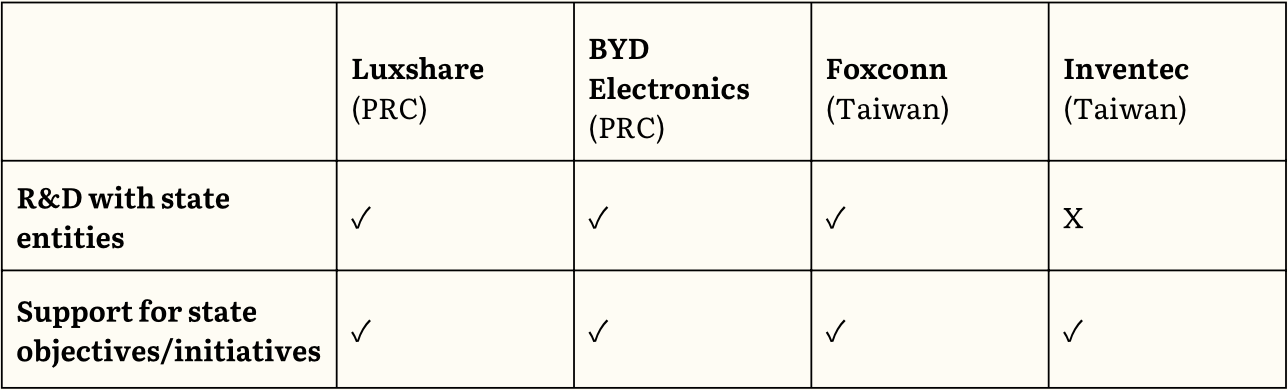
Beyond the involvement with “Seven Sons” universities detailed above, all of the firms except Inventec have collaborated with Party-run or national-level research institutions on developing technologies prioritized in government policies. For instance, all three have collaborated with the Chinese Academy of Sciences (CAS). Luxshare has established a joint engineering center with the Songshan Lake Materials Laboratory (松山湖材料实验室), which is led by the CAS Institute of Physics, an organization that focuses on national strategic needs and features on the U.S. government’s Entity List. [47]BYD is involved with “integrated innovation” (融合创新) with both CAS and a State Grid-affiliated energy research platform in Hunan. [48] And Foxconn has collaborated with the Shenyang Institute of Automation (SIA), part of CAS, on work related to industrial robotics via the firm’s president, Dai Jiapeng (戴家鹏). [49]
Both PRC firms have extensive ties with organizations that the U.S. government has put on its Entity List or has categorized as a Chinese Military Company. Luxshare has co-developed humanoid robotics products for industrial settings with China Unicom (中国联合网络通信集团), a Chinese Military Company. [50] It also partners on metaverse-related innovation with Sugon (曙光信息产业) and Cambricon (寒武纪科技), both of whom appear on the Entity List. [51] Less directly, Luxshare is a member of the China Cloud Computing Technology and Industry Alliance (中国云计算技术与产业联盟), whose membership includes firms the U.S. government designates as Chinese military companies: China Mobile (中国移动), Huawei, and Inspur (浪潮). [52] BYD, meanwhile, is intimately involved with the Chinese Academy of Engineering (CAE), another Party-run research organization that features on the Entity List. Its principal scientist, Lian Yupo (廉玉波), became a CAE academician in late 2025. [53]
The two Taiwanese firms do not appear to have any further involvement with Party-state research institutions, outside of Dai Jiapeng’s CAS affiliation. Foxconn, however, does have local government clients. It has signed agreements with Nanjing’s city government to build R&D centers for LCD smart TVs and intelligent terminals, and it has a “strategic cooperation agreement” (战略合作协议) with the Henan government to advance its “3+3” strategy (a precursor to the current “3+3+3” framework). [54] Inventec’s website, meanwhile, expresses alignment with the “Made in China 2025” strategy, though it does not appear to be embedded in the Party-state research ecosystem to the same extent as the other firms. [55]
Table 2: Firm Involvement With State-led Research and Development
Governance Ties: Party Committees or Executives with Formal Political Positions
Party work within private companies, along with political activities conducted by management- or executive-level employees, is found across all four contract manufacturers analyzed in this brief. Certain caveats apply when assessing the role of the CCP within private companies. As the establishment of Party organizations is mandatory for practically all private enterprises operating in the PRC—including overseas enterprises—the mere presence of Party cells, branches, or committees does not necessarily entail a national security risk or alignment with the Party’s agenda. Many of the cases presented here, however, appear to far exceed that threshold.
Of the four, Luxshare is by far the most formally integrated with the Party-state. Its corporate bylaws explicitly mandate the establishment of a CCP organization within the company: Article 12 states the company must “carry out Party activities” (开展党的活动) and “provide the necessary conditions” (提供必要条件) for the Party organization’s work. [56] In late 2024, employees at one Luxshare facility held a study session to absorb lessons from Xi Jinping’s industrial inspection tour of Anhui province. [57] Most critically, the company’s chairwoman, Wang Laichun (王来春), is a senior member of at least two central Party bodies. She is a member of the National Committee of the Chinese People’s Political Consultative Conference (CPPCC), which is a central coordinating body for the Party’s united front system, and she is Vice Chair of the China Women’s Chamber of Commerce, a body that sits under the All-China Federation of Industry and Commerce (ACFIC), an organization managed by the United Front Work Department. [58]
BYD Electronics does not have such high-level individuals with prominent Party roles. One senior scientist, however, Gong Qing (宫清), is simultaneously the dean of both BYD’s Central Research Institute and its Basic Science Research Institute, and a deputy to the Shenzhen People’s Congress. All of these positions require her to contribute to national development strategies. [59]
Foxconn exhibits a remarkable level of Party activity for a non-PRC firm. As of late 2025, it had established a “group Party school” (集团党校) and had roughly 16,000 registered Party members within its workforce across almost 1,000 Party branches. At its Kunshan facility, internal Party members work to “stimulate red momentum” (激发红色动能) and build a “Red Foxconn” (红富士) brand. [60] Media coverage claims that Foxconn’s Party members have “actively stepped forward to spearhead the company’s innovation and transformation” (党员纷纷争当企业创新转型的排头兵), while the firm employee with the most patent applications for four years running in the mid-2010s, “invention king” Li Xiaoguang, explicitly linked his work to his ambitions for national development. [61] This reinforces research highlighted above that links higher Party activity in private enterprises with more innovation.
Inventec, again, is the firm with the lowest level of integration with Party-state governance structures. The strongest piece of evidence came in 2024, when Vice Chair of the National Committee of the CPPCC and chair of the CCP-led Taiwan Democratic Self-Government League Su Hui (苏辉), conducted an inspection tour of Inventec’s facilities in Chongqing. Such visits can serve as official signals of approval, and in this case suggest at least a minimal degree of compliance with Beijing’s cross-strait policy framework and support for industrial cooperation. [62]
Table 3: Firm Ties with the Party-State
Public Political Alignment with Party-State Policies
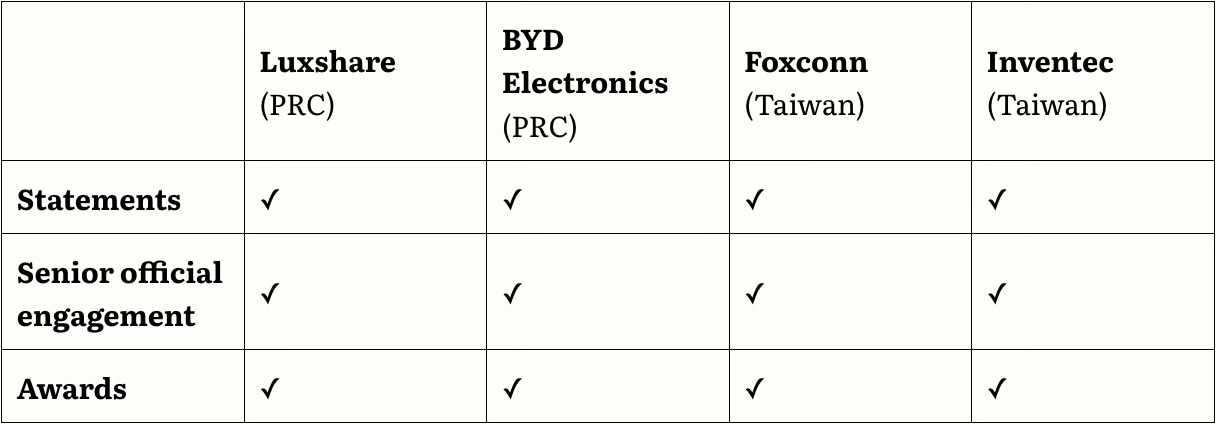
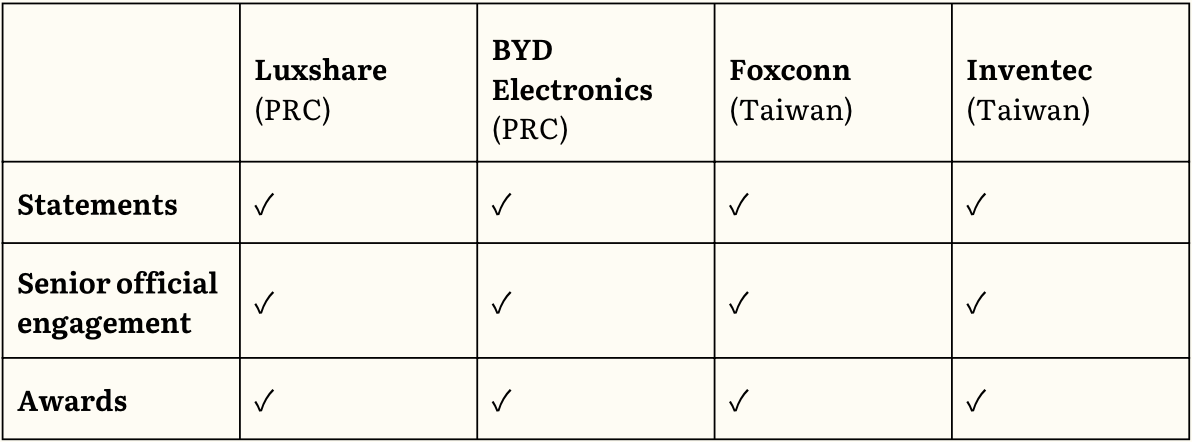
All four firms have demonstrated alignment with PRC national strategies. As with indicators of Party alignment covered above, some of these are rhetorical: company executives frequently tailor statements to their target audience, which in the PRC is frequently Party or local government officials who hold considerable power over the fates of enterprises. Stated commitments therefore must be handled with care, as follow-through does not always occur. Foxconn’s founder and former chairman Terry Gou, for instance, has announced factories all over the world that either fell short of expectations or failed to materialize. [63] Just as firms may not follow through on commercial commitments, political commitments may also fail to move beyond symbolism.
Statements can still be revealing, even if they are not always literal reflections of company policy. For instance, Luxshare’s chairwoman Wang Laichun has publicly said that private manufacturing firms are “important practitioners of national strategy” (国家战略的重要践行者) and that growth requires “resonating with the times” (与时代同频共振)—in other words, aligning with state priorities. In 2024, then-general manager Chen Chaofei (陈朝飞) explicitly credited the company’s growth to the “great support of Party committees and governments at every level” (各级党委、政府的大力支持). [64] BYD, meanwhile, has stated that its R&D model is designed to “actively integrate into the national innovation system” (主动融入国家创新体系), working with state entities to explore “autonomous and controllable” (自主可控) technology paths. In PRC industrial policy language, “autonomous and controllable” refers to reducing dependence on foreign suppliers in strategically sensitive technology stacks and ensuring domestic control over core industrial capabilities, particularly in advanced manufacturing and high-tech systems with potential dual-use relevance, which is closely associated with broader national security and defense-industrial resilience objectives. [65] Terry Gou has also previously stated that Foxconn would “participate wholeheartedly and by no means be absent” (将全力参与,绝不缺席) in the Made in China 2025 strategy. [66]
A slightly better indicator of political alignment is interaction with political leaders. Terry Gou has participated in numerous signing ceremonies with top-level officials on behalf of Foxconn, including Henan Governor Guo Gengmao (郭庚茂) and Provincial Party Secretary Lou Yangsheng (楼阳生); and in 2017, Premier Li Keqiang (李克强) toured Foxconn’s unmanned smart manufacturing workshop in Zhengzhou. [67] Luxshare similarly has gone to great lengths to prove its bona fides, holding a joint CCP study session with State Grid Xuancheng Power Supply (国网宣城供电) in 2024, attended by company leadership and district Party officials, and fielding multiple visits from government-affiliated service platforms and external experts as it sought to formalize its entry into defense-related production. [68]
A stronger signal is state approval of company efforts, for instance through the awarding of industry prizes. Dr. Gong Qing (宫清) of BYD, for instance, received the China National Patent Gold Award in 2013 for her technical patents, an honor jointly issued by the World Intellectual Property Organization and the PRC’s National Intellectual Property Administration. [69] Inventec’s Shanghai factory also received the “2020 China Benchmark Smart Factory” (2020中国标杆智能工厂) award, which management linked to the company’s progress toward the “Made in China 2025” strategy. [70] Inventec also participates in the World Internet Conference in Wuzhen, a key state-sponsored forum for promoting the PRC’s vision of internet governance. CEO Tom Cho (卓桐华), who is a citizen of the Republic of China (Taiwan), has been a featured speaker on cross-Strait Internet development at the event. [71]
Compared to the three categories above, the evidence provided here is only weakly indicative of firms’ support for the Party-state’s ambitions. It nevertheless complements the stronger evidence presented in earlier sections, as well as reinforcing the distinction between domestic and Taiwanese contract manufacturers.
Table 4: Firm Symbolic Ties to the Party-State
Conclusion
In the mid-1980s, a U.S. government report warned of the dangers of technology transfer to the PRC. Following a decision to loosen controls on the export of dual-use technologies, analysts at the Office of Technology Assessment (OTA) wrote, “the ultimate risk is that a future China that may be hostile to the United States would benefit militarily as well as economically.” [72] That future has now arrived. Xi Jinping is doubling down on a strategy of self-reliance in technological innovation through what some analysts describe as an “industrial policy of everything.” [73] Xi is explicit about this agenda. At the Central Economic Work Conference in December 2025, he affirmed that the country “must strengthen internal capabilities to meet external challenges” (必须以苦练内功来应对外部挑战) and encouraged those listening to “comprehensively enhance independent innovation capabilities and remain invincible amid turbulent times” (全面增强自主创新能力,在惊涛骇浪中始终立于不败之地). [74]
Contract manufacturers, as this brief has shown, have been an important, if understudied, channel for the PRC’s industrial upgrading. By producing hardware on behalf of leading Western firms, they have enabled the transfer of technology, knowledge, and resources to the PRC. This has also led to positive spillover effects among the wider manufacturing sector in the PRC—often to the detriment of the industrial bases of Western countries. As contract manufacturers have expanded dramatically in the PRC over the last three decades, their scale has frequently led them to seek political support and protection; but it has also exposed them to certain vulnerabilities. As the comparison between domestic and Taiwanese firms operating in the country shows, firms do not have to be ideologically aligned with the CCP to end up behaving in ways that contribute to its agenda. While companies may decide to engage in Party- or state-aligned activities because it makes commercial sense to do so, the Party-state has constructed its Integrated National Strategic System and Capabilities in such a way that firms’ achievements support national strength regardless of their individual preference, through military–civil fusion initiatives, R&D collaborations, or other legal and regulatory obligations.
As leading contract manufacturers transition toward producing higher-end technologies that Beijing views as strategically critical, the risks for overseas customers and non-PRC manufacturers are becoming more acute. The PRC seeks to use these firms to help it seize the commanding heights in technologies such as robotics, AI infrastructure, and NEVs. This runs counter to the interests of the United States and its allies—including Taiwan. The risks these firms will incur going forward will be exacerbated by tit-for-tat policy measures. Chinese authorities have repeatedly warned that Taiwanese firms will suffer from attempts to decouple supply chains from the PRC; and Beijing is expanding policies to restrict the outflow of AI talent from the country. [75] Aggressive controls of this nature are now the norm. It is now up to both firms and policymakers to recognize this new risk environment and take requisite precautionary steps to mitigate further technology transfers to the Chinese military and deeper support for a manufacturing ecosystem designed to strengthen the West’s principal systemic rival.
This issue brief was originally published on The Jamestown Foundation’s website. you can read it here.
Notes
[1] “Firmly Implement the Holistic National Security Concept and Safeguard Chinese-Style Modernization with High-Level Security [坚定不移贯彻总体国家安全观 以高水平安全护航中国式现代化],” Qiushi [求是], April 15, 2025,https://archive.ph/kyGdJ.;
“Chen Yixin Published an Article in Study Times Entitled ‘Building a Solid Barrier to National Security in All Respects’ [陈一新在《学习时报》发表署名文章《全面筑牢国家安全的铜墙铁壁》],” Ministry of State Security [国家安全部], December 8, 2025, https://archive.ph/pzYia.;
Wang, Howard, “China Plans for ‘Total War’: Developing the Capacity to Defeat the ‘Strong Enemy’ of the United States,” Journal of Contemporary China April (2026), 1–15, doi:10.1080/10670564.2026.2662561.
[2] “Constitution of the Chinese Communist Party [中国共产党章程],” CCP Members Net [共产党员网], accessed May 27, 2026, https://archive.ph/5sY00.;
“Authorized Release from the Two Sessions: Outline of the 15th Five-Year Plan for National Economic and Social Development of the People’s Republic of China [两会受权发布丨中华人民共和国国民经济和社会发展第十五个五年规划纲要],” Xinhua [新华社], March 13, 2026, https://archive.ph/amIeg.
[3] Gary Gereffi, “The Organization of Buyer-Driven Global Commodity Chains: How US Retailers Shape Overseas Production Networks.” In Gary Gereffi and Miguel Korzeniewicz, eds., Commodity Chains and Global Capitalism. Praeger, 1994
[4] Emir Malikov and Shunan Zhao, “On the Estimation of Cross-Firm Productivity Spillovers with an Application to FDI,” Review of Economics and Statistics 105, no. 5 (2023): 1207–23, https://doi.org/10.1162/rest_a_01080.
[5] Gary Gereffi, John Humphrey, and Timothy Sturgeon, “The Governance of Global Value Chains,” Review of International Political Economy 12, no. 1 (2005): 78–104, https://doi.org/10.1080/09692290500049805.
[6] Sean O’Connor, “How Chinese Companies Facilitate Technology Transfer from the United States,” U.S.-China Economic and Security Review Commission, May 6, 2019,https://www.uscc.gov/sites/default/files/Research/How%20Chinese%20Companies%20Facilitate%20Tech%20Transfer%20from%20the%20US.pdf.
[7] John Minnich, Scaling the Commanding Heights: The Logic of Technology Transfer Policy in Rising China, nos. 2023–2 (MIT Political Science Department, 2023), https://ssrn.com/abstract=4496386.
[8] Jie Bai, Panle Jia Barwick, Shengmao Cao, and Shanjun Li, “Quid Pro Quo, Knowledge Spillovers, and Industrial Quality Upgrading: Evidence from the Chinese Auto Industry,” American Economic Review 115, no. 11 (2025): 3825–52,https://doi.org/10.1257/aer.20221501.
[9] “Findings of the Investigation into China’s Acts, Policies, and Practices Related to Technology Transfer, Intellectual Property, and Innovation under Section 301 of the Trade Act of 1974,” Office of the United States Trade Representative, March 22, 2018, https://ustr.gov/sites/default/files/Section%20301%20FINAL.PDF.;
“Executive Summary of Four Year Review of China Tech Transfer Section 301,” Office of the United States Trade Representative, May 14, 2024,https://ustr.gov/sites/default/files/05.13.2024%20Executive%20Summary%20of%20Four%20Year%20Review%20of%20China%20Tech%20Transfer%20Section%20301%20(Final).pdf.
[10] Beata Smarzynska Javorcik, “Does Foreign Direct Investment Increase the Productivity of Domestic Firms? In Search of Spillovers through Backward Linkages,” American Economic Review 94, no. 3 (2004): 605–27,https://doi.org/10.1257/0002828041464605;
Wolfgang Keller and Stephen Yeaple, “Multinational Enterprises, International Trade, and Productivity Growth: Firm-Level Evidence from the United States,” Review of Economics and Statistics 91, no. 4 (2009): 821–31, http://www.jstor.org/stable/25651379.
[11] Malikov and Zhao, supra 4.
[12] William Ridley, Wolfgang Keller, Larry D. Qiu, and Kun Jiang, “Joint Ventures and Technology Transfer: New Evidence from China,” VoxEU, Centre for Economic Policy Research, April 15, 2018,https://cepr.org/voxeu/columns/joint-ventures-and-technology-transfer-new-evidence-china.
[13] Bai et al., supra 8;
Jaedo Choi, George Cui, Younghun Shim, and Yongseok Shin, The Dynamics of Technology Transfer: Multinational Investment in China and Rising Global Competition, no. 34284 (National Bureau of Economic Research, 2025),https://doi.org/10.3386/w34284.
[14] Boy Lüthje, Global Production Networks and Industrial Upgrading in China: The Case in Electronics Contract Manufacturing, no. 74 (East-West Center, 2004),https://scholarspace.manoa.hawaii.edu/server/api/core/bitstreams/732b22e0-d1de-4b90-a402-aba0e2beabb1/content.
[15] “How Luxshare Went from Minor Manufacturer to Major iPhone Supplier,” AppleInsider, October 23, 2023,https://appleinsider.com/articles/23/10/23/how-luxshare-went-from-minor-manufacturer-to-major-iphone-supplier.
[16] David Autor, David Dorn, and Gordon H. Hanson, “The China Shock: Learning from Labor-Market Adjustment to Large Changes in Trade,” Annual Review of Economics 8 (October 2016): 205–40, https://doi.org/10.1146/annurev-economics-080315-015041;
David Autor and Gordon H. Hanson, “We Warned About the First China Shock. The Next One Will Be Worse,” New York Times, July 14, 2025, https://www.nytimes.com/2025/07/14/opinion/china-shock-economy-manufacturing.html;
U.S.-China Economic and Security Review Commission, China Shock 2.0 (U.S.-China Economic and Security Review Commission, 2025), https://www.uscc.gov/sites/default/files/2025-11/Chapter_8--China_Shock_2.0.pdf;
Sander Tordoir and Janka Oertel, “China Shock 2.0: The Cost of Germany’s Complacency,” Centre for European Reform, May 20, 2026, https://www.cer.eu/publications/archive/policy-brief/2026/china-shock-20-cost-germanys-complacency.
[17] Jennie Bai, Luc Laeven, Yaojun Ke, and Hong Ru, “China’s Global Ownership,” NBER Working Paper 35106, April (2026), https://www.nber.org/papers/w35106.
[18] Jaedo Choi et al., 2025, supra 13.
[19] Ryan Hass and Emily Weinstein, “The United States, China, and the Contest for the Fourth Industrial Revolution,” Brookings Institution, November 10, 2021, https://www.brookings.edu/articles/the-united-states-china-and-the-contest-for-the-fourth-industrial-revolution/; Bai et al., supra 8.
[20] Danie Koss, “Party Building as Institutional Bricolage: Asserting Authority at the Business Frontier,” The China Quarterly 248, no. S1 (2021): 222–43. https://doi.org/10.1017/S0305741021000692;
Margaret M. Pearson, Meg Rithmire, and Kellee S. Tsai, “China’s Party-State Capitalism and International Backlash: From Interdependence to Insecurity,” International Security 47, no. 2 (2022): 135–176. https://doi.org/10.1162/isec_a_00447.
[21] Liu, Xiaoxue, Jingyun Zhou, You Wu, and Na Hao, “The Influence of Party Organization Involvements in Corporate Governance on Innovation: Evidence from China’s Private-Owned Enterprises” Sustainability 14, no. 24 (2022). https://doi.org/10.3390/su142416334.
[22] Gereffi, 1994, supra 3.
[23] Anti–Foreign Sanctions Law of the People’s Republic of China [中华人民共和国反外国制裁法] (promulgated by the Standing Committee of the National People’s Congress, June 10, 2021, effective June 10, 2021);
Camille Boullenois, Malcolm Black, and Alessia Caruso, “China’s Next-Generation Industrial Policy,” Rhodium Group, May 11, 2026, https://rhg.com/research/chinas-next-generation-industrial-policy/.
[24] Sankalp Phartiyal and Debby Wu, “Foxconn’s Recall of More Chinese Staff Tests Apple’s India Push,” Bloomberg, August 23, 2025, https://www.bloomberg.com/news/articles/2025-08-23/foxconn-s-recall-of-more-chinese-staff-tests-apple-s-india-push;
Isaac Stone Fish, “The Impossible Partnership: Apple’s Coming Reckoning with China,” American Affairs 10, no. 2 (May 2026), https://americanaffairsjournal.org/2026/05/the-impossible-partnership-apples-coming-reckoning-with-china/.
[25] U.S.-China Economic and Security Review Commission, “Made in China 2025: Evaluating China’s Performance,” November 14, 2025, https://www.uscc.gov/research/made-china-2025-evaluating-chinas-performance.
[26] The Laws:
Law of the People’s Republic of China on Promoting the Transformation of Scientific and Technological Achievements [中华人民共和国促进科技成果转化法] (promulgated by the Standing Committee of the National People’s Congress, May 15, 1996; amended August 29, 2015).
Science and Technology Progress Law of the People’s Republic of China [中华人民共和国科学技术进步法] (promulgated by the Standing Committee of the National People’s Congress, July 2, 1993; amended December 24, 2021).
National Defense Law of the People’s Republic of China [中华人民共和国国防法] (promulgated by the National People’s Congress, March 14, 1997; amended December 26, 2020).
Guiding Opinions of Seven Departments on Financial Support for New Industrialization [工业和信息化部等七部门, 关于金融支持新型工业化的指导意见] (Ministry of Industry and Information Technology et al., April 2024).
Policy Measures to Accelerate the Construction of a Science and Technology Finance System [中国人民银行等七部门, 关于扎实做好科技金融大文章的工作方案] (People’s Bank of China et al., May 2024).
Provisions on Industrial and Supply Chain Security [产业链供应链安全稳定发展条例] (draft regulation issued by the Ministry of Industry and Information Technology for comment, 2023).
Rules on Counteracting Unjustified Extraterritorial Application of Foreign Legislation and Other Measures [国务院, 阻断外国法律与措施不当域外适用办法] (promulgated by the Ministry of Commerce, January 9, 2021, effective January 9, 2021).
[27] Ryan D. Martinson, “The Staged Death of China’s Military-Civil Fusion,” The Diplomat, April 25, 2026, https://thediplomat.com/2026/03/the-staged-death-of-chinas-military-civil-fusion/.
[28] Liu et al., 2022, supra 21.
[29] “Business Policy [經營方針],” Foxconn, accessed May 24, 2026, https://archive.ph/EpNlP.
[30] Yan Cui [严翠], “BYD Electronics’ revenue in 2025 was 179.477 billion yuan, with net profit decreasing by 17.61% year-on-year [比亚迪电子2025年营收1794.77亿元 净利润同比下降17.61%],” Securities Times Online [证券时报网], March 27, 2026, https://archive.ph/vorNZ.
[31] Xu Shengliang [余胜良], “Luxshare Precision’s shareholders’ meeting focused on AI computing power and new growth areas, while simultaneously developing its core strengths in both optical and copper technologies [立讯精密股东会交流聚焦AI算力与新赛道 光铜并进深耕核心优势]”, Securities Times Online [证券时报网], May 25, 2026, https://archive.ph/YzcEj.
[32] “BYD’s Hybrid Technology Is Already Serving the Military—What Do the Critics Have to Say Now? [比亚迪混动技术已经在服务军方了,喷子们作何感想],” Sohu [搜狐], May 27, 2024, https://archive.is/yvQc6.
[33] “China Academy of Launch Vehicle Technology Will Carry Out Strategic Cooperation with BYD on Honeycomb Structures and Composite Materials [火箭院将与比亚迪公司开展蜂窝结构以及复合材料战略合作],” China International Composite Exhibition [中国国际复合材料展览会], April 16, 2018, https://archive.is/wwx4A;
“The First Academy of Aerospace Science and Technology Teams Up with BYD to Advance Military–Civil Fusion [航天科技一院牵手比亚迪 发力军民融合 ],” China Defense Science and Technology Information Center [中国国防科技信息中心], March 19, 2018, https://archive.is/QV0Ae.
[34] “Sichuan Daily: Suining Private Enterprises Eagerly ‘Join the Military’ [四川日报:遂宁民营企业踊跃‘参军’],” Suining Daily [遂宁日报], June 14, 2017, https://archive.is/OqzgF;
“2024 Sustainability Report [2024 可持续发展报告],” Luxshare [立讯精密], April 26, 2025, http://web.archive.org/web/20251209180553/https://www.luxshare-ict.com/Public/Uploads/uploadfile2/files/20250426/lixunjingmi2024kechixufazhanbaogao-840.pdf.
[35] “Military-Civilian Technology Drives Development and Integration in Twin Cities [军民科技促发展联动融合建双城],” Suining Daily [遂宁日报], January 20, 2022, https://archive.is/aeYvs.
[36] “Shenzhen Prince New Materials Co., Ltd. Initial Public Offering Prospectus [深圳王子新材料股份有限公司首次公开发行股票招股说明书],” Sina Finance [新浪财经], November 21, 2014, https://archive.is/THYfc;
“Shenzhen Prince New Materials: Military Industry Business Up 343% Year-on-Year, Transformation Showing Initial Results [王子新材:军工业务同比增长343%,转型初显成效],” Sina Finance [新浪财经], May 11, 2022, https://archive.is/xhhE9;
“Shenzhen Prince New Materials Acquires the Remaining 49% Equity of CE Huarui, Continuing to Expand in Military-Related Business [王子新材并购中电华瑞剩余49%股权 继续发力军工相关业务],” Sina Finance [新浪财经], July 18, 2022, https://archive.is/zmBGx;
“Shenzhen Prince New Materials Co., Ltd. 2024 Annual Report [深圳王子新材料股份有限公司 2024 年年度报告],” Shenzhen Prince New Materials Co, Ltd. [深圳王子新材料股份有限公司], March 29, 2025,https://web.archive.org/web/20260323190543/https://static.cninfo.com.cn/finalpage/2025-03-29/1222946874.PDF.
[37] Ibid.
[38] “He is Known as ‘A Defense Industry Leader Who Dares to Fight Tough Battles,’ and His Motto Is ‘Once the Sword Is Drawn, There Is No Retreat’ [他被誉为‘敢打硬战的军工带头人’,他的座右铭是‘一旦亮剑,绝不退缩’],” Chongqing Times [重庆时报], July 24, 2018,https://web.archive.org/web/20250930203811/https:/dangjian.people.com.cn/n1/2018/0724/c420581-30166696.html;
“Military–Civil Fusion Industry Funds Benefit Defense Stocks, Humanoid Robots, and the Deep-Sea Economy [军民融合产业基金受益军工股、人形机器人、深海经济等],” Zhihu [知乎], March 25, 2025, https://archive.ph/dslT4.
[39] “In-Depth Report — Capital | Making Full Use of Capital to Accelerate Industrial Upgrading — Interview with Gao Shujun, Party Secretary and Chairman of Fusion Holding Group [【深度报道——资本】用活资本力量加速产业升级——专访融合控股集团党委书记、董事长高树军],” State-Owned Assets Report Magazine [《国资报告》杂志], December 28, 2020, https://archive.ph/VTlY0.
[40] “Launch Meeting for the Private Enterprises Digital Transformation Initiative of the All-China Federation of Industry and Commerce Held in Beijing [全国工商联民营企业数字化转型行动启动会在京召开],” All-China Federation of Industry and Commerce Economic Services Department [中华全国工商业联合会经济服务部], April 28, 2023, https://archive.ph/zAhFW;
“Military–Civil Fusion Characteristic Town: A Regional Practice of National Strategy [军民融合特色小镇:国家战略的区域实践],” Ministry of National Defense Net [国防部网], April 24, 2017, https://archive.ph/S5Run.
[41] “Xi’an Xiaolong Technology Co., Ltd. [西安枭龙科技有限公司],” Baidu [百度百科], accessed March 26, 2026,https://archive.is/7HSVm.
[42] “Letter to FBI,” Select Committee on the CCP, U.S. House of Representatives, July 15, 2025,https://chinaselectcommittee.house.gov/sites/evo-subsites/selectcommitteeontheccp.house.gov/files/evo-media-document/07.15.25_letter-to-fbi.pdf.
[43] “Professor Jay Lee from the University of Cincinnati and Delegation Visited Our University for Academic Exchange and Delivered an Excellent Academic Lecture [美国辛辛那提大学Jay Lee教授一行来我校交流访问并做精彩学术报告],” Nanjing University of Aeronautics and Astronautics [南京航空航天大学], March 16, 2018,https://archive.is/VbAbl;
“Terry Guo: Harbin Institute of Technology Trains Diligent and Pragmatic Talent — Foxconn Technology Group Founder and Chairman Terry Gou and Professor Jay Lee of the University of Cincinnati Visit the Campus [郭台铭:哈工大培养的人才勤奋务实——富士康科技集团创办人兼总裁郭台铭、美国辛辛那提大学教授李杰一行来访校区],” Harbin Institute of Technology, Shenzhen [哈尔滨工业大学(深圳)], May 25, 2018, https://archive.ph/WZxVT;
“Zhong Zhi, Director of the Institute of Detection and Measurement Technology at the School of Information and Communications, Harbin Engineering University, Conducts Research Visit to Foxconn Technology Group (Yantai) Industrial Park [哈尔滨工程大学信通学院检测与测量技术研究所所长钟志调研富士康科技集团(烟台)工业园],” Yantai Research Institute and Graduate School Construction and Management Office [烟台研究院、研究生院建设管理办公室], September 12, 2019, https://archive.is/CwgYf;
“Personal Homepage [基本信息],” Northwestern Polytechnical University [西北工业大学], accessed March 25, 2026, https://teacher.nwpu.edu.cn/2001000011.
[44] Examples of some published research in these fields coauthored by researchers at HHRI are as follows: Fahad Aziz, Kuan-Ting Lin, Ping-Yi Wen, Samina, Yu-Chen Lin, Emely Weigand, Ching-Ping Lee et al., “Nearly Quantum-Limited Microwave Amplification via Interfering Degenerate Stimulated Emission in a Single Artificial Atom.” npj Quantum Information 11, no. 45 (2025). https://doi.org/10.1038/s41534-025-00993-3;
Jihao Fan, Jun Li, Ya Wang, Yonghui Li, Min-Hsiu Hsieh, and Jiangfeng Du, “Partially Concatenated Calderbank-Shor-Steane Codes Achieving the Quantum Gilbert-Varshamov Bound Asymptotically,” IEEE Transactions on Information Theory 69, no. 1 (2023): 262–272, doi: 10.1109/TIT.2022.3201239;
Guo-Dong Su, Chia-Chen Lin, and Yung-Hui Li. “Position-Aware Guided Hiding Data Scheme with Reversibility and Adaptivity for Dual Images” Symmetry 14, no. 3 (2022). https://doi.org/10.3390/sym14030509;
Catherine Langpoklakpam, Siddharth Rana, Chi-Hsiang Hsieh, Jitendra Pratap Singh, Po-Tsung Lee, Ray-Hua Horng, Chang-Ching Tu, and Hao-Chung Kuo, “State-of-the-Art Solar Blind and X-Ray Photodetectors Based on Gallium Oxide,” Advanced Photonics Research 6, no. 11 (2025). https://doi.org/10.1002/adpr.202500008
[45] “2018 Chongqing–Suining Military–Civil Fusion Matching Conference Held [2018年重(庆)遂(宁)军民融合对接会举行],” Suining Daily [遂宁日报], January 21, 2022, https://archive.is/ODsNo.
[46] “R&D and Technology,” Foxconn, accessed May 24, https://archive.ph/zD4r1.
[47] “Wang Weihua: Cultivating a ‘Testing Ground’ for Reform and Innovation with the Spirit of Scientific Exploration [汪卫华:用科学探索精神耕耘改革创新的‘试验田’],” Chinese Academy of Sciences Journal [中国科学院院刊], November 11, 2021, https://archive.is/YZDJy.
[48] “BYD: Practice and Reflections on Driving Green Development Through Integrated Innovation [比亚迪:以融合创新驱动绿色发展的实践与思考],” Chinese Academy of Sciences [中国科学院] 40, no. 5 (2025): 828–834. https://web.archive.org/web/20260129192204/https://www.bjb.cas.cn/kcyw/202505/P020250523699357106337.pdf;
“BYD Energy Storage and State Grid Hunan Comprehensive Energy Deepen Cooperation, Focusing on Distributed Energy Storage [比亚迪储能与国网湖南综能深度合作,聚焦集散式储能],” China Energy Storage Alliance [中关村储能产业技术联盟], July 7, 2025, https://archive.is/SIRUw.
[49] “Foxconn Technology Group Vice President Dai Jiapeng Visits the Shenyang Institute of Automation [富士康科技集团副总裁戴家鹏访问沈阳自动化所],” Chinese Academy of Sciences [中国科学院], September 6, 2016,https://archive.ph/rOLtt;
“Chinese Academy of Sciences Shenyang Institute of Automation 2019–2020 Recruitment Notice [中国科学院沈阳自动化研究所2019-2020年招聘启事],” Chinese Academy of Sciences [中国科学院], September 10, 2019,https://archive.ph/BWEv3.
[50] “On-the-Ground Report from the Digital China Summit: ‘AI+’ Rapidly Enters Thousands of Industries [实探数字中国建设峰会 ‘人工智能+’快步走进千行百业],” Securities Daily [证券日报], April 30, 2025, https://archive.is/DW824;
“Smart Manufacturing Industry Site Selection List: Luxshare Robotics Headquarters Base Settles in Changshu [智能制造行业企业选址清单:立讯机器人总部基地落户常熟],” Qianzhan [前瞻网], September 9, 2025,https://archive.is/60rhE;
“Luxshare Robots [立讯机器人],” BOSS Direct Hire [BOSS直聘], accessed March 26, 2026,https://www.zhipin.com/gongsi/dcf954f131456c880HN40tS4.html.
[51] “New Observations on Future Industries: Dual-Core Drive Brings the ‘Virtual’ into Reality in Jiangsu [未来产业新观察︱双核驱动,江苏将‘虚拟’照进‘现实’],” Xinhua Daily [新华日报], September 16, 2025, https://archive.is/bXnap;
[52] “China Cloud Computing Technology and Industry Alliance Announces Establishment in Beijing [中国云计算技术与产业联盟在京宣布成立],” CSDN, February 1, 2010, https://archive.ph/OwpGI.
[53] “Chief Scientists of BYD and CATL Elected as Academicians of the Chinese Academy of Engineering [比亚迪、宁德时代首席科学家均当选中国工程院院士],” Sina Finance [新浪财经], November 21, 2025, https://archive.is/oOSdz.
[54] “Nanjing Municipal Government and Foxconn Technology Group Sign Strategic Cooperation Agreement [南京市政府与富士康科技集团签署战略合作协议],” Nanjing Daily [南京日报], September 13, 2017, https://archive.ph/xq5av;
“Provincial Government and Foxconn Technology Group Sign Strategic Cooperation Agreement; Lou Yangsheng and Wang Kai Attend [省政府与富士康科技集团签署战略合作协议 楼阳生王凯出席],” Henan Government Net [河南政府网], July 23, 2024, https://archive.ph/cGdJj;
“Foxconn and the Henan Provincial Government Sign a Strategic Cooperation Agreement [富士康与河南省政府签署战略合作协议],” China Securities Net [中证网], July 24, 2024, https://archive.ph/tFwYL.
[55] “Inventec’s Shanghai Factory Named to the ‘2020 China Benchmark Smart Factory’ List [英业达上海工厂荣登“2020中国标杆智能工厂”榜单],” Inventec [英业达], accessed March 26, 2026, https://archive.is/f4xUa.
[56] “Articles of Association of Luxshare Precision Industry Co., Ltd. [立讯精密工业股份有限公司 章程],” Luxshare [立讯精密], April 2023, https://web.archive.org/web/20260323162724/https://www.luxshare-ict.com/Public/Uploads/uploadfile/files/20231025/lixunjingmigongsizhangcheng2023nian4yue.PDF.
[57] “BYD Energy Storage and State Grid Hunan Comprehensive Energy Deepen Cooperation, Focusing on Distributed Energy Storage [比亚迪储能与国网湖南综能深度合作,聚焦集散式储能],” Supra 48.
[58] “Wang Laichun, CPPCC National Committee Member and Chairwoman of Luxshare Precision: Leveraging the Leading Role of ‘Chain-Leading’ Enterprises to Drive High-Quality Manufacturing Development [全国政协委员、立讯精密董事长王来春:发挥链主企业头雁效应 引领制造业高质量发展],” Shanghai Securities News [上海证券报], March 8, 2023, https://archive.is/LnWvn.
[59] “Innovation and Entrepreneurship Lecture | Dr. Gong Qing: Industrial Development and Application of Functional Materials for Intelligent Manufacturing [双创讲座|宫清博士:面向智能制造的功能材料 产业化开发与应用],” Nanjing University [南京大学], December 7, 2020, https://archive.is/pnKvb;
“Gong Qing, Director of BYD Basic Science Research Institute, Is 58 Years Old and a Female PhD, She Shows High Loyalty [比亚迪基础科学研究院院长宫清已经58岁 是女博士忠诚度很高],” Sina Finance [新浪财经], November 28, 2023, https://archive.is/r0iDn;
“Gong Qing [宫清],” Shenzhen Technology University [深圳技术大学], January 31, 2024, https://archive.is/cDk4e.
[60] “Kunshan Explores Innovative Party-Building Paths in Emerging Sectors [昆山探索新兴领域党建创新路径,]” Suzhou Daily [苏州日报], May 6, 2025, https://archive.ph/3zcGU;
“Foxconn Establishes Group Party School with 16,000 Registered Party Members [拥有1.6万名在册党员的富士康成立集团党校了],” Nanfang Daily [南方日报], July 9, 2018, https://archive.ph/7cz3w;
“How to Ignite ‘Red Momentum’ in Taiwanese-Funded Enterprises? A Look at Foxconn Kunshan’s Innovative Practices [如何在台资企业激发红色动能?昆山富士康创新做法看这里],” Party Building in Non-Public Enterprises Magazine [《非公有制企业党建》杂志], December 17, 2020, https://archive.is/alkfd.
[61] “The ‘Red Engine’ Boosts Foxconn’s Development [“红色引擎”助力富士康发展],” Nanfang Daily [南方日报], March 6, 2018, https://archive.ph/0jMld.
[62] “CPPCC Vice Chairman Su Hui Leads a Delegation to Chongqing for Inspection and Research; Hu Henghua and Cheng Lihua Participate in Related Activities [全国政协副主席苏辉率队到重庆考察调研 胡衡华程丽华参加相关活动],” Chongqing Daily [重庆日报], April 19, 2024, https://archive.is/X57Qs.
[63] Josh Dzieza, “Inside Foxconn’s Empty Buildings, Empty Factories, and Empty Promises in Wisconsin,” The Verge, October 19, 2020, https://archive.ph/5FK7Q.
[64] “Gong Qing [宫清],” Supra 59;
“Zheng Guangquan Leads Delegation to Visit and Inspect Luxshare Precision Industry Co., Ltd. [郑光泉率队拜访考察立讯精密工业股份有限公司],” The Paper [澎湃新闻], September 5, 2024, https://archive.ph/WXVXx.
[65] “Shenzhen Prince New Materials Acquires the Remaining 49% Equity of CE Huarui, Continuing to Expand in Military-Related Business [王子新材并购中电华瑞剩余49%股权 继续发力军工相关业务],” Sina Finance [新浪财经], July 18, 2022, https://archive.is/zmBGx;
For more information about 自主可控, see “How to Understand the Autonomous and Controllable Industrial System [如何理解产业体系自主可控],” Economic Daily [经济日报], August 14, 2023, https://archive.is/PXTsl.
[66] “After Foxconn’s “Thirteen Jumps”: One Million Employees and the Transformation Dilemma of a Contract-Manufacturing Empire [富士康‘十三跳’后:百万员工与代工帝国的转型困局],” 人民网 IT频道 [People’s Daily Online IT Channel], May 27, 2015, http://web.archive.org/web/20211207151947/http://it.people.com.cn/n/2015/0527/c1009-27064134.html.
[67] “Terry Gou: Foxconn Will Not Be Absent from ‘Made in China 2025’ [郭台铭:中国制造2025富士康绝不缺席],” Foxconn [富士康], accessed March 25, 2026, https://archive.ph/7H44b;
“Was Made in China 2025 Successful?,” Rhodium Group, May 5, 2025, https://rhg.com/research/was-made-in-china-2025-successful/;
“Zhengzhou Foxconn Technology Group Zhengzhou Science and Technology Park [郑州富士康科技集团郑州科技园],” Foxconn Employment Net [富士康招聘网], July 26, 2016, https://archive.ph/l2KUj;
“Provincial Government and Foxconn Technology Group Sign Strategic Cooperation Agreement; Lou Yangsheng and Wang Kai Attend [省政府与富士康科技集团签署战略合作协议 楼阳生王凯出席],” Henan Government Net [河南政府网], July 23, 2024, https://archive.ph/cGdJj;
“Foxconn and the Henan Provincial Government Sign a Strategic Cooperation Agreement [富士康与河南省政府签署战略合作协议],” China Securities Net [中证网], July 24, 2024, https://archive.ph/tFwYL;
“Foxconn and China’s Industrialization [富士康与中国的工业化],” Zhihu [知乎], July 16, 2017, https://archive.ph/JK4CU
[68] “Sichuan Daily: Suining Private Enterprises Eagerly ‘Join the Military’” [四川日报:遂宁民营企业踊跃‘参军’],” Suining Daily [遂宁日报], June 14, 2017, https://archive.is/OqzgF;
“State Grid Xuancheng Power Supply Company and Xuancheng Luxshare Precision Industry Co., Ltd. Hold Joint Study Session and Unveiling Ceremony for the Wanmei Communist Party Member Service Team [国网宣城供电公司与宣城立讯精密工业有限公司开展联学暨皖美共产党员服务队揭牌仪式举行],” Anhui Xuancheng High-Tech Industrial Development Zone [安徽宣城高新技术产业开发区], December 20, 2024, https://archive.is/7qGPf.
[69] “Gong Qing [宫清],” Supra 59.
[70] “Inventec’s Shanghai Factory Named to the ‘2020 China Benchmark Smart Factory’ List [英业达上海工厂荣登“2020中国标杆智能工厂”榜单],” Inventec [英业达], accessed March 26, 2026, https://archive.is/f4xUa.
[71] “Inventec CEO Tom Cho Remarks [英业达集团董事长卓桐华发言],” Economic Daily [经济日报], November 8, 2018, https://archive.is/a3yUY.
[72] Energy Technology Transfer to China—A Technical Memorandum (U.S. Congress, Office of Technology Assessment, 1985), https://www.princeton.edu/~ota/disk2/1985/8510/851001.PDF.
[73] Camille Boullenois, Malcolm Black, and Alessia Caruso, “China’s Next-Generation Industrial Policy,” Rhodium Group, May 11, 2026, https://rhg.com/research/chinas-next-generation-industrial-policy/.
[74] Xi Jinping [习近平], “Strengthen, Optimize, Grow the Real Economy [做强做优做大实体经济],” Qiushi [求是], May 15, 2026, https://archive.ph/aig0D#selection-65.0-65.10.
[75] “Lai Ching-te’s So-Called ‘Non-Red Supply Chain’ is Being Used to Sell Out Taiwan in Order to Pursue ‘Independence,’ Which Will Only Harm and Destroy Taiwan [赖清德搞所谓“非红供应链” 国台办:为谋“独”而卖台,只会害台毁台],” Xinhua [新华], March 25, 2025, https://archive.ph/qmt8s;
Bloomberg News, “China Expands Travel Curbs to Top AI Talent at Private Firms.” Bloomberg, May 26, 2026. https://archive.ph/CKR9q.