

Central Asia’s Increasing Commitment to Ankara’s Turkic World Alarms Moscow
Paul Goble
Executive Summary:
Moscow has long been nervous about the growing identification of Central Asians and their governments with the Turkic world. New steps both Türkiye and Central Asian countries have been taking are sparking alarm in the Russian capital.
The Kremlin fears that such moves will threaten Moscow’s efforts to retain influence in that region and its broader ideological and organizational efforts to prevent the further disintegration of Russian influence in the former Soviet space.
Moscow has forced some Central Asian countries to declare that they have no intention of becoming part of a Türkiye-led security community, but it is losing its positions in Central Asia and will be unlikely to regain them even when its war against Ukraine ends.
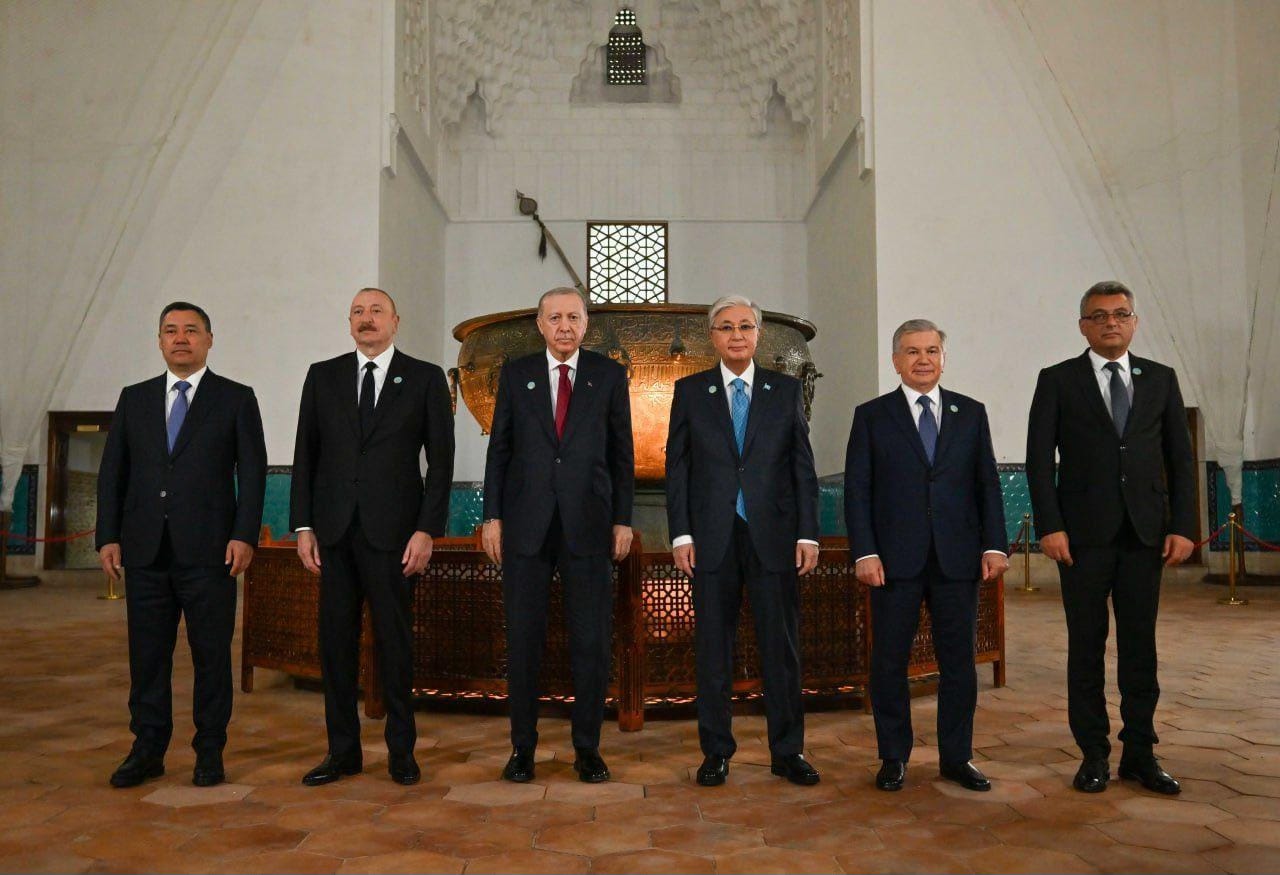
Turkish President Recep Tayyip Erdoğan’s May 14–15 state visit to Kazakhstan and the informal summit of the Council of Heads of State of the Organization of Turkic States (OTS) in the city of Turkestan have intensified Russian anxiety over Türkiye’s growing influence in Central Asia (Turkish Directorate of Communications, May 14; OTS, May 15). Russia has long been nervous about the growing identification of Central Asians and their governments with their Turkic roots and especially with Ankara’s promotion of a reunified Turkic world (see EDM, April 28). The latest steps both Türkiye and Central Asian leaders are taking have only deepened such concerns and are sparking alarm in Moscow (Boenno-Politicheskaya Analitika, May 9; Nezavisimaya Gazeta; Altyn-Orda, May 14). The Kremlin fears that such moves will not only threaten Moscow’s efforts to retain influence in Central Asia but also Moscow’s broader ideological and organizational efforts to prevent the further disintegration of the former Soviet space (see EDM, December 16, 2021). Moscow’s opposition, as well as the calculations of the Central Asian countries themselves, have forced some of them to make clear that they have no intention of becoming part of any Türkiye-led security community that would oppose the Russian Federation (Vostochnyi Ekspress 24, May 17). Despite that, there is no question that the Kremlin is losing its position in Central Asia and is unlikely to regain it even after Russia’s war against Ukraine ends (Eurasia Today, May 15; Altyn-Orda, May 16).
Since 1991, Moscow has become increasingly nervous about growing efforts of Central Asians to recover their Turkic past, shift from a Cyrillic to a Latin-based Turkic alphabet, and introduce common history textbooks. It views such moves as inherently anti-Russian and laying the groundwork for the destruction of the former Soviet space as a Russian-dominated area (Nezavisimaya Gazeta; Altyn-Orda, May 14). Those fears intensified after the end of the Armenia and Azerbaijan’s Nagorno-Karabakh conflict in 2023, which opened new trade opportunities for Central Asia via the South Caucasus. They grew further as Azerbaijan began taking part in Central Asian meetings, where it has served as a conduit for the expansion of Turkish influence through the OTS and other regional groupings (see EDM, June 26, 2025, January 21; Window on Eurasia, November 22, 2025; Caspian Post, May 15). Russian concerns have now reached a fever pitch following Erdoğan’s state visit to Astana, Kazakhstan, during which he and Kazakhstan President Kassym-Jomart Tokayev proclaimed that the 21st century will be the era of the Turkic world. Erdoğan then participated in the informal OTS summit in Turkestan, a Kazakh city whose name carries ideological weight because Türkiye has resumed using “Turkestan” to refer to Central Asia (The Times of Central Asia, October 14, 2024). (On just how ideologically loaded this name is, for Turks as well as Russians, see News.Az, October 11, 2024.)
Both meetings advanced regional cooperation while signaling a deeper political shift that has alarmed Russia. Those signals will set off alarm bells in Moscow, and Russian officials are likely to try to limit, if not reverse, the increasing ties between Central Asian countries and Türkiye. The two leaders’ declaration that the current era is “the century of the Turkic world” is not just political politesse. It is, in the minds of Central Asians and Turks, a redrawing of the geopolitical map. As one Kazakh commentator wrote, “Such words must ring particularly painfully in the ears of those ensconced in the Kremlin who are accustomed to viewing Central Asia as ‘a zone of historical influence.’” The commentator added, “The time when the region’s destiny was decided in distant offices is drawing to a close,” and that the Turkic world “no longer speaks in whispers but with the voice of sovereign states.” Eurasia, the commentator continued, is no longer “a map of empires where a single center issues orders while the rest merely listen and obey” but a “map of routes, alliances, markets, and technologies” (Altyn-Orda, May 14). Other Kazakh and Russian commentators have drawn similar conclusions, albeit typically expressed in less dramatic language (Nezavisimaya Gazeta; Altyn-Orda, May 14).
Erdoğan and Tokayev agreed to expand trade and use it as the basis for a strategic partnership to take advantage of new corridors through the South Caucasus and advance their national interests (The Astana Times, May 14, [1], [2], [3]). The two leaders, however, did not agree to form a common military bloc, even though Erdoğan appears to have sought such an outcome. Tokayev was explicit that Astana is not prepared to take that step, possibly because the Kazakhstan president wants to keep his channels to Moscow open and also because Moscow has made it clear just how much it views outside military participation on former Soviet territory as a red line (see EDM, March 6, 2024; Vostochnyi Ekspress 24, May 17).
The stress these two leaders laid on the importance of the Turkic world continued at the informal OTS summit, where Azerbaijani President Ilham Aliyev was also present. Erdoğan stressed the symbolism of holding the meeting in Turkestan, while Aliyev said that the family of Turkic peoples “must become one of the influential geopolitical centers of force in the 21st century.” Other leaders echoed these remarks (Bugin Info; Eurasia Today, May 15; Altyn-Orda, May 16 [1], [2]). The meeting issued a joint declaration that echoed all these points and committed the countries involved to work toward greater cooperation (Altyn-Orda, May 16). A prominent Moscow commentator, Viktoriya Panfilova of Nezavisimaya Gazeta, described the meeting as one in which the Central Asians sought to define themselves as their region grows in importance due to trade and population growth (Nezavisimaya Gazeta, May 14).
The meetings in Astana and Turkestan are not the end of the story. They are declarations rather than achievements, and Moscow can be counted on to do whatever it can to slow or stop this Turkish advance into what Russians have long viewed as part of its sphere of influence. It is clear, however, that the Kremlin is playing a losing game not only because the idea of a Turkic world is popular across much of the former Soviet Union, but also because what the Turkic peoples are saying fits into the decolonization rhetoric that is now increasingly informing the thinking of people inside the current borders of the Russian Federation, a danger that Russian commentators are pointing to (Nezavisimaya Gazeta, May 14). The meetings in Astana and Turkestan are fateful not only for the peoples of Central Asia and the Turkic world but for the Russian Federation and Russia’s other neighbors, including Ukraine. Many in Moscow and elsewhere are certain to assume that a Russian retreat anywhere could lead to a more general withdrawal. This development could transform the world’s geopolitics even more dramatically than the ideas presented by Erdoğan, Tokayev, Aliyev, and others at these two meetings.
This article was originally published in Eurasia Daily Monitor.