

Executive Summary:
New hydropower and renewable energy projects are expanding Central Asia’s energy capacity, strengthening domestic energy security while positioning the region as a hub for global energy markets.
Central Asia is moving beyond its traditional role as a raw material supplier, positioning itself as an energy hub for alternative sources and supply chains as Europe seeks to diversify energy supplies amid Russia’s war against Ukraine.
While attracting investment from multiple external partners, Central Asian states remain committed to a pragmatic, multivector approach that maximizes geoeconomic benefits.
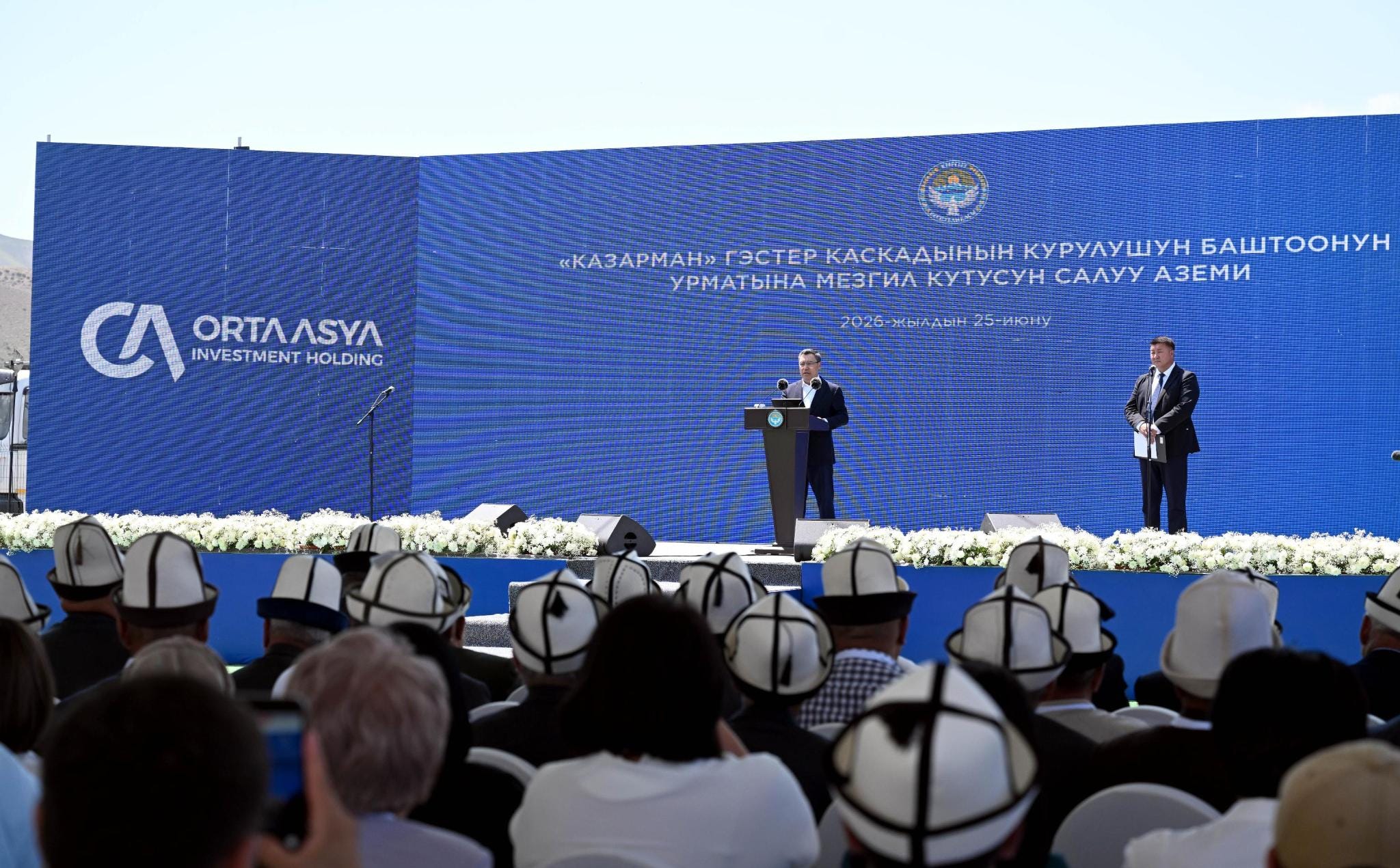
On June 25, the Kyrgyz Republic announced the launch of the Kazarman cascade of hydroelectric power plants on the Naryn River, developed in partnership with Türkiye (President of the Kyrgyz Republic, June 25). The initiative represents one of the most significant energy infrastructure projects that Kyrgyzstan has undertaken since gaining independence. The new project, with total investments estimated at around $3 billion, includes three hydropower plants—Ala-Buga, Kara-Bulun-1, and Kara-Bulun-2—with a combined installed capacity of 912 megawatts and expected annual electricity generation of more than 3.75 billion kilowatt-hours (Times of Central Asia, June 26).
While the project is designed to bolster Kyrgyzstan’s energy security and reduce reliance on electricity imports, it also underscores Central Asia’s growing role as a hub for alternative energy production amid a shifting geopolitical landscape in Eurasia and the Middle East. The region is positioning itself as an attractive destination for energy-related investment, driven by rising global demand for diversified energy sources. Following disruptions from Russia’s war against Ukraine, the recent U.S.–Iran conflict further exposed the fragility of global energy supply chains, highlighting Central Asia’s potential to serve as an alternative energy supplier during times of crisis (see EDM, December 4, 2025, March 27, March 24, April 13, 28, June 2, 4, 17).
Central Asia’s growing energy importance has intensified competition among major external players. The People’s Republic of China (PRC) has long viewed the region as essential to strengthening its long-term energy security, while Europe is expanding partnerships with Central Asian states to diversify energy supplies following disruptions to liquefied natural gas (LNG) infrastructure (see China Brief, October 17, 31, 2025, May 11; see EDM, November 19, 2025, May 5). The race for Central Asian energy sources fuels the Russia–PRC geopolitical rivalry, as both states consider the region to be within their own traditional spheres of influence.
Energy‑rich states such as Kazakhstan and Uzbekistan are seeking to capitalize on growing international demand by attracting greater foreign investment, particularly in renewable energy and critical minerals. Building on their growing renewable energy capacities, Kazakhstan and Uzbekistan, together with Azerbaijan, are advancing the Trans‑Caspian Green Energy Corridor (see EDM, June 24, 2024, May 14, 2025, July 14; Eurasianet, April 9, 2025). The project, agreed to in 2024, envisions transmitting renewable electricity generated in Central Asia across the Caspian Sea to Azerbaijan before reaching European markets through a planned Black Sea submarine cable connecting Azerbaijan through Georgia to Romania and the broader European electricity grid (Caliber, June 25; The Astana Times, June 30). Kazakhstan currently operates around 169 renewable energy facilities with approximately 3.7 gigawatts of installed capacity. Astana plans to add another 10 gigawatts of renewables by 2035 under its QaJET (Kazakhstan Just Energy Transition Investment Platform) initiative (EUAlive, June 30).
These projects show that Central Asia is moving beyond its traditional role as a passive supplier of raw materials and increasingly seeking a leading position in the reconfigured global energy landscape. Regional states now recognize the geoeconomic benefits of an energy transition, though achieving a full transition will require deeper regional cooperation and coordination to build more diversified and resilient energy systems. In this vein, Astana and Tashkent moved forward and, during the Bukhara summit on April 11, signed a bilateral partnership document on a joint framework for geological exploration, setting a combined investment target of $1 billion for critical minerals development (President of Kazakhstan; The Astana Times, April 11).
On June 16, Uzbekistan signed a separate cooperation document with Azerbaijan for the joint development of an Uzbek gold deposit and other mineral resources to attract additional foreign stakeholders to the local market (Eurasianet, June 17). These initiatives highlight that Central Asia is emerging as an important hub within global supply chains for critical minerals and alternative energy sources. The interregional partnership between Central Asia and the Caucasus has become a key element in advancing balancing strategies and multivector diplomacy (see EDM, October 23, November 19, 2025, January 21, 28, April 28, May 19, June 2, 17). Within this framework, the Trans-Caspian Green Energy Corridor stands out as one of the most ambitious cross-regional initiatives, envisioned to establish a “green bridge” between Central Asia and Europe. By fostering renewable energy integration and connectivity, the project has the potential to accelerate the energy transition across the two regions.
Central Asia’s ambition to position itself as an energy hub for alternative sources and global supply chains aligns closely with Europe’s objectives of diversifying energy supplies, strengthening energy security, and reducing dependence on Russia. The region’s role in critical mineral exports also offers the West an opportunity to establish supply chains beyond PRC’s control. Central Asian states remain cautious about aligning with any single external power, instead pursuing a pragmatic approach focused on maximizing geoeconomic benefits.
This article was originally published in Eurasia Daily Monitor.