

Central Asia Accessing Pakistani Sea Ports by Bypassing Afghanistan
Syed Fazl-e-Haider
Executive Summary:
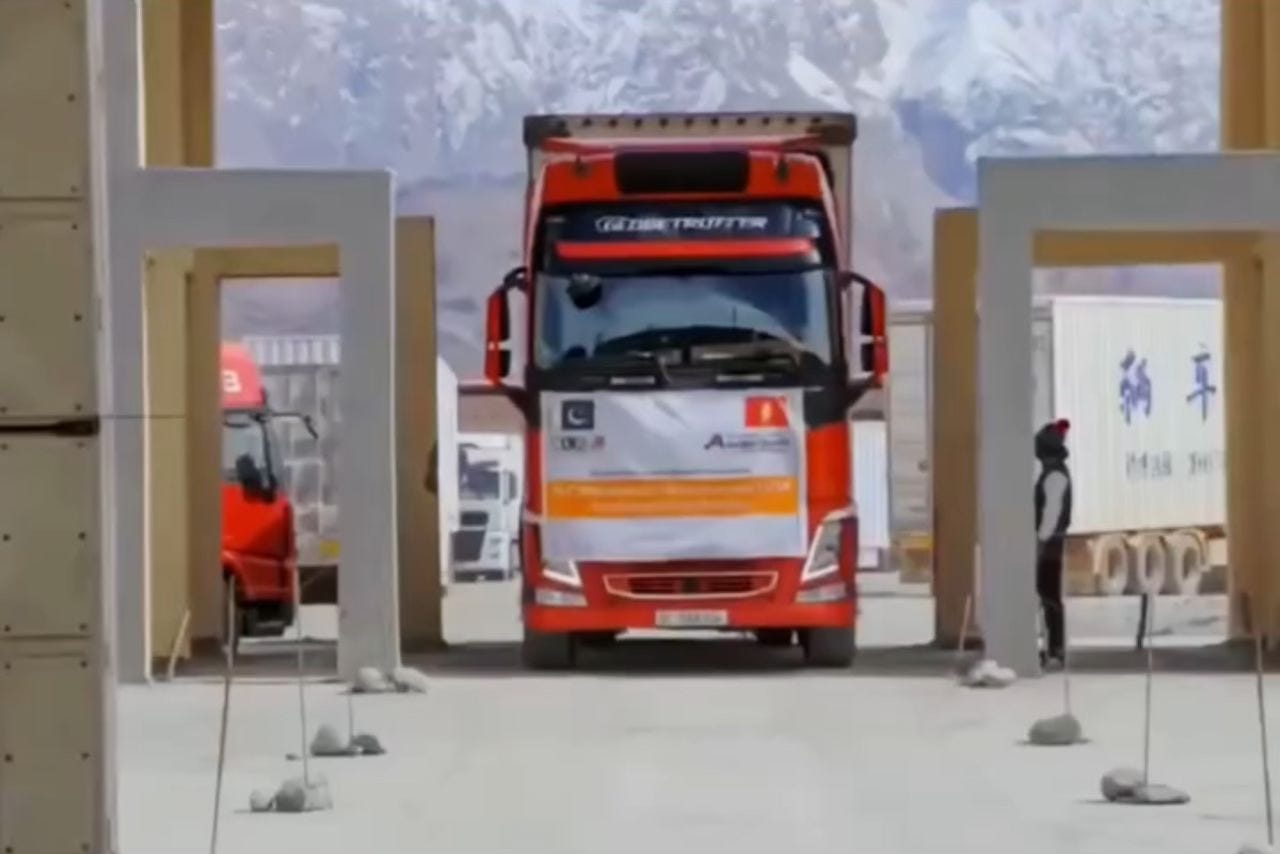
Kyrgyzstan’s Ministry of Transport and Communications announced the successful implementation of a pilot transport project on the Kyrgyzstan–China–Pakistan route on April 24. The new 2,000-mile route through the People’s Republic of China (PRC) is an important step for Kyrgyzstan to revive foreign trade and access seaports.
Islamabad no longer considers Afghanistan as the primary transit gateway to Central Asia because of its ongoing conflict with the Taliban. The South Asian country has activated alternative trade corridors via the PRC and Iran to access Central Asia.
For Central Asian countries and Pakistan, Afghan routes are currently not viable due to persistent security risks, frequent Pakistan–Afghanistan border skirmishes, and the presence of militant groups on Afghan soil.
On April 24, Kyrgyzstan’s Ministry of Transport and Communications announced the successful implementation of a pilot transport project on the Kyrgyzstan–China–Pakistan route. A single truck carrying goods from Kyrgyzstan reached the port in Pakistan’s city of Karachi along the Karakorum Highway via the People’s Republic of China (PRC), bypassing Afghanistan. The Kyrgyz Ministry of Transport and Communications carried out the pilot project with the cooperation of the International Association of Freight Forwarders of Kyrgyzstan as part of its strategy to develop international transport corridors and provide direct access to the seaports for global trade (Kyrgyz Ministry of Transport, April 24). The successful test of Kyrgyzstan’s pilot project opens access for other land-locked Central Asian countries to Pakistan’s seaports. The new 2,000-mile route through the PRC is an important step for Kyrgyzstan to expand its international logistics role, revive foreign trade, and access seaports.
Islamabad no longer considers Afghanistan as the primary transit gateway to Central Asia because of its ongoing conflict with the Taliban. The South Asian country has activated alternative trade corridors via the PRC and Iran to access Central Asia. For Central Asian countries and Pakistan, Afghan routes are currently not viable due to persistent security risks, frequent Pakistan–Afghanistan border skirmishes, and the presence of militant groups on Afghan soil. Pakistan considers routes to Bishkek and Almaty through the PRC as shorter, faster, and more secure compared to Afghan transit (Business Recorder, April 21). For instance, the authorities in Uzbekistan and Pakistan signed a deal for development of trade through two major land routes bypassing Afghanistan in November 2025. These were the Pakistan–China–Tajikistan–Uzbekistan and Pakistan–China–Kyrgyzstan–Uzbekistan land routes (Eurasianet, December 8, 2025).
Other new land routes directly link Pakistani ports to Iran via multiple Pakistan–Iran border points. These land routes extend northward into Central Asia and further to Russia. In April, Pakistan dispatched its first export to Uzbekistan through Iran, bypassing Afghanistan (Times of Islamabad, May 4).
Pakistani officials say they have faced cross-border attacks from Afghanistan-based anti-Pakistan militant groups since the Taliban’s takeover of Afghanistan in 2021. The Taliban’s government turned a deaf ear to Islamabad’s several requests for action against the groups allegedly operating against Pakistan from Afghan territory. In February, Islamabad declared an “open war” against the Taliban regime and launched Operation Ghazab lil Haq to target what it says are safe havens of cross-border terrorist outfits inside Afghanistan (Dawn, February 27).
Several Central Asian leaders have visited Pakistan over the past six months and proposed connectivity projects to access Pakistani seaports. In December 2025, Kyrgyz President Sadyr Japarov visited Islamabad. The two countries signed a series of deals to revive and expand their bilateral relations in different sectors, including use of Pakistani ports (24.kg, December 4, 2025). In February, Uzbek President Shavkat Mirziyoyev paid a two-day visit to Pakistan. The countries agreed to increase bilateral trade to $2 billion within the next five years, and to promote maritime trade and preferential arrangements at the Pakistani ports of Karachi, Gwadar, and Bin Qasim (Dawn, February 5). In February, Kazakh President Kassym-Jomart Tokayev visited Pakistan and discussed the development of transit routes through Afghanistan with Pakistani leadership. In his meeting with Pakistani Prime Minister Shehbaz Sharif, Tokayev discussed access to the Karachi and Gwadar ports. Kazakhstan and Pakistan signed 20 agreements covering transport, logistics, and other sectors. They also discussed the proposed $7 billion railway project connecting Kazakhstan to Pakistani ports via Afghanistan and Turkmenistan (Eurasianet, February 4).
As Central Asia’s strategy for accessing Pakistani sea ports shifts away from routes through Afghanistan because of security concerns, routes through the PRC and Iran have become more important. In April, Pakistan opened the Gabd–Rimdan border crossing with Iran, opening a functional corridor towards Turkmenistan and Uzbekistan. The Iran route became operational after Pakistan dispatched the first shipment of frozen meat toward Tashkent. A senior Pakistani official involved in regional connectivity planning reportedly said, “Pakistan is moving from being a terminal geography to a transit economy … This is about securing trade continuity, diversifying routes, and reducing exposure to single-point disruptions” (Business Recorder, April 21).
Several Trans-Afghan connectivity projects from Central Asia have been in the doldrums for decades due to conflict in Afghanistan. These projects still have an uncertain future. For example, the $4.8 billion Uzbekistan–Afghanistan–Pakistan (UAP) railway project cannot be completed by 2027 due to Pakistan–Afghan conflict (Special Eurasia, July 23, 2025). Similarly, the $10 billion Turkmenistan–Afghanistan–Pakistan–India (TAPI) gas pipeline, one of Central Asia’s most ambitious infrastructure projects, has been delayed by three decades due to conflict in Afghanistan. The ongoing Pakistan–Afghan conflict, threats from Afghanistan-based militant groups, economic instability, and political uncertainty in Afghanistan continue to cast doubt on the future of this ambitious gas pipeline (Turkmen Portal, September 11, 2024).
Routes through the PRC are shorter and more secure compared to Afghan transit. Moreover, Pakistan can leverage the PRC’s more developed infrastructure to connect with Kyrgyzstan, Kazakhstan, and Tajikistan via the Khunjerab Pass. Land routes through Iran are longer than Afghan routes, but they are more cost-effective in real terms, though also are jeopardized by conflict (Business Recorder, April 21). With a major shift in Pakistan’s Afghanistan policy and activation of routes through Iran and the PRC, the future of all Trans-Afghan connectivity projects are uncertain.
This article was originally published in Eurasia Daily Monitor.