

Beijing Redefines Stability as Non-Interference
Christopher Nye
Executive Summary:
At the Trump–Xi summit in May, both sides agreed to some version of Beijing’s proposed “constructive strategic stability” framework. Read against Beijing’s own vocabulary of relationship labels, the formula is a downgrade of relations, not a thaw.
The 2026 formula is the first to drop partnership and cooperation as the lead idea, resting the relationship on stability alone. This positioning marks a shift from a period in which Beijing reached for ever more ambitious framings, from 1997’s “constructive strategic partnership” to 2013’s proposed “new type of major-country relations.”
The modifiers “constructive” and “stable” signal strained or transitional ties that disappear as relations improve. These recur across the Beijing’s troubled relationships, including with the European Union and, more recently, Japan.
The formula demands mutual non-interference and pre-assigns blame: each side keeps to its own path, allowing Beijing to recast a future U.S. tariff, export control, or arms sale to Taiwan as Washington breaking the stability.
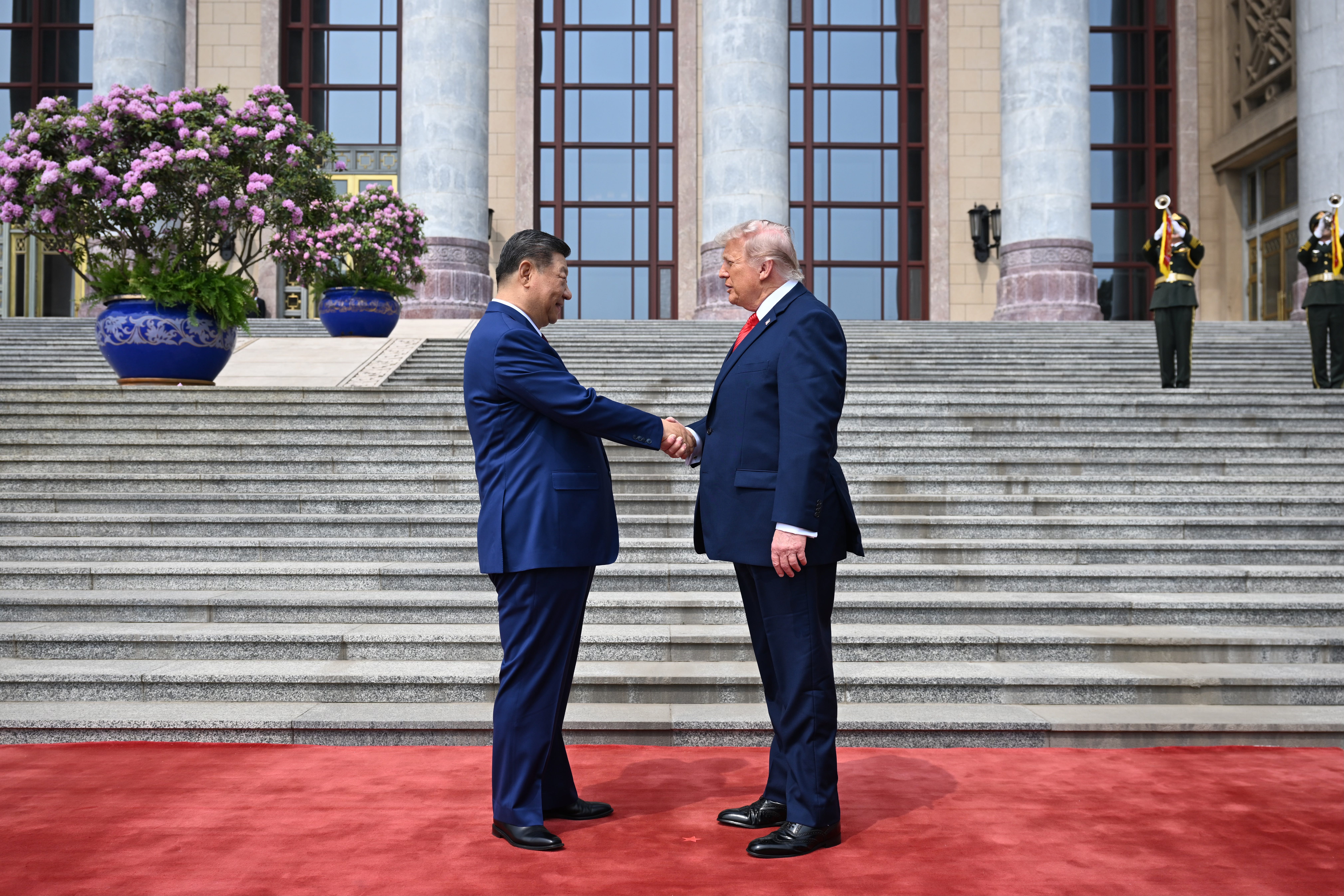
An unexpected but important product of the summit between U.S. President Donald Trump and Chinese President Xi Jinping was a new framing of bilateral ties: “a constructive China–U.S. relationship of strategic stability” (中美建设性战略稳定关系). Beijing cast this as a “new positioning” (新定位) and a guide for the next three years and beyond (Xinhua; The White House, May 14). To Western ears, “strategic stability” is a concept more often associated with arms control; but it has often been used by Beijing to frame relations between the People’s Republic of China (PRC) and other countries as part of its own hierarchical system of relationship labels (China Brief, September 6, 2024, September 20, 2024). Under this understanding, strategic stability is a demand for mutual non-interference.
The Formula Caps Beijing’s Long Retreat From Partnership
Beijing’s use of the term “constructive” to frame the relationship was not new. It also appeared in a 1997 joint statement produced during President Jiang Zemin’s state visit to the United States. In an attempt to generate positive energy after a cooler start to the 1990s, the two countries agreed to build a “constructive strategic partnership” (建设性战略伙伴关系) (Ministry of Foreign Affairs [MFA], November 7, 2000). A rocky start to the 2000s, exemplified by the 1999 accidental U.S. bombing of the PRC embassy in Belgrade and the 2001 collision between a U.S. reconnaissance aircraft and a Chinese interceptor, led to Beijing dropping the word “partner” and settling on a “constructive cooperative relationship” (建设性合作关系) (MFA, February 7, 2004). When things later improved under President Hu Jintao, the vocabulary followed suit: a November 2009 joint statement lost the word “constructive,” but opted for the more favorable “positive, cooperative, and comprehensive relationship” (积极合作全面关系). A January 2011 state visit finally restored a full “cooperative partnership” (合作伙伴关系) based on mutual respect and mutual benefit (MFA, November 17, 2009; January 20, 2011).
Beijing’s decision to shed the tentative “constructive” qualifier by the 2010s signaled that the partnership no longer needed to be built; but the trajectory soon soured under Xi Jinping. In 2013, Xi pressed Washington to accept a “new type of major-country relations” (新型大国关系), defined as no conflict, no confrontation, mutual respect, and win-win cooperation, an explicit claim to co-equal standing (MFA, June 9, 2013). Washington never endorsed it and instead moved the other way. The first Trump administration named the PRC a strategic competitor, while the Biden administration further defined the country as “the only competitor with both the intent to reshape the international order and … [the] power to advance that objective” (White House, December 2017; October 2022; China Brief, January 6). By the 2023 San Francisco summit, Beijing’s positioning had narrowed to three principles: mutual respect, peaceful coexistence, and win-win cooperation (Xinhua, November 16, 2023).
What is new in the latest formula is the foregrounding of “stability” as the lead idea, which suggests a desire to establish a floor for the relationship. Read in sequence, these past labels trace the rise and fall of Beijing’s ambition for the relationship. They cover a partnership it hoped to build in 1997, a co-equal standing it claimed in 2013, and a desire for coexistence of 2023.
‘Constructive’ and ‘Stable’ Used For Troubled Relations
Beijing chooses labels for diplomatic partners carefully, and a comparison of a term’s deployment for different partners provides insight into its intended use. The PRC’s positioning of the European Union (EU), for instance, has also used the terms “constructive” and “stable/stability.” At the first PRC–EU bilateral summit in 1998, Beijing and the European Commission jointly advocated a “long-term, stable, and constructive partnership” (长期稳定的建设性伙伴关系) for the 21st century. These modifiers marked a relationship still finding its footing after a post-Tiananmen estrangement. As ties improved, those modifiers fell away, evolving into a “comprehensive partnership” (全面伙伴关系) by 2001 and a “comprehensive strategic partnership” (全面战略伙伴关系) by 2003 (MFA, April 2026).
The intended meaning behind Beijing’s use of “constructive” and “stable” is also clear in its framing of relations with Japan. When meeting Prime Minister Takaichi Sanae on October 31, 2025, Xi said that the PRC sought a “constructive and stable” (建设性、稳定) relationship (MFA, October 31, 2025). A week later, Beijing reacted angrily to remarks Takaichi made in the Diet about Taiwan, culminating in tightened dual-use export controls in January and an ongoing barrage of media commentary decrying what Beijing calls a “new militarism” in Japan (Ministry of Commerce, January 6; China Brief, April 28). As this suggests, “constructive” and “stable” are the terms Beijing reaches for when a relationship is strained.
Demands for Non-Interference
Xi’s new formula for PRC–U.S. relations carries a demand that each side keeps to its own course without external interference. Stability here conditions any future improvement in relations on Washington holding still, even while Beijing continues building out its economy and military, pressuring its periphery, and reordering supply chains in its favor. The asymmetry that anchors the concept suggests that it may be short-lived (China Brief, May 15).
Stability, in this framing, is predicated on the United States adhering to an older PRC principle, “non-interference in internal affairs” (不干涉内政), which is now being repurposed from messaging about sovereignty and applied to strategic competition. This shifts the burden of restraint onto Washington. It also forces an implicit recognition of the PRC’s great power status. Only a recognized great power is owed that kind of forbearance, allowing Beijing to present mutual distance as a mark of parity. The advocacy for a “constructive” relationship similarly carries an implicit accusation that Beijing’s counterpart has failed to contribute positively to bilateral ties.
Conclusion
Under Beijing’s own terms, “a constructive China–U.S. relationship of strategic stability” relegates the United States from a partner the PRC once sought to build with to a rival it now intends only to manage. Beijing has eagerly capitalized on its reception by the U.S. side, with state media approvingly amplifying Defense Secretary Pete Hegseth’s reciting of the phrase at the Shangri-La Dialogue on May 30 (Department of Defense; Xinhua, May 30). Zhou Bo, a retired PLA senior colonel and current scholar, characterized the statements as the first U.S. recognition of the PRC as a peer power (NPR, May 30).
By setting the terms for the relationship, Beijing is now able to cast future tariffs, export controls, or arms sales to Taiwan as evidence of the United States reneging on the agreement the two leaders affirmed at the recent summit in Beijing (The National Interest, May 22). In this sense, the phrase is not just a characterization of the relationship but a device for assigning blame to the United States for the relationship’s breakdown, at a time of Beijing’s choosing.
This article originally appeared in China Brief Notes. Check it out here!
Christopher Nye is a Non-Resident Fellow at The Jamestown Foundation.